
Research. Futuro. “Para un hombre que sólo considera tolerable la vida manteniéndose en la superficie de sí mismo, es natural sentirse satisfecho al ofrecer a los demás sólo su propia superficie.”

Paul Auster, The Invention of Solitude En buena medida la historia de los pueblos ha estado determinada por su capacidad para hacer más eficiente el trabajo; aquel que obtuviera más bienes para su especie tendría más posibilidades de sobrevivir. El axioma cobraría otra dimensión con el advenimiento del capitalismo y la tecnología que llevaba asociada, sobre todo en lo que se refiere a aumentar la productividad de las horas de trabajo. Según el historiador norteamericano Lewis Mumford (1895-1990), “es el reloj la clave para entender el desarrollo del capitalismo y no la máquina de vapor” (como dice su cita más repetida). Obviamente los primeros relojes eran caros y los únicos que los poseían eran los nuevos capitalistas, que no pocas veces los alteraban para hacer trabajar más a sus empleados. Mensaje inteligente. Trends vs Market Reports: Which is More Accurate, Faster? Google released a research paper yesterday that takes an in-depth look at Google Trends and Google Insights for Search and compares its trend results against more mainstream industry reports based on actual sales data in several different categories like auto sales and home sales.

Several statistical models are explained and compared, and relative accuracy is determined for each model. As interesting as that sounds, the crucial difference is that, for Google, the statistics have already been generated -- sometimes for weeks before actual retail numbers come out. Google's trends are much closer to the present day economic situation, meaning that analysis can be made earlier, and market turning points can be identified sooner.
All this forecasting power isn't available just to Google, either. An important point that is made at the beginning of the report is that Google Trends pulls from all Google properties using localized, anonymous search usage data. Internet 2009 in numbers. What happened with the Internet in 2009?
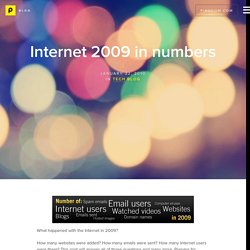
How many websites were added? How many emails were sent? How many Internet users were there? This post will answer all of those questions and many more. Prepare for information overload, but in a good way. We have used a wide variety of sources from around the Web. Enjoy! Email 90 trillion – The number of emails sent on the Internet in 2009.247 billion – Average number of email messages per day.1.4 billion – The number of email users worldwide.100 million – New email users since the year before.81% – The percentage of emails that were spam.92% – Peak spam levels late in the year.24% – Increase in spam since last year.200 billion – The number of spam emails per day (assuming 81% are spam).
Websites 234 million – The number of websites as of December 2009.47 million – Added websites in 2009. Web servers Domain names Internet users Social media Images Videos Web browsers Malicious software Data sources: Website and web server stats from Netcraft. Gary Hamel on Managing Generation Y - the Facebook Generation - By Gary Hamel The experience of growing up online will profoundly shape the workplace expectations of “Generation F” – the Facebook Generation.
At a minimum, they’ll expect the social environment of work to reflect the social context of the Web, rather than as is currently the case, a mid-20th-century Weberian bureaucracy. If your company hopes to attract the most creative and energetic members of Gen F, it will need to understand these Internet-derived expectations, and then reinvent its management practices accordingly. Sure, it’s a buyer’s market for talent right now, but that won’t always be the case—and in the future, any company that lacks a vital core of Gen F employees will soon find itself stuck in the mud. With that in mind, I compiled a list of 12 work-relevant characteristics of online life. 1. 2. 3. 4.