
Blog Archive » Paper Tape Dressform. Materials: 2 rolls gummed Kraft paper tape (of which we ended up using less than 1 (each was 150 meters)).
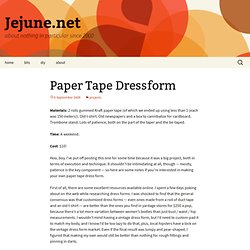
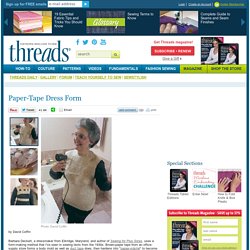
Old t-shirt. Old newspapers and a box to cannibalize for cardboard. Trombone stand. Lots of patience, both on the part of the taper and the be-taped. Time: A weekend. Cost: $10! Hoo, boy. First of all, there are some excellent resources available online. After some research, I decided to go with paper tape, instead of duct tape. Before beginning, this old article was very helpful at giving the basics, as well as containing an intriguing formula for a stand (though our local Home Depot doesn’t carry the necessary PVC connectors). I should mention that this all took place during July, when Pete and I were spending at least three hours a day watching Tour de France coverage (as a missing, but necessary, TiVo cable slowly ambled its way across the border from the States). Also on the other side: me, wearing the old June of ’44 t-shirt destined to be taped. Same thing on the back. Paper-Tape Dress Form. David Coffin Photo: David Coffin by David Coffin Barbara Deckert, a dressmaker from Elkridge, Maryland, and author of Sewing for Plus Sizes, uses a form-making method that I've seen in sewing texts from the 1930s: Brown-paper tape from an office-supply store forms a body mold as well as duct tape does, then hardens into "papier-mâché" to become a pinnable form, which you don't even have to stuff. from Threads #75, p.41 <A HREF=" Widgets</A>
Duct-Tape Dress Form #2. David Coffin Photo: David Coffin by David Coffinfrom Threads #75, p. 39 Leah Crain, a dressmaker and costumer from Cincinnati, OH, has another take on the duct-tape version of form making.
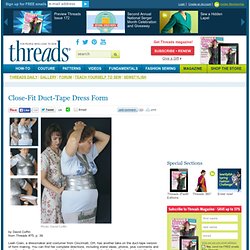
You can find her complete directions, including stand ideas, photos, plus comments and questions from other sewers, on the Internet (www.leanna.com). Leah's forms look remarkably like their prior "inmates. " Here are the highlights: You'll start with a similarly underclad wrappee, but Leah suggests cutting off one sleeve from a second T-shirt and basting it onto the first to form a neck cover. A strong wooden hanger placed inside before stuffing is the start of either a hanging form or a simple stand. Molded Papier-Mâché Form. David Coffin Photo: David Coffin by David Coffinfrom Threads #75, p.40 The best thing about the poured-foam form that you make from a surgical-plaster cast or mold is that the mold makes a very accurate copy of your body contours, complete with distinct collarbones and shoulder blades.
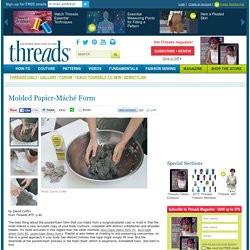
It's more accurate in this regard than the other methods (duct-tape dress form #1, duct-tape dress form #2, paper-tape dress form). Plaster is also better at molding to and preserving concavities, so this is a good approach if your body has distinct hollows that tape might simply fill over. Gail Gosser, an artist and art teacher from Schwenksville, Pennsylvania, likes the accuracy of the plaster mold.
When the glue is dry (and at any point in the future, if needed), reinforce the join and edges with more mâché in pulp or traditional strip form. This method is time-consuming (drying time can add days) but very accurate, and it suits Gail's training as a sculptor. More dress forms: <A HREF=" Widgets</A>