
Remote-Control a Human? Zabosu Project Aims to Give You That Power. Sci-fi becomes reality as DNA is turned into living drive able to store, read and erase data. Sections of living DNA glow red or green to store computer dataCould be used like computers inside the bodyDNA storage can be written, rewritten and erased at will'Took us three years and 750 attempts,' says lead researcher By Rob Waugh Published: 15:33 GMT, 22 May 2012 | Updated: 07:48 GMT, 23 May 2012 The idea of storing information in living cells has been the plot of sci-fi fantasies such as Johnny Mnemonic, starring Keanu Reeves - and today it has become reality It sounds like the stuff of science fiction fantasies, but scientists have turned living cells into data storage devices - like 'living hard drives'.

The idea of storing computer information inside living cells - or human brains - has formed the plot of sci fi thrillers such as Johnny Mnemonic (pictured). But in reality, the cells are likely to become a method for retrieving information from inside the human body. How to Live Forever By Turning Your Brain Into Plastic. Brad, I am not unnecessarily defining anything.

I am certain that if you have a clone made of you, whether physically or in some sort of computer rendering, that clone will live on. But, you will die when our time comes, and go into the "big black" wherever that leads to. Meanwhile (or even while you live), the clone will be "born" and awake into it's own existence, but you must have a continuity of your consciousness for it to BE you. Your mind doesn't just teleport when a copy or rendering of you is made, any more than a copy of a computer file, or a photocopy is where the original moves to! And, if the original is destroyed, that object ceases to exist.
IEEE Pervasive Computing Magazine. The Clash between Privacy and Automation in Social Media.
Ubiquitous computing. Ubiquitous computing (ubicomp) is a concept in software engineering and computer science where computing is made to appear everywhere and anywhere.
In contrast to desktop computing, ubiquitous computing can occur using any device, in any location, and in any format. A user interacts with the computer, which can exist in many different forms, including laptop computers, tablets and terminals in everyday objects such as a fridge or a pair of glasses. The underlying technologies to support ubiquitous computing include Internet, advanced middleware, operating system, mobile code, sensors, microprocessors, new I/O and user interfaces, networks, mobile protocols, location and positioning and new materials.
Digital Natives: Fact or Fiction? « Oxford University Press – English Language Teaching – Global Blog. Born Digital - Understanding the first generation of digital natives. Digital native. A digital native is a person who was born during or after the general introduction of digital technologies and through interacting with digital technology from an early age, has a greater understanding of its concepts.
Alternatively, this term can describe people born during or after the 2000s, as the Digital Age began at that time; but in most cases, the term focuses on people who grew up with the technology that became prevalent in the latter part of the 20th century and continues to evolve today. [citation needed] Other discourse identifies a digital native as a person who understands the value of digital technology and uses this to seek out opportunities for implementing it with a view to make an impact.
This term has been used in several different contexts, such as education (Bennett, Maton & Kervin 2008), higher education (Jones & Shao 2011) and in association with the term New Millennium Learners (OECD 2008). Origins[edit] Conflicts between generations[edit] Discourse[edit] Biotechnology News, Videos, Reviews and Gossip - io9. 'Brain cap' technology turns thought into motion; Mind-machine interface could lead to new life-changing technologies for millions of people.
"Brain cap" technology being developed at the University of Maryland allows users to turn their thoughts into motion. Associate Professor of Kinesiology José 'Pepe' L. Contreras-Vidal and his team have created a non-invasive, sensor-lined cap with neural interface software that soon could be used to control computers, robotic prosthetic limbs, motorized wheelchairs and even digital avatars.
"We are on track to develop, test and make available to the public- within the next few years -- a safe, reliable, noninvasive brain computer interface that can bring life-changing technology to millions of people whose ability to move has been diminished due to paralysis, stroke or other injury or illness," said Contreras-Vidal of the university's School of Public Health. Peer Reviewed. Biotech Breakthrough: Monkeys can feel virtual objects using a brain implant. As long as they figure out which areas to stimulate those problems can be solved with neuro-optics.
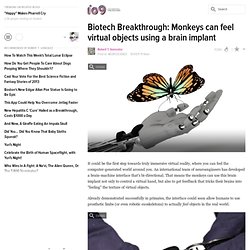
It works by inserting a gene into the target neurons that makes them fire when exposed to a specific frequency of light. Scientists Enhance Intelligence of Mice with Human Brain Cells. Brain-to-brain interfaces have arrived, and they are absolutely mindblowing. I am almost speechless at this!
This is astounding! This is truly astounding! If it can be scaled up to the human level, if it can be done without what is sure to be hugely invasive brain surgery, this might revolutionize everything in ways we barely guess at. 3D Ear Scanning Enables Custom-Fit Headphones. Panasonic unveils bone-conduction TV headphones. LAS VEGAS (AP) — People who don't want to disturb sleeping family members could use a new product from Panasonic that doesn't need speakers or even your own ears: wireless bone-conduction headphones.

The headphones connect to a TV via the Bluetooth wireless standard and attach to your head like a normal set of headphones. But instead of using your ears, the headphones work like hearing aids by transmitting sound waves through your skull. They are one of several innovations Panasonic unveiled at the International CES show in Las Vegas. It also showed off a new user interface for its "Smart Viera" TVs, featuring a TV-mounted camera that recognizes the user and sets viewing preferences accordingly.
The Japanese electronics maker also showed off an easy way to send YouTube videos from smartphones to the TV. Amazing video shows us the actual movies that play inside our mind. Upon rereading the entire article it does appear that the second clip shown to the subjects was fully reconstructed by what was learned from the brain in the first mapping session.
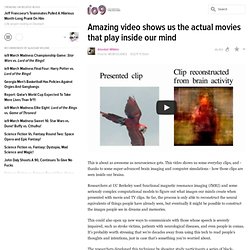
That is fucking incredible. Agreed. Cyborg Snail Turned Into Living Battery. A snail transformed into a living battery has moved the world one step closer to having tiny cyborg spies underfoot.

The pioneering experiment harnessed a snail's blood sugar to "recharge" an implanted battery — the first time researchers have shown sustainable generation of electricity in a living creature's body over several months. If the snails' bodies can create enough electricity to power microelectronics, they could act as living sensors or detectors for the U.S. military and Homeland Security.
"In this [direction] the biofuel cells are expected to operate in small creatures (snails, worms, insects, etc) providing sustainable electrical power for various sensors and wireless transmitters," said Evgeny Katz, a professor of chemistry at Clarkson University in Potsdam, N.Y. Creating Artificial Muscles More Powerful Than Anything In Nature. The bionic arm that's so sophisticated you can even touch-type. Information-iStock_000001402061XSmall1-300x199.jpg (JPEG Image, 300 × 199 pixels)
The history of computing project. Biographies of computer pioneers A-J. Biographies of computer pioneers K-Z. How to store the world’s data on DNA. Storage cost for DNA vs. tape (credit: Nick Goldman et al. /Nature) Researchers at the EMBL-European Bioinformatics Institute (EMBL-EBI) have created a way to store data in the form of DNA — a material that lasts for tens of thousands of years. The new method, published in the journal Nature, makes it possible to store at least 100 million hours of high-definition video in about a cup of DNA. Channelpedia. Cybernetics Bionics Robotics.
This wireless brain implant could make telekinesis a reality. Memory implantation is now officially real. In this study, the mouse is now afraid of an environment in which it never received pain, and would therefore not associate pain with it. By artificially activating the neurons associated with the pain-free environment in a new context with a foot shock, a fear response is now elicited the original context where no shock or pain occurred. The experiment takes advantage of associations, but uses optogenetic activation to make the mouse remember shock where shock never occurred (false memory).
Brain-to-Brain Interface: Harvard Innovation Allows Humans To Control Animals Using Their Mind [VIDEO] What if a brain-to-brain interface could let you control someone else? Scientists at Harvard University have created the first non-invasive brain-to-brain interface, allowing a human to control the tail of a rat simply by thinking the appropriate thought. ExtremeTech reports that the technology is represents the first step to a functioning, telepathic link between two human brains — a future innovation that could alter the very definition of communication Their findings are published in the journal PLoS One. The new technology builds on previous research in brain/computer interfaces, where a computer records activity within the brain and translates it into discrete thoughts and motor patterns.
While scientists are still far from understanding the brain's complex coding methods, they can determine which cerebral region is responsible for a given action. IBM's "neurosynaptic" chips are the closest thing to a synthetic brain yet. A nice, clear, and mostly correct statement. Xlarge.png (PNG Image, 640 × 360 pixels) Have This Pattern. Seth Lloyd. Ada Lovelace. Augusta Ada King, Countess of Lovelace (10 December 1815 – 27 November 1852), born Augusta Ada Byron and now commonly known as Ada Lovelace, was an English mathematician and writer chiefly known for her work on Charles Babbage's early mechanical general-purpose computer, the Analytical Engine. Claude Shannon. Alan Turing. Alan Mathison Turing, OBE, FRS (/ˈtjʊərɪŋ/ TEWR-ing; 23 June 1912 – 7 June 1954) was a British mathematician, logician, cryptanalyst, philosopher, pioneering computer scientist, mathematical biologist, and marathon and ultra distance runner.
He was highly influential in the development of computer science, providing a formalisation of the concepts of "algorithm" and "computation" with the Turing machine, which can be considered a model of a general purpose computer.[2][3][4] Turing is widely considered to be the father of theoretical computer science and artificial intelligence.[5] Alan Turing's legacy: how close are we to 'thinking' machines? Citizen scientists honour Alan Turing with sunflowers.
A Turing Machine Overview. Turing machine simulation: addition, subtraction, multiplication and factorial unary. • select operation: addition (+), subtraction (-), multiplication (*), division (/), factorial (!) Turing machine simulation: addition, subtraction, multiplication and factorial unary built in javascript and html. • select operation: addition (+), subtraction (-), multiplication (*), factorial (!) The Enigma Machine. Video demo of the Enigma machine. Turing_oncomputablenumbers_1936.pdf (application/pdf Object)
Halting problem. Alan Turing proved in 1936 that a general algorithm to solve the halting problem for all possible program-input pairs cannot exist. A key part of the proof was a mathematical definition of a computer and program, which became known as a Turing machine; the halting problem is undecidable over Turing machines. Turing_intelligent_machinery_1936.swf (application/x-shockwave-flash Object) James Parry. The History of Early Computing Machines, from Ancient Times to 1981. Emma Nutt. Most Popular Hackers Of All Time. Early 90s Hacker Culture Touchstones. John Titor.