
MindMup Outil de mind mapping collaboratif. MindMup est un outil en ligne qui permet de faire du Mind mapping et des cartes heuristiques en mode collaboratif.
MindMup a l’avantage d’être entièrement gratuit et en Open Source. C’est une bonne surprise que ce service qui ne paye pas de mine au premier abord, mais qui propose les fonctions essentielles de tout bon outil de Mind Mapping. Il a même quelques atouts par rapport à des solutions beaucoup plus lourdes. MindMup est dans le Cloud. Vous pourrez accéder à vos données où que vous soyez et depuis n’importe quel dispositif. L’utilisation de l’éditeur de Mind Maps a été conçu avec soin pour être le plus efficace possible.
MindMup permet aussi le travail collaboratif et en temps réel sur une carte heuristique. Un nouveau menu va apparaitre avec trois fonctions qui vous permettront de savoir qui est en ligne, d’inviter des collaborateurs et de quitter la session. Comment gérer la quantité d’informations d’une mindmap ? Comment gérer la quantité colossale d’informations de certaines mindmap ?
Difficile, parfois, de conserver un tant soit peu de lisibilité. Et je ne parle même pas des problèmes d’impression. Je vous propose, dans une série d’articles dont voici le premier, d’explorer plusieurs façons de gérer ce problème. L’infobésité nous guette. How to Translate Your Ideas Into An Effective Mind Map — Prezi Blog. When it’s time to turn your ideas into a presentation deck, it can be hard to trim the big picture.
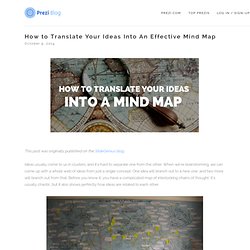
How do you turn creative chaos into a neat narrative? Sometimes, you don’t have to—visualize your web of ideas by creating a mind map with Prezi. Finding order in the chaos. The challenge to mind mapping is that complex topics can easily turn into a huge, dizzying mess. To create some order, you’ll need to practice a bit of discipline. XMind - Social Brainstorming and Mind Mapping. TreeSheets Tutorial. A "hierarchical spreadsheet" that is a great replacement for spreadsheets, mind mappers, outliners, PIMs, text editors and small databases.

Suitable for any kind of data organization, such as todo lists, calendars, project management, brainstorming, organizing ideas, planning, requirements gathering, presentation of information, etc. It's like a spreadsheet, immediately familiar, but much more suitable for complex data because it's hierarchical. TreeSheets. MindMapping: Mind Maps, PDF Management and Reference Management. Are you using mind mapping tools such as MindManager, FreeMind or XMind?
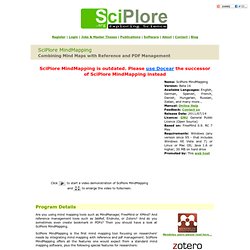
And reference management tools such as JabRef, Endnote, or Zotero? Visual Thinking. Spatial & Sequential Thinking Spatial and sequential thinking are two different mental organisations that affect the way people view the world. Mapping the Stairs to Visual Excellence. Thinkmap Visual Thesaurus - An online thesaurus and dictionary o. Five glorious presentations on visual thinking. Do you think in words or pictures, or both?
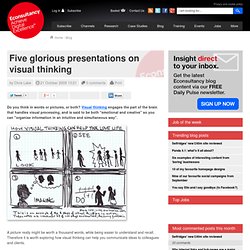
Visual thinking engages the part of the brain that handles visual processing, and is said to be both "emotional and creative" so you can "organise information in an intuitive and simultaneous way". A picture really might be worth a thousand words, while being easier to understand and recall. Therefore it is worth exploring how visual thinking can help you communicate ideas to colleagues and clients. I have collated a few presentations to help you do exactly that.
These will help you to understand the benefits of visual thinking, and there - obviously - lots of useful visualisations to aid you. Visual Thinking for Design. Visual Literacy: An E-Learning Tutorial on Visualization for Communication, Engineering and Business. Mindjet Connect: Visual Thinking vs. Linear Thinking. Gamestorming. Welcome to the Virtual Crash Course in Design Thinking.
Welcome to the d.school’s Virtual Crash Course resource page!
We know not everyone can make a trip to the d.school to experience how we teach design thinking. So, we created this online version of one of our most frequently sought after learning tools. Using the video, handouts, and facilitation tips below, we will take you step by step through the process of hosting or participating in a 90 minute design challenge. If you choose to participate, in 90 minutes you will be taken through a full design cycle by participating in The Gift-Giving Project. This is a fast-paced project where participants pair up to interview each other, identify real needs, and develop a solution to “redesign the gift-giving experience” for their partner. The Brainstormer - The Brainstormer by Andrew Bosley. The Brainstormer9/16/13: Brainstormer Facebook Page Read reviews of the app and see what others are doing with the Brainstormer!
Visit, "like it", and pass it along! 9/16/13: More wheels! New features! Fully customizable! A 12-Day Plan of Simple Writing Exercises. It’s the perfect time to restart your engine and get back into writing.
Here, I offer up a 12-day plan of simple writing exercises to help you keep your creative juices flowing without eating up too much of your time. Follow this plan and in less than half a month, you’ll not only be impressed with what you’ve accomplished, but you may also have something worth publishing. The 12-Day Plan of Simple Writing Exercises Day 1: Write 10 potential book titles of books you’d like to write. Day 2: Create a character with personality traits of someone you love, but the physical characteristics of someone you don’t care for. Rainy Cafe: Ambient White Noise Generator. 雨のカフェ. About a little thing called 750 Words. About a little thing called 750 Words. Famous Quotes at BrainyQuote. "To uncover the plot of your story, don’t ask what should...
Daily Writing Tips. Unmissable articles on writing. 30+ Tools For The Amateur Writer. NaNoWriMo (National Novel Writing Month) is almost upon us.
On November 1st, brave souls everywhere will embark on a month long endeavor to write a story of at least 50,000 words. We've gathered 30+ tools to help those folks who want to try their hand at it. Collaborative Writing Coventi.com - A site offering several different packages, with the cheapest being free for the personal user. Google Docs - Part of the Google suite of products, which enables you to invite others to work with you on a document. Glypho.com - Put down the basic idea of your story, get a plot and character suggestions. Fifty (50!) Tools which can help you in Writing - lifehack.org.
Creative Thinking Tools. The 101 Most Useful Websites on the Internet. Here are the most useful websites on the Internet that will make you smarter, increase productivity and help you learn new skills. These incredibly useful websites solve at least one problem really well. And they all have cool URLs that are easy to memorize thus saving you a trip to Google.
Also see: The Best Android Apps Also see: The Best Mac Apps and Utilities seatguru.com – consult this site before choosing a seat for your next flight.webmakerapp.com — an offline playground for building web projects in HTML, CSS and JavaScript. 5½ Timeless Commencement Speeches to Teach You to Define Your Own Success. By Maria Popova The great and terrible truth of clichés, why success is a dangerous bedfellow, and how disappointment paves the way for originality. It’s that time of year again, the time when cultural icons and luminaries of various stripes flock to podiums around the world to impart their wisdom on a fresh crop of graduating seniors hungry to take on the world. New Year's Resolution Reading List: 9 Essential Books on Reading and Writing. By Maria Popova Dancing with the absurdity of life, or what symbolism has to do with the osmosis of trash and treasure.
Hardly anything does one’s mental, spiritual, and creative health more good than resolving to read more and write better. Today’s reading list addresses these parallel aspirations. Six Tips on Writing from John Steinbeck. By Maria Popova If this is indeed the year of reading more and writing better, we’ve been right on course with David Ogilvy’s 10 no-nonsense tips, Henry Miller’s 11 commandments, and various invaluable advice from other great writers. Now comes Pulitzer Prize winner and Nobel laureate John Steinbeck (February 27, 1902–December 20, 1968) with six tips on writing, originally set down in a 1962 letter to the actor and writer Robert Wallsten included in Steinbeck: A Life in Letters (public library) — the same magnificent volume that gave us Steinbeck’s advice on falling in love.
Steinbeck counsels: Abandon the idea that you are ever going to finish. Lose track of the 400 pages and write just one page for each day, it helps. If there is a magic in story writing, and I am convinced there is, no one has ever been able to reduce it to a recipe that can be passed from one person to another. Jack Kerouac's List of 30 Beliefs and Techniques for Prose and Life. Why I Write: George Orwell's Four Motives for Creation. By Maria Popova “All writers are vain, selfish, and lazy, and at the very bottom of their motives there lies a mystery.” Literary legend Eric Arthur Blair, better known as George Orwell, remains best remembered for authoring the cult-classics Animal Farm and Nineteen Eighty-Four, but he was also a formidable, masterful essayist.
Henry Miller’s Reflections on Writing. The Nature of Fun: David Foster Wallace on Why Writers Write. By Maria Popova “Fiction becomes a weird way to countenance yourself and to tell the truth instead of being a way to escape yourself or present yourself in a way you figure you will be maximally likable.” On the heels of the highly anticipated new David Foster Wallace biography comes Both Flesh and Not: Essays (public library) — a collection spanning twenty years of Wallace’s nonfiction writing on subjects as wide-ranging as math, Borges, democracy, the U.S.
Open, and the entire spectrum of human experience in between. F. Scott Fitzgerald on the Secret of Great Writing. Neil Gaiman's 8 Rules of Writing. By Maria Popova In the winter of 2010, inspired by Elmore Leonard’s 10 rules of writing published in The New York Times nearly a decade earlier, The Guardian reached out to some of today’s most celebrated authors and asked them to each offer his or her commandments.
Margaret Atwood's 10 Rules of Writing. Zadie Smith's 10 Rules of Writing. What Will Survive of Us Is Love: 9 Rules of Writing from Helen Dunmore. 10 Tips on Writing from David Ogilvy. The Daily Routines of Famous Writers. REVEALING YOUR HERO'S WOUND: Good Will Hunting. At the beginning of your screenplay, your hero should be in a state of inertia — settling for a life that may be emotionally safe and tolerable, but that lacks passion, risk and fulfillment. DESIRE: THE DRIVING FORCE OF ALL SUCCESSFUL SCREENPLAYS. In past articles (see the Archives to the right), I’ve covered everything from Structure and Adaptation to pitching and marketing your script. THE 6 CATEGORIES OF ROMANTIC COMEDY. Romantic comedies – especially Hollywood romantic comedies – are among the most formulaic of genres, with elements that have consistently contributed to these scripts’ and films’ success.
MASTERING OUTER MOTIVATION. If you've ever heard me lecture, or ever read almost anything I've written, you've heard me talk about Outer Motivation -- a clear finish line that the hero is desperate to cross by the end of the story. MULTPILE WRITING SAMPLES. TEN SIMPLE KEYS TO PLOT STRUCTURE. Structure is something that every agent and executive in Hollywood talks about, and that all of us teachers/authors/consultants/gurus/whatever go on and on about, to the point that it can seem complicated, intricate, mysterious and hard to master.
BOOKS INTO MOVIES. Michael Hauge's Story Mastery. 8 tips on writing from Kurt Vonnegut, the most beautiful book in the world, Feynman, Sagan, Curie, and other great minds define science, and more. TEN SIMPLE KEYS TO PLOT STRUCTURE. Brain Pickings. Creative Writing Ideas, Courses Online, Free Classes for Writers. Famous Quotes, Quotations and Proverbs in Proverbia.net. Success! Creative Writing Games. Questionnaires for Writing Character Profiles - Creative Writing Help - StumbleUpon. Daily Writing Tips. Fifty (50!) Tools which can help you in Writing - StumbleUpon. Writing Prompts for Journals and Writers Notebooks. Cure writers block with writing prompts - writing tips character name generator - StumbleUpon.
Every Writer's Resource: Resources for Writers. Fiction Writing: What Makes Readers Care About Your Characters? 80 Journal Writing Prompts. 23 Advice Websites. One Sentence Stories. Character Name Generator. Writing Character Profiles. Punctuation Differences.
How to Write a Novel Using the Snowflake Method. Character Creation Made Easy, Pick a Personality-Method 6-MBTI Profiles. PilotHandwriting.com. OneLook Dictionary Search. Graphic Organizer Interactives & 18 Literacy Strategy Site (Verm. Synonym Finder & Find synonyms, antonyms & definition for (almost) any word - StumbleUpon. Wordiness, Wordiness, Wordiness List.
100 Exquisite Adjectives. CALLIHOO Writing Idea Generators: The 37 Dramatic Situations. ClichéSite.com - The largest collection of clichés or cliches, phrases and sayings with definitions and explanations. Cliches: Avoid Them Like the Plague. Writer's Diet. CALLIHOO Writing Helps. 105 Writing Tips from Professional Writers. Plague Words and Phrases - StumbleUpon. Bookmark This: Rick Moody's Guide to Revision. Strunk, William, Jr. 1918. The Elements of Style.
Novel Writing Tips & Fundamentals – Storyfix.com. Customer Reviews: Writing the Breakout Novel. Blockbuster Plots for Writers » Plot Tools. Kurt Vonnegut explains drama. Daily Writing Tips. Plot Whisperer for Writers and Readers. 10 Ridiculously Simple Tips for Writing a Book.