
Anthropology in Practice. Chili peppers.

First plants caused ice ages, new research reveals. New research reveals how the arrival of the first plants 470 million years ago triggered a series of ice ages.
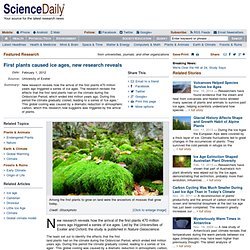
Led by the Universities of Exeter and Oxford, the study is published in Nature Geoscience. The team set out to identify the effects that the first land plants had on the climate during the Ordovician Period, which ended 444 million years ago. During this period the climate gradually cooled, leading to a series of 'ice ages'. This global cooling was caused by a dramatic reduction in atmospheric carbon, which this research now suggests was triggered by the arrival of plants. Among the first plants to grow on land were the ancestors of mosses that grow today. Flowers Communicate with Electricity. BrainPOP - Site éducatif animé pour enfants – Sciences, Sciences Sociales/Histoire-Géo, Anglais, Maths, Art et Musique, Santé et Technologie. Nitrogen Fixation. Fritz Haber I’m haunted by one of the stories in the latest episode of Radiolab, can’t get it out of my head.

Like everyone else, I love Radiolab and often sprinkle stories I learned from the show into cocktail party conversation (do I go to nerdy cocktail parties or do I make cocktail parties nerdy?) , but the Bad Show was especially gripping, in particular the story of Fritz Haber. Haber was a German chemist working in the early 20th century, but his name is well known in Chemical Engineering departments (he is, after all, one of The Most Popular Chemical Engineers Ever.)
Experimental Recipes with Azolla, Super Plant (and Future Space Food?) © Erik Sjödin If you've heard about duckweed (the pollution-cleaning, climate change-fighting super food) then maybe you've also heard of azolla, a family of seven species of edible water-dwelling ferns that grows lightning-fast and is packed full of nutrients.

Scientists are now studying azolla's potential in space agriculture as a super food crop for Mars habitation. So what does a super plant taste like? Tiny protein helps bacteria 'talk' and triggers defensive response in plants. Scientists have discovered a new signal that helps invading bacteria communicate but also helps targeted rice plants coordinate defensive attacks on the disease-causing invaders, a finding that could lead to new methods of combating infection not just in plants, but in humans.

Findings from the study, conducted by a team of researchers led by a University of California, Davis, scientist, are reported in the journal PLoS ONE and in the journal Discovery Medicine. "Just as invading armies often use coded messages to coordinate attacks on their targets, so single-celled bacteria use biological signals to communicate when they attack plants and animals," said Pamela Ronald, a UC Davis professor of plant pathology and the lead researcher on the study. "Scientists have known this for 20 years, however results from our study reveal a type of bacterial signal that has never been described before. " Ronald has posted an article about the study on her blog, "Tomorrow's Table," at. Purple lights and math help PlantLab grow food more efficiently. We’ve had local food, organic food, slow food and even urban farming.

Now get ready for disco farming. The Dutch “plant control freaks” behind PlantLab want to farm indoors under purple light. It’s not just for the looks, though. PlantLab has recently developed a set of technologies for optimal indoor farming so that food can grow anywhere from the sunless heart of an office building to an abandoned factory. Picture a 5-star hotel for lettuce, as opposed to the motel provided by a standard glasshouse. No sun, no problem: scientists discover dark secrets of the plant world. The dark secret of plants ... revealed.

Photo: Getty Images. Plants create a water reserve in the soil. Public release date: 15-Sep-2011 [ Print | E-mail Share ] [ Close Window ] Contact: Tilo Arnholdpresse@ufz.de 49-341-235-1635Helmholtz Association of German Research Centres.

Universcience. Cité des Sciences. Univers science VOD. Jeux pour enfants en SCIENCES. "Quand la Terre gronde" - animations flash pour les 8-12 ans (volcans, séismes, tsunamis, prévention des catastrophes naturelles) - Universcience.fr. Horticulture Discotech: LED Grow Lights Power Sustainable Farming.
What if we could grow fruits and vegetables in half the time with no pesticides or hormones and use 90 percent less water to do it?

What if we could grow those fruits and vegetables anywhere in the world, during any season? A Netherlands-based company called PlantLab believes we can. Apples from Chile, asparagus from Peru—an average of six to 12 percent of every dollar we spend on food goes to transportation costs. Traditionally, most agriculture has been limited to large swaths of land with rich soil, controllable pests, and a predictable climate, but even under optimum conditions traditional methods of agriculture drain our water supply, require intensive resources, and produce a crop dependent on an undependable climate. Digital inventory of medicinal plants underway in Pune - Mumbai. The Maharashtra government’s Rajiv Gandhi Science and Technology Commission is setting up a digitised inventory of medicinal plants of Maharashtra.

All he is saying, is give pee a chance. How the waste was won – a new pop-up restaurant for the Melbourne Food and Wine festival, which combines art, food and ecology, is about creating a sustainable world. NO DOUBT there's a more polite, even more technically accurate, way of phrasing this, but it doesn't get the message across half as well. And Joost Bakker is very much about sending the world a message. So when the celebrated artist/gardener/environmental designer/eco-entrepreneur pops up his Greenhouse restaurant concept for the Melbourne Food and Wine Festival in March, he will be well and truly taking the piss.
Scientists Discover First Night-Flowering Orchid : The Two-Way. Logy Magazine. Atmospheric oxygen really took off on our planet about 2.4 billion years ago during the Great Oxygenation Event. At this key juncture of our planet’s evolution, species had either to learn to cope with this poison that was produced by photosynthesizing cyanobacteria or they went extinct. It now seems strange to think that the gas that sustains much of modern life had such a distasteful beginning. So how and when did the ability to produce oxygen by harnessing sunlight enter the eukaryotic domain, that includes humans, plants, and most recognizable, multicellular life forms? One of the fundamental steps in the evolution of our planet was the development of photosynthesis in eukaryotes through the process of endosymbiosis. This crucial step forward occurred about 1.6 billion years ago when a single-celled protist captured and retained a formerly free-living cyanobacterium.
Bhattacharya leads the Rutgers Genome Cooperative that has spread the use of genome methods among university faculty. Flowers in Ultra-Violet. The compilation of species will continue to be updated at irregular intervals. All species listed here have been documented, and links are added whenever I can find spare time for updating. These images are made for illustrative purposes, not as artistic statements per se. However, there are lots of food for thought in the convoluted ways Nature expresses itself, so for once the artist can step backand let the subjects speak for themselves. "Das Ding an Sich" to paraphrase Kant, or Eigenvalue of Nature.
Plants Use Body Clocks to Prepare for Battle. By Olivia Solon, Wired UK Biologists at Rice University have discovered that while plants might look fairly inactive in the day, they are surreptitiously preparing for battle with hungry insects. [partner id="wireduk"]“When you walk past plants, they don’t look like they’re doing anything,” said Janet Braam, one of the investigators on a new study, which appears in the Proceedings of the National Academy of Sciences.
“It’s intriguing to see all of this activity down at the genetic level. It’s like watching a besieged fortress go on full alert.” Biologists have long known that plants have an internal clock that lets them measure the passing of time regardless of the light conditions. In order to test this theory, graduate biochemistry and cell biology student Danielle Goodspeed designed an experiment.
Key mechanism that regulates shape and growth of plants discovered. UBC researchers have discovered a key mechanism that -- much like a construction site foreperson -- controls the direction of plant growth as well as the physical properties of the biopolymers that plants produce. Tiny protein helps bacteria 'talk' and triggers defensive response in plants.
Strawberries Protect The Stomach From Alcohol.