
Meet the new Light Table. 05 Nov 2012 Meet the new Light Table We have to start with a picture.
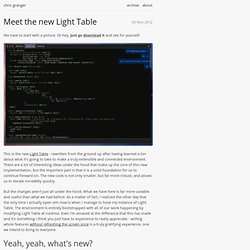
Or hey, just go download it and see for yourself. This is the new Light Table - rewritten from the ground up after having learned a ton about what it's going to take to make a truly extensible and connected environment. There are a lot of interesting ideas under the hood that make up the core of this new implementation, but the important part is that it is a solid foundation for us to continue forward on. But the changes aren't just all under the hood. Yeah, yeah, what's new? Clojure Gazette 1.17. Exploring the connection between lambda calculus and programming As we all know, Lisp is based on the Lambda Calculus.

In this issue, we will open the lambda can of worms, especially as it relates to programming languages. A brief introduction: Lambda Calculus consists of three parts (with their Lisp equivalents): Casting SPELs with Clojure - Home - Anyone who has ever learned to program in Lisp will tell you it is very different from any other programming language.
It is different in lots of surprising ways - This comic book will let you find out how Lisp's unique design makes it so powerful ! This tutorial was adapted for Clojure, an exciting new dialect of Lisp running on the Java Virtual Machine. Clojure's syntax and API resembles Common Lisp, but there are enough differences to write a dedicated version of this book. Most of the time, we will say "Lisp" instead of "Clojure", since most of the concepts presented apply to Lisp in general - we will point out the places where Clojure handles things a little different.
PCL -> Clojure. Clojure - Functional Programming for the JVM. By R.
Mark Volkmann, Partner Object Computing, Inc. (OCI) last updated on 6/2/13 Contents Introduction. Keynote: Simplicity Matters by Rich Hickey. SOLID Clojure.
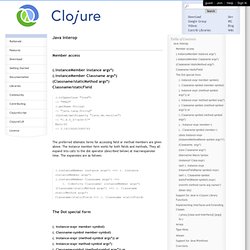
Java_interop. Member access (.instanceMember instance args*) (.instanceMember Classname args*)
Flowchart for choosing the right Clojure type definition form. Clojure offers a number of different forms that define types (and generate Java classes).

Choosing between deftype, defrecord, reify, proxy, and gen-class can be a tripping point for those new to Clojure. I’d obviously like to make such decisions easier for everyone. I know that many people learn best through visual aids, so I’ve been working on a flowchart that attempts to encapsulate some of the significant choices that go into deciding between the different type-definition forms. A draft of it is below; let me know if it is helpful to you (or not!) , how you think it could be made better, etc.
“The ‘Interop Zone’” demarcates use cases (e.g. needing to define multiple constructors) and forms (proxy and gen-class) that are exclusively the domain of Clojure’s JVM interoperability support. Updated 2011-07-05 18:28 UTC based on initial feedback. Clojure & Java Interop. About a year ago I got a phone call asking if I wanted to join another team at DRW.
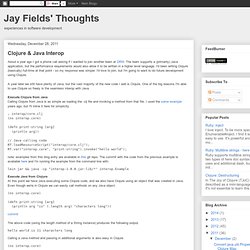
The team supports a (primarily) Java application, but the performance requirements would also allow it to be written in a higher level language. I'd been writing Clojure (basically) full-time at that point - so my response was simple: I'd love to join, but I'm going to want to do future development using Clojure. A year later we still have plenty of Java, but the vast majority of the new code I add is Clojure. Multimethods. ::rect -> :user/rect (derive ::rect ::shape) (derive ::square ::rect) (parents ::rect) -> #{:user/shape} (ancestors ::square) -> #{:user/rect :user/shape} (descendants ::shape) -> #{:user/rect :user/square} (isa?

42 42) -> true (isa? (derive java.util.Map ::collection) (derive java.util.Collection ::collection) (isa? Polymorphism in Clojure. In most Object Oriented programming languages, polymorphism is tied to inheritance.

In Clojure however, the concept of concrete inheritance is not built into the language. So, when I was first learning Clojure, it was hard for me to use my previous knowledge of polymorphism in the functional world. No need to fear, Clojure provides great methods for achieving polymorphism without using concrete inheritance. Clojure multi-methods. A friend asked me a question about multi-methods and since the response was long-ish, I’m dumping it here in case it helps someone else: Question: “Is it possible to write a multimethod that has defmethods which handle ranges of values?
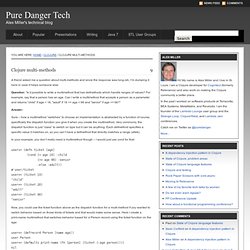
For example, say that a person has an age. Can I write a multimethod that accepts a person as a parameter and returns “child” if age < 16, "adult" if 16 <= age < 66 and "senior" if age >= 66?” Answer: Sure – how a multimethod “switches” to choose an implementation is abstracted by a function of course, specifically the dispatch function you give it when you create the multimethod. In your example, you don’t really need a multimethod though – I would just use cond for that: Clojure multimethods « Constant Arguments. I have just began my adventures in Clojure land. So far it seems exotic for someone who’s just beginning to grasp the marvels of functional programming and for whom Lisp has previously been just magic inside parentheses.
However, even though my experience with Clojure is very limited, I’ve already noticed that it is a very enabling language. I’m planning to post brief introductions or tutorials on Clojure’s features on this blog, mostly to educate myself. I’m sure I won’t be able to avoid errors. If you spot one, please let me know. Protocols. Protocols were introduced in Clojure 1.2.Motivation Clojure is written in terms of abstractions. There are abstractions for sequences, collections, callability, etc. In addition, Clojure supplies many implementations of these abstractions. The abstractions are specified by host interfaces, and the implementations by host classes.
Clojure Protocols & Datatypes — A sneak peek « The Free Geek. Clojure 1.2 introduces two very remarkable features – Protocols and Datatypes . Clojure is defined in terms of abstractions and various implementations of those abstractions. For example, vectors, maps, lists, sets in Clojure implement the sequence abstraction which lets us treat any of those data structures as sequences.
Until recently it was not possible feasible to define and implement such core abstractions in Clojure itself; one had to drop down to Java (or C#) for those tasks, but not anymore Clojure 1.2 now has excellent facilities for defining and implementing similar abstractions in a highly dynamic manner while maintaining fantastic performance characteristics.
In this post, I will give you a brief overview of these new features and will show you how they are useful. Rich Hickey on Protocols and Clojure 1.3. 3. It’s essentially solving the expression problem. If you know what that is, it’s a way to do that. The expression problem makes it harder for people to understand. People understand that it can be difficult to extend the systems that require you to change your types. So when you have something that allows you to write new extensions, new functions that behave differently depending on the types they're passed without touching those types - that’s something that allows for independent extension. 5. Clojure 1.2 Protocols. Brool » Blog Archive » Pattern Matching In Clojure. Updated: Note that this is available as a clojars module. Light Table by Chris Granger.
Here's a much higher quality video: Despite the dramatic shift toward simplification in software interfaces, the world of development tools continues to shrink our workspace with feature after feature in every release. Even with all of these things at our disposal, we're stuck in a world of files and forced organization - why are we still looking all over the place for the things we need when we're coding?
Why is everything just static text? 4clojure – Welcome! The Clojure Toolbox. Keyword Arguments in Clojure, the Right Way. Update Feb. 10, 2010: I was wrong. Recent discussions indicate that placing optional arguments in-line, as in my first example, is preferred. Programming Hadoop with Clojure. Welcome to Apache™ Hadoop™! Clojure - home.