
Horatio Alger, Jr. Horatio Alger, Jr.

(January 13, 1832 – July 18, 1899) was a prolific 19th-century American author, best known for his many juvenile novels about impoverished boys and their rise from humble backgrounds to lives of middle-class security and comfort through hard work, determination, courage, and honesty. His writings were characterized by the "rags-to-riches" narrative, which had a formative effect on America during the Gilded Age.
Alger's name is often invoked incorrectly as though he himself rose from rags to riches, but that arc applied to his characters, not to the author. Essentially, all of Alger's novels share the same theme: a young boy struggles through hard work to escape poverty. Critics, however, are quick to point out that it is not the hard work itself that rescues the boy from his fate, but rather some extraordinary act of bravery or honesty, which brings him into contact with a wealthy elder gentleman, who takes the boy in as a ward. Biography[edit] Horatio Alger, Jr.
Horatio Alger, Jr.

(January 13, 1832 – July 18, 1899) was a prolific 19th-century American author, best known for his many juvenile novels about impoverished boys and their rise from humble backgrounds to lives of middle-class security and comfort through hard work, determination, courage, and honesty. His writings were characterized by the "rags-to-riches" narrative, which had a formative effect on America during the Gilded Age. Alger's name is often invoked incorrectly as though he himself rose from rags to riches, but that arc applied to his characters, not to the author. Essentially, all of Alger's novels share the same theme: a young boy struggles through hard work to escape poverty.
Critics, however, are quick to point out that it is not the hard work itself that rescues the boy from his fate, but rather some extraordinary act of bravery or honesty, which brings him into contact with a wealthy elder gentleman, who takes the boy in as a ward. Biography[edit] Ludlow Massacre. The Ludlow Massacre was an attack by the Colorado National Guard and Colorado Fuel & Iron Company camp guards on a tent colony of 1,200 striking coal miners and their families at Ludlow, Colorado, on April 20, 1914.
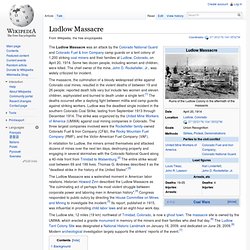
Some two dozen people, including women and children, were killed. The chief owner of the mine, John D. Rockefeller, Jr., was widely criticized for incident. The massacre, the culmination of a bloody widespread strike against Colorado coal mines, resulted in the violent deaths of between 19 and 26 people; reported death tolls vary but include two women and eleven children, asphyxiated and burned to death under a single tent.[1] The deaths occurred after a daylong fight between militia and camp guards against striking workers. Ludlow was the deadliest single incident in the southern Colorado Coal Strike, lasting from September 1913 through December 1914. The Ludlow Massacre was a watershed moment in American labor relations. Background[edit] Strike[edit] Massacre[edit] Rev. John D. Rockefeller. John Davison Rockefeller, Sr.
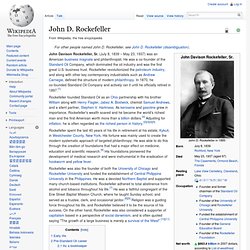
(July 8, 1839 – May 23, 1937) was an American business magnate and philanthropist. He was a co-founder of the Standard Oil Company, which dominated the oil industry and was the first great U.S. business trust. Rockefeller revolutionized the petroleum industry, and along with other key contemporary industrialists such as Andrew Carnegie, defined the structure of modern philanthropy. In 1870, he co-founded Standard Oil Company and actively ran it until he officially retired in 1897.[1] Rockefeller spent the last 40 years of his life in retirement at his estate, Kykuit, in Westchester County, New York.
Rockefeller was also the founder of both the University of Chicago and Rockefeller University and funded the establishment of Central Philippine University in the Philippines. Early life Eliza, a homemaker and devout Baptist, struggled to maintain a semblance of stability at home, as Bill was frequently gone for extended periods. Rockefeller at age 18, ca. 1857.