
The Golden Bough. The Golden Bough: A Study in Comparative Religion (retitled The Golden Bough: A Study in Magic and Religion in its second edition) is a wide-ranging, comparative study of mythology and religion, written by the Scottish anthropologist Sir James George Frazer (1854–1941).
It was first published in two volumes in 1890; in three volumes in 1900; the third edition, published 1906–15, comprised twelve volumes. The work was aimed at a wide literate audience raised on tales as told in such publications as Thomas Bulfinch's The Age of Fable, or Stories of Gods and Heroes (1855). Frazer offered a modernist approach to discussing religion, treating it dispassionately[1] as a cultural phenomenon rather than from a theological perspective. The influence of The Golden Bough on contemporary European literature and thought was substantial.[2] Subject matter[edit]
Red Book (Jung) The Red Book, also known as Liber Novus (Latin for New Book), is a 205-page manuscript written and illustrated by Swiss psychiatrist Carl Gustav Jung between approximately 1914 and 1930, prepared for publication by The Philemon Foundation and published by W.

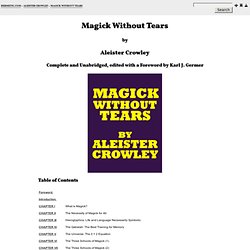
W. Norton & Co. on October 7, 2009. Until 2001, his heirs denied scholars access to the book, which he began after a falling-out with Sigmund Freud in 1913. Magick Without Tears. Table of Contents.
Foucault's Pendulum. This article is about the novel by Italian philosopher Umberto Eco.
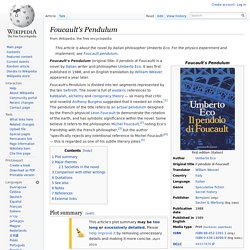
For the physics experiment and implement, see Foucault pendulum. Foucault's Pendulum (original title: Il pendolo di Foucault) is a novel by Italian writer and philosopher Umberto Eco. It was first published in 1988, and an English translation by William Weaver appeared a year later. Foucault's Pendulum is divided into ten segments represented by the ten Sefiroth. The novel is full of esoteric references to Kabbalah, alchemy and conspiracy theory — so many that critic and novelist Anthony Burgess suggested that it needed an index.[1] The pendulum of the title refers to an actual pendulum designed by the French physicist Léon Foucault to demonstrate the rotation of the earth, and has symbolic significance within the novel. Plot summary[edit] After reading too many manuscripts about occult conspiracy theories, three vanity publisher employees (Belbo, Diotallevi and Casaubon) invent their own conspiracy for fun. Mr. Mr. John M. Allegro.
John Allegro John Marco Allegro (17 February 1923, Balham, South London[1] – 17 February 1988, Sandbach, Cheshire[2]) was an English archaeologist and Dead Sea Scrolls scholar.

He was known as a popularizer of the Dead Sea Scrolls through his books and radio broadcasts. He was the editor of some of the most famous and controversial scrolls published, the pesharim. A number of Allegro's later books, including The Sacred Mushroom and the Cross, brought him both popular fame and notoriety. Training[edit] Allegro matriculated from Grammar school in 1939, though did not go on to university, as his father saw little value in higher education, so Allegro joined the British Navy, serving during World War Two and going on to become an officer. The Copper Scroll[edit] It was on Allegro's recommendation in 1955 that the Copper Scroll was sent by the Jordanian government to Manchester University in order for it to be cut into sections, allowing the text to be read.
Publishing the Pesharim[edit] J.M. The Transmigration of Timothy Archer. The Transmigration of Timothy Archer is a 1982 novel by Philip K.

Dick. As his final work, the book was published shortly after his death in March 1982 following a series of strokes, although it was written the previous year. The book was originally titled Bishop Timothy Archer. The novel was nominated for the Nebula Award for Best Novel in 1982.[1] Plot introduction[edit] Www.webofmimicry.com/museum/bookreview-viewer.php?review=godwin. Probably the best short introduction to this subject for anyone who's interested but has no idea where to start.

A fast-paced overview of the theory of music from a wide-angle conceptual/historical lens, this book is brimming over with exciting material that should be (and secretly is) the lifeblood of all musicianship. If you can't grab a musician by the lapels & yank them out of their 'rhythm and notes' stupor, maybe you can try to introduce him/her to something inspiring. Www.webofmimicry.com/museum/bookreview-viewer.php?review=corbin. Ok friends, in this library, if you want to get anywhere, this is a good starting point.

By way of introduction into our worldview from the Ivory Tower, we feel obliged to state the following as a primer and introduction. The main difficulties of opinion anyone has with 'religion' in general at this point are to be counted as merits of good instinct. Anyone who shows an unwillingness to be shystered under a certain God-concept is just being relatively cautious and smart. Human beings have this funny way of learning from experience - the herding of slaves into the temporal Temple has shown itself time and time again to be a dubious exercise of illicit power, at least in most cases.