
If Matthew Arnold could read Riddley Walker. Future Hell: Nuclear Fiction in Pursuit of History. The questions that these cyclical post nuclear fictions pose are best framed by evoking the Hegelian model of the dialectic.

Hegel writes in Verstand[6] “Thus understood the Dialectical principle constitutes the life and soul of scientific progress, the dynamic which alone gives immanent connection and necessity to the body of science; and, in a word, is seen to constitute the real and the true, as opposed to the external, exaltation above the finite” (Hegel 95).
What Hegel has captured in the lens of the dialectic is that once a concept can be handled rationally in the mind, the only due course of action will be name what it is, then proceed to deconstruct it into its constituent parts or even prove the opposite. Vice versa, the continuing dialectic is the process by which competitive or complimentary ideologies are synthesized in the rationally cultivated mind. These methods inform, sometimes unconsciously, the styles and quarries of the featured texts. III. IV. V. 1.) 2.) 3.) 4.) Russell Hoban « MetaBlog. Like most I came to writing through reading, and what engaged me most as a reader when I was young was science fiction.

The idea of looking at the “future” was enticing to me, and science fiction served as a lens through which I could see what was coming next. As a kid I had fantastic dreams about when humans would live on Mars, or a planet orbiting Alpha Centauri…to a ten-year old’s mind, it all seemed so close. And then I learned physics. Like many I came to engineering through an inexplicable thirst to understand what made things work, and what I could do to make things work. My desire to understand the world clashed head-on with my sci-fi dreams, and the result was not the dreams becoming squashed, just modified a tad. Enter Cyberpunk. Though Cyberpunk was my fiction darling through high school and into college, for the sake of completeness I’ll cover three genres here that are all well read by me, and in my mind, connected.
Dystopia Post-Apocalyptic Cyberpunk. General Fiction – Che Guevara, Rodney Hall, Anne Hebert, Hermann Hesse, Alan V Hewat, Russell Hoban, Spencer Holst, Glyn Hughes, J K Huysmans, A bit out of place in the fiction shelves Che Guevara’s Bolivian Diary was first published by Lorrimer Third World Press in 1968, and is indeed the edition pictured below.

Che Guevara was and still remains an iconic figure in popular culture, the archetypal revolutionary hero. I did have a poster of him at the time as well, long lost. Rodney Hall is a well known Australian author. His novel (the only one of his books I appear to own) Just Relations won the Miles Franklin Award in 1982. Russell Hoban on Riddley Walker rhymes (Guardian interview) Russell Hoban A Great American Writer. [books] Riddley Walker by Russell Hoban. [books] Riddley Walker by Russell Hoban Last night, I finished reading Riddley Walker by Russell Hoban (1980) [ Powell's ].
![[books] Riddley Walker by Russell Hoban](http://cdn.pearltrees.com/s/pic/th/books-riddley-walker-russell-9136483)
Brighter minds than mine have spent much thought on this book over the years [ Wikipedia | Riddley Walker Annotations ], but oddly enough I still have a few things to say. This book could be a type specimen in the argument Daniel Abraham was exploring just yesterday about the dynamic tension between sentence and story. One could write a perfectly decent bit of post-apocalyptic science fiction about the recovery of lost knowledge and the dynamics of social and technological power using the plot, characters and setting of Riddley Walker.
That’s not what Hoban did. Riddley Walker is written in a mode very reminiscent of eye dialect. Science fiction writers especially use linguistic evolution as a story telling and worldbuilding tool, but most of us don’t do it with every damned word on the page. My best advice, swiped from tillyjane (a/k/a my mom) is to read it aloud. Riddley Walker - Index. Riddley Walker. Hoban began writing the novel in 1974, inspired by the medieval wall painting of the legend of Saint Eustace at Canterbury Cathedral.
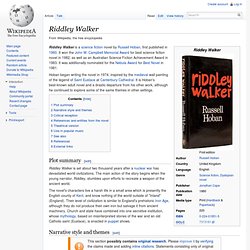
It is Hoban's best-known adult novel and a drastic departure from his other work, although he continued to explore some of the same themes in other settings. Plot summary[edit] Riddley Walker is set about two thousand years after a nuclear war has devastated world civilizations. Russell Hoban's RIDDLEY WALKER. Back to The Head of Orpheus: a Russell Hoban Reference Page (home). ...theres some thing in us it dont have no name...it aint us but yet its in us.

Its looking out thru our eye hoals. --Riddley Walker, (p. 6) Winner, John W. Cambell Memorial Award, 1982 Winner, Australian Science Fiction Achievement Award, 1983 Nominated for National Book Critics Circle Award 1981 Big News! Mariemichel. Riddley Walker: Thoughts on language. Wrapped Up In Books is The A.V.

Club’s monthly book club. We’re currently discussing this month’s selection, Russell Hoban’s Riddley Walker, in a series of posts to be followed by a live online chat Thursday at 3:30 p.m. CST and a feature interview with Hoban on Friday. Todd VanDerWerff: Trubba not, fellow Wrapped Up in Books-keteers.