
Communicate Powerfully... Without Being A BITCH: A Guide For Women. The way you talk at work, like, matters - you know? - Ask Annie. By Anne Fisher, contributor FORTUNE -- Dear Annie: I work on a team with a bright, talented young woman who has a lot of potential.

The problem is that our director and other colleagues are frustrated with her communication style, which is what you might call "Valley Girl. " We really want her to do well and get ahead, and we believe the way she speaks is holding her back. Can you offer any tips on how to overcome this? She is generally open to constructive suggestions and I think she would follow your advice. — Trying to Help Dear TH: "'Valleyspeak' is the verbal equivalent of coming to work looking like you just rolled out of bed," says executive speech coach Christine K. Jahnke is president of Washington, D.C. One drawback to talking like a Valley Girl is that it often entails ending sentences with an upward inflection, as if they were questions, which "sounds as if you're seeking approval rather than making a statement," Jahnke says.
Student Branding Blog - Dan Schawbel. Perhaps I am just sensitive to certain speech patterns, but the repetitive use of the word “like” usually pricks up my ears.

The offenders are usually groups of young adults engaged in casual conversation. However, that is not always the case. I was attending a conference a few weeks ago. In the middle of a discussion, a young finance professional spoke up. Her response was peppered with the word “like,” and I am certain as the day is long that she was completely unaware of her verbal transgressions. The movie Valley Girl forever changed the way young Americans communicate. Barbara Pachter's Blog: Pachter's Pointers: Top Ten Things To Avoid When Making a Sales Presentation. How do we appear experienced and mature, when we’re not?

The above question was asked recently by a young man as I was giving feedback to a group of new hires during a sales-presentation class. He and the other participants in the class were very bright, talented individuals, but they needed to play down their youthful demeanor. Their customers wanted to buy from sources who presented themselves as credible and mature. I suggested that they eliminate discounting, immature mannerisms from their sales pitches to appear more self-assured and confident. Seasoned professionals also can check their presentations against this list. Here are the top ten things to avoid when making a sales presentation: 1. Minneapolis St. Paul Kitchen Remodeling. The kitchen, as we all know, is where people congregate at any gathering. The importance of the kitchen, as well as the technologies available to make our lives more convenient, have evolved over the years.
The kitchen has changed from a utilitarian space that was often delegated the "leftover" main floor space to a modern-day gathering place and the focal point of your home. Let our award-winning designers and craftsmen help you create the kitchen of your dreams! First remodel certified as a Minnesota GreenStar Pilot Project! The scope of this kitchen project was to open up a load-bearing wall, remove the front hallway, and make a larger gathering space for the entire family to enjoy.
RFA-HS-10-018: Improving Patient Safety through Simulation Research (R18) Part I Overview Information Department of Health and Human Services Participating Organizations Agency for Healthcare Research and Quality (AHRQ), ( Components of Participating Organizations Center for Quality Improvement and Patient Safety (CQuIPS) ( Title: Improving Patient Safety through Simulation Research (R18) Note: The policies, guidelines terms and conditions stated in this announcement may differ from those used by the NIH.

Diagnose the Learning Needs. Diagnostic Assessment: Learning and Teaching should meet the needs of the Whole Learner. Self-Diagnosis. Following is a strategy for self-diagnosing/self-assessing desired behaviors or required competencies pertaining to learning about any particular topic or subject matter.

CTE - Choosing teaching strategies – an overview. CTE Home >> Resources >> Online Resources >> New Faculty Resource Guide >> Choosing teaching strategies – an overview Matching teaching methods to course objectives is an essential, good teaching practice.

Preparing your course has parallels to preparing your research. You wouldn’t choose a research method without first knowing your research questions; you should treat choosing your teaching strategy with the same mindset. Here is the teaching/research analogy: Here is an example of matching your teaching methods to your course objectives: In this chapter we will be discussing common teaching practices in greater detail. Learning styles. Learning style is an individual's natural or habitual pattern of acquiring and processing information in learning situations.

A core concept is that individuals differ in how they learn.[1] The idea of individualized learning styles originated in the 1970s, and has greatly influenced education.[2] Proponents of the use of learning styles in education recommend that teachers assess the learning styles of their students and adapt their classroom methods to best fit each student's learning style. Although there is ample evidence for differences in individual thinking and ways of processing various types of information, few studies have reliably tested the validity of using learning styles in education.[2] Critics say there is no evidence that identifying an individual student's learning style produces better outcomes.
David Kolb's model[edit] Myers-Briggs Type Indicator. A chart with descriptions of each Myers–Briggs personality type and the four dichotomies central to the theory.
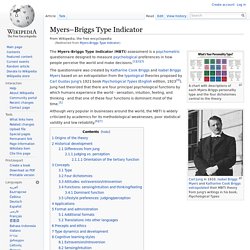
The Myers–Briggs Type Indicator (MBTI) assessment is a psychometric questionnaire designed to measure psychological preferences in how people perceive the world and make decisions.[1][2][3] The questionnaire was created by Katharine Cook Briggs and Isabel Briggs Myers based on an extrapolation from the typological theories proposed by Carl Gustav Jung's 1921 book Psychological Types (English edition, 1923[4]). Jung had theorized that there are four principal psychological functions by which humans experience the world - sensation, intuition, feeling, and thinking - and that one of these four functions is dominant most of the time.[5] Although very popular in businesses around the world, the MBTI is widely criticized by academics for its methodological weaknesses, poor statistical validity and low reliability.[6][7] Origins of the theory[edit] Historical development[edit] Type[edit]
DVC Learning Styles Inventory Results. Learning Needs Analysis. Learning Needs Analysis Learning needs analyses are undertaken in industry and business to determine the gap between the existing skills, knowledge and abilities of staff and those that are needed for the organisation to function at the desired level.

Once this gap is determined, decisions can be taken as to the type of training required (if this is the preferred action) and the form of delivery. Likewise, in an educational setting, a learning needs analysis helps students identify where they are in terms of their knowledge, skills and competencies, versus where they wish to be - what are their learning goals?