
Elearningeuropa.info. Knowledge Management, management des connaissances - Méthodes et outils. Cette rubrique décrit les méthodes et outils mis en oeuvre dans le cadre des Phases II de démarches Knowledge Management.
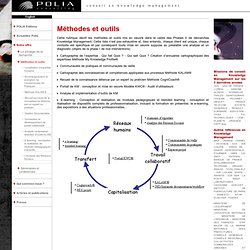
Cette liste n’est pas exhaustive et, bien entendu, chaque client est unique, chaque contexte est spécifique et par conséquent toute mise en oeuvre suppose au préalable une analyse et un diagnostic (objets de la phase I de nos interventions). Cartographie de l’expertise : Qui fait Quoi ? - Qui sait Quoi ? Création d’annuaires cartographiques des expertises Méthode My Knowledge Profile® Communautés de pratiques et communautés de veille Cartographie des connaissances et compétences appliquées aux processus Méthode KALAM® Recueil de la connaissance détenue par un expert ou praticien Méthode CogniCoach® Portail de KM : conception et mise en oeuvre Modèle KWC® - Audit d’utilisateurs Analyse et implémentation d’outils de KM.
Knowledge Management, management des connaissances - Ingénierie de la Connaissance et Génie de l'Organisation. Préface du livre "Manager la connaissance dans l’entreprise" de Jean-Yves PRAX, INSEP Editions, 1997 Longtemps, les sciences fondamentales de l’ingénierie furent connues sous le nom de « sciences du génie », et le Québec francophone conserve encore ce riche héritage : les écoles d’ingénieurs y sont « facultés des sciences du génie ».
La racine du « génie » (ou de « l’Ingenium » latin, cette « capacité de relier ce qui est séparé » rappelait G. Vico en 1710, s’étonnant de la difficulté de la langue française à traduire ce mot), ne s’avère-t-elle pas toujours vivace : génie maritime, génie civil, génie militaire, génie rural... survivent depuis trois siècles et cautionnent le génie urbain ou le génie logiciel que l’usage contemporain a volontiers accueilli dans les années 1970-1980. Avoir un mot pour le nommer ne permettrait-il pas de le penser ? Les techniques du type « système client-serveur », « intranet », « global office » et tant d’autres que présente ou qu’évoque ce livre de J.Y.
Cours_intro.pdf (Objet application/pdf) Inc: Knowledge-Based Engineering (KBE) KBE represents a merging of object-oriented programming, artificial intelligence, and computer aided design.

KBE systems aim to capture product and process information to allow businesses to model engineering processes, and then use the model to automate all or part of the process. A product model represents the engineering intent behind the product design, storing the how, why, and what of a design. It is a computer representation of the product design process and can contain information on both the product and the processes that are used to create the part. A KBE product model can also use information outside its environment, such as physics-based analysis, databases, spreadsheets, legacy programs, and cost models.
Many CAD systems provide "design automation" capabilities. Feuille de route de création de valeur de PTC - PTC.com. Overview Let’s face it – in the eyes of investors, great companies are created by great products and services, not the other way around. Yet few companies consistently create robust pipelines of successful products and services. Why? Doing so requires improved strategy and planning activities across the enterprise to empower smarter decision-making about the way you create and service your products. Knowledge-based engineering. Knowledge-based engineering (KBE) is a discipline with roots in computer-aided design (CAD) and knowledge-based systems but has several definitions and roles depending upon the context. An early role was support tool for a design engineer generally within the context of product design.
Overview[edit] KBE can be defined as engineering on the basis of digital knowledge models. Such knowledge models are the result of knowledge modeling that uses knowledge representation techniques to create the computer interpretable models. The knowledge models can be imported in and/or stored in specific engineering applications that enable engineers to specify requirements or create designs on the basis of the knowledge in such models.
KBE can have a wide scope that covers the full range of activities related to Product Lifecycle Management and Multidisciplinary design optimization. KBE also has more general overtones. There are similar techniques, such as electronic design automation. Jean-Francois Rischard. MENA - KBE jf RISCHARD.