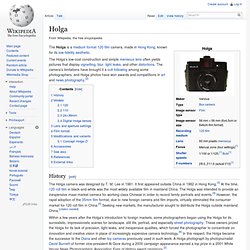
Lomography. Wiki Holga. History[edit] The Holga camera was designed by T. M. Lee in 1981. It first appeared outside China in 1982 in Hong Kong.[3] At the time, 120 roll film in black-and-white was the most widely available film in mainland China. Recently the Holga has experienced renewed consumer interest outside China due to the increasing popularity of toy cameras, and a continuing counterculture response to the increasing complexity of modern cameras.[7] Models[edit] 120[edit] Holga 120S – The original Holga, since discontinued. 110[edit] Holga Micro-110 Holga Micro 110 - Standard 26 mm 110 holgaHolga 110 TFS - A 110 camera with a switchable standard, and panorama format 24×36mm[edit] Holga 135 – A Holga with 35mm filmHolga 135BC – A Holga already made for 35mm film, plastic lens and the same lens mount of the Holgas 120 but with 47mm lens, f1:8 or 1:11 and shutter speed 1/100.
Digital Holga lenses[edit] Lens and aperture settings[edit] A sample Holga image showing its characteristic vignetting. Film format[edit] Wiki Lomography. The original Lomo LC-A Lomography is an analog camera movement and community, and is also a commercial trademark of Lomographische AG. The Lomographic Society International was founded in 1992 by a group of Viennese students after they discovered the Lomo LC-A camera[1] created by LOMO PLC of Saint Petersburg, Russia.
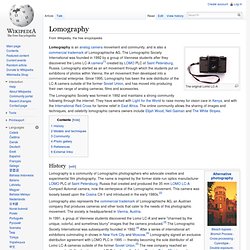
Lomography started as an art movement through which the students put on exhibitions of photos within Vienna; the art movement then developed into a commercial enterprise. Since 1995, Lomography has been the sole distributor of the LC-A camera outside of the former Soviet Union, and has moved into producing their own range of analog cameras, films and accessories. The Lomographic Society was formed in 1992 and maintains a strong community following through the internet. They have worked with Light for the World to raise money for vision care in Kenya, and with the International Red Cross for famine relief in East Africa. History[edit] Sample shot from Lomo LC-A camera. Holga Mods. Wiki Diana Camera. Camera model The Diana-style cameras frequently suffer from light leaks, film advance issues and other problems. However, its plastic lens has been celebrated for its artistic effects in photographs, normally resulting in a slightly blurred composition that can provide a 'dreamlike' quality to the print.[2] The Diana first appeared during the early 1960s as an inexpensive box camera sold by the Great Wall Plastic Factory of Kowloon, Hong Kong.[3][4][5] Most were exported to the United States and the United Kingdom.
In the United States, the Diana was imported by the Power Sales Company of Willow Grove, Pennsylvania.[5][6] During the 1960s, the Power Sales Company sold the Diana by the case of 144 cameras at about 50 cents U.S. per unit to a variety of retailers and promotional merchandisers.[5][7] Characteristics and variants [edit] A twist on the classic 1960s first-version Diana, Diana F+ was produced in 2007 and offers four apertures, including a pinhole. Lomography's official site.