
Faraday november09 1. Control light with magnets and olive oil?! (Faraday effect) SFB/TR7. Garching Core-Collapse Supernova Archive. Core-Collapse Supernova Archive People contributing to this archive Crab Supernova Remnant: NASA, ESA and Allison Loll/Jeff Hester (Arizona State University), thanks to: Davide De Martin (ESA/Hubble) Gravitational core-collapse events and supernova explosions are among the most powerful cosmic phenomena, releasing more energy within seconds than stars like the sun produce in billions of years.

They terminate the lives of massive stars, giving birth to neutron stars or stellar-mass black holes, and are responsible for the production of about half of the chemical elements heavier than iron. By far most of the energy release occurs in the form of elusive neutrinos, elementary particles that are abundantly produced when the hot, compact remnant settles and cools.
Scale2/scale2.swf?bordercolor=white. Lectures. Physics. Multimedia - HÜTTINGER Electronics. Spinoff 2010 homepage.
Earth Image Archive. Globe Here are some movies Image of the Earth.
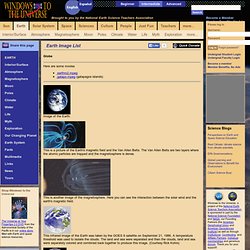
This is a picture of the Earth's magnetic field and the Van Allen Belts. The Van Allen Belts are two layers where the atomic particles are trapped and the magnetosphere is dense. This is another image of the magnetosphere. The European Organization for Nuclear Research.
Home. Robonaut: Home. News.chess.cornell.edu/articles/2004/PRfocus92.pdf. Sixty Symbols - Physics and Astronomy videos. Spinoff homepage. News & Notes. Wilkinson Microwave Anisotropy Probe (WMAP) Z.najmudin. Summary Zulfikar Najmudin is a Professor of Physics and is currently Deputy Director of the John-Adams Institute.

The John-Adams Institute is a joint Institute for research and advancement of accelerator science with the University of Oxford and Royal Holloway College, London. Prof. Najmudin directs the division at Imperial College that specialises in plasma based particle acceleration. He has been a Lecturer in the Plasma Physics group in the Blackett Laboratory since 2001, and a Professor of Physics since 2011. His research interests include interaction of high intensity laser with matter, laser-driven fusion and next generation particle accelerators. Publications Najmudin Z, Kneip S, Bloom MS, et al., 2014, Compact laser accelerators for X-ray phase-contrast imaging., Royal Society of London. Yu J, Jin X, Zhou W, et al., 2013, Influence of the initial size of the proton layer in sheath field proton acceleration, Laser and Particle Beams, Vol:31, ISSN:0263-0346, Pages:597-605.
Technical Reports Server. Physicsworld.com. WorldWide Telescope. Free Electron Laser - Wiggler Magnet. Max-Born-Institut, Aktuell. Is there any quantum mechanics in laser-induced double ionization?
21st February 2014 The multi-electron dynamics in atoms and molecules is a great challenge in contemporary quantum physics, with implications from chemical reactions to superconductivity. A classical example, much investigated over the last two decades, has been the so-called "nonsequential" double ionization (NSDI) of atoms by an intense laser field, where "nonsequential" means that ionization does not happen one step at a time, viz. ionization of the atom later followed by ionization of the positively charged ion, but rather in one combined process. A precondition for this to happen is electron-electron correlation. Ionization appears as a paradigmatic quantum process (according to some textbooks proving the quantum nature of light). Reference: "Quantum effects in double ionization of argon below the threshold intensity," XL. HubbleSOURCE: Photoshop FITS Liberator.
If you are reading this you are probably an admirer of the beautiful color images produced year after year by the Hubble news team.
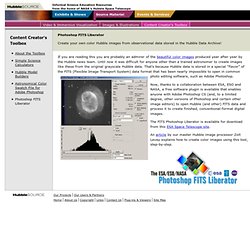
Until now it was difficult for anyone other than a trained astronomer to create images like these from the original grayscale Hubble data. That’s because Hubble data is stored in a special “flavor” of the FITS (Flexible Image Transport System) data format that has been nearly impossible to open in common photo editing software, such as Adobe Photoshop. Now, thanks to a collaboration between ESA, ESO and NASA, a free software plugin is available that enables anyone with Adobe Photoshop CS (and, to a limited degree, other versions of Photoshop and certain other image editors) to open Hubble (and other) FITS data and process it to create finished, conventional-format digital images. The FITS Photoshop Liberator is available for download from this ESA Space Telescope site.