
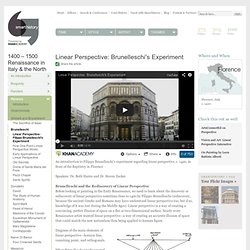
Discovery of Linear Perspective. Linear Perspective: Filippo Brunelleschi's Experiment. An introduction to Filippo Brunelleschi's experiment regarding linear perspective, c. 1420, in front of the Baptistry in Florence Speakers: Dr.
Beth Harris and Dr. Early Applications of Linear Perspective. Representing the Body What renaissance artists had clearly achieved through the careful observation of nature, including studies of anatomical dissections, was the means to recreate the 3-dimensional physical reality of the human form on 2-dimensional surfaces.

In part, the key to this achievement lay in understanding the underlying, hidden structure of the human body which then enabled the artist to produce realistic representations of what he saw on the flat surface of a wall (in the case of frescoes) or on a wooden panel or paper (in the case of drawings). Artists in the early 15th century had learned to portray the human form with faithful accuracy through careful observation and anatomical dissection, and in 1420 Brunelleschi's experiment provided a correspondingly accurate representation of physical space.
Antonio Manetti, Brunelleschi's biographer, writing a century later, describes the experiment based on careful mathematical calculation. Text by Dr.