
Pro-Choice Poetry Slam. Study Says Most Women Don't Regret Abortion. Why do I need to register or sign in for WebMD to save?
We will provide you with a dropdown of all your saved articles when you are registered and signed in. WebMD Health News Aug. 22, 2000 -- The impact of an abortion on a woman's mental health has been questioned for years. Some studies have suggested that many women suffer depression, regret and even a form of post-traumatic stress disorder called 'post-abortion syndrome.' But a study out this month finds that 80% of women were not depressed after having an abortion.
The study's authors say the results agree with previous studies -- including one by former Surgeon General C. Continue reading below... "Most women were satisfied with their decision, believed they had benefited more than had been harmed by their abortion, and would have the abortion again," writes study author Brenda Major, PhD. For the study, published in the August issue of Archives of General Psychiatry, Major and colleagues interviewed 882 women undergoing abortion.
25 Years. Facts on Induced Abortion in the United States. July 2014 • Half of pregnancies among American women are unintended, and four in 10 of these are terminated by abortion.[1] •Twenty-one percent of all pregnancies (excluding miscarriages) end in abortion.[2] • In 2011, 1.06 million abortions were performed, down 13% from 1.21 million in 2008.
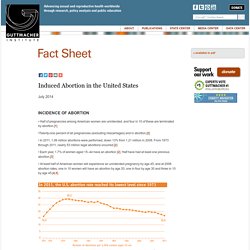
From 1973 through 2011, nearly 53 million legal abortions occurred.[2] • Each year, 1.7% of women aged 15–44 have an abortion [2] . • At least half of American women will experience an unintended pregnancy by age 45, and at 2008 abortion rates, one in 10 women will have an abortion by age 20, one in four by age 30 and three in 10 by age 45.[4,5] • Eighteen percent of U.S. women obtaining abortions are teenagers; those aged 15–17 obtain 6% of all abortions, 18–19-year-olds obtain 11%, and teens younger than 15 obtain 0.4%.[3]
Why I do Abortions. I grew up in a small town, the son of small town teachers.

We were Methodists but we went to whichever of the two churches (they alternated services) was open on a particular day for worship, Sunday School, MYF, BTU, prayer meeting or revival; the Baptist or the Methodist, it didn't matter...we were there! My father was the Sunday School superintendent (at the Methodist church) and my mother played the piano at both churches. Obviously we were well churched. We were also poor as church mice since my parents had five children on a very limited income. I had no concept that I would ever be able to go to medical school when I was young, and when we started in 1964, I had no idea how we were going to be able to finish.
By 1967 I was a third year medical student, still with no visible means of support, and we were pregnant with our third child. "Oh God, doctor," she said quietly, "I was hoping it was cancer. " Christians Have as Many Abortions as Everyone Else, Catholics Have More. San Francisco, Calif.

(PRWEB) March 12, 2006 With over one million abortions being performed in the US each year, this issue has dominated the political landscape. In recent years the rhetoric has escalated, with the pro-life movement becoming a flagship for Christian morality and ethics. The prevailing Christian doctrine--that abortion is murder--has polarized the issue, firmly placing the vast majority of Christians on the pro-life side of the debate.
Incendiary comments by some of the more outspoken Christian figureheads have sought to portray abortion as an “evil” perpetrated by the non-Christian left. The study, available as a downloadable report, reveals that Christians have just as many abortions as non-Christians. All data sources used in the study are publicly available, and are referenced in the report. God forbid you ever had to walk a mile in her shoes ‘Cuz then you really might know what it’s like to have to choose. THE PRO-CHOICE ACTION NETWORK. When the Anti-Choice Choose By Joyce Arthur (copyright © September 2000) ** A supporter has translated this article into Belorussian: click here to read the translation** Abortion is a highly personal decision that many women are sure they'll never have to think about until they're suddenly faced with an unexpected pregnancy.

But this can happen to anyone, including women who are strongly anti-choice. So what does an anti-choice woman do when she experiences an unwanted pregnancy herself? In the spring of 2000, I collected the following anecdotes directly from abortion doctors and other clinic staff in North America, Australia, and Europe. "I have done several abortions on women who have regularly picketed my clinics, including a 16 year old schoolgirl who came back to picket the day after her abortion, about three years ago.
"We too have seen our share of anti-choice women, ones the counselors usually grit their teeth over. "In 1973, after Roe v. Legal or Not, Abortion Rates Compare. Abortion is Pro Life. Celebrating the right to choose. The One Minute Case For Abortion Rights. What is abortion?

Abortion is the termination of a pregnancy by the induced removal of the fetus which results in the death of the fetus. There are two issues raised in abortion debates: Does a fetus have a right to be in a woman’s body against her will? Does the government have the right to restrict reproductive rights to pursue social objectives? Anti-abortionists confuse the potential with the actual A human being is a physically distinct being who survives by the use of reason. There is no right to be a parasite Rights derive from the fact that human beings need freedom from the coercion of others in order to live. A fetus is not an independent entity – in order to live, it must drain the resources of the mother – it is literally a parasite until it is born. Humans own their own body The most fundamental of rights is the right to one’s own life, which means the right to own one’s body.