
Glossary of linguistic terms. Context for this page: Modular book: Glossary of linguistic terms, by Eugene E.
Loos (general editor), Susan Anderson (editor), Dwight H., Day, Jr. (editor), Paul C. Jordan (editor), and J. Douglas Wingate (editor) In bookshelf: Linguistics. *** Why do People Have Accents? *** Variations occur in the way different individuals produce sounds because of the infinite variation of the shape and size of mouth, throat, tongue, teeth, and in the way each individual makes the sounds.

The term "accent" usually refers to the sound aspect of language. As We LearnEach individual is unique in the way they produce the complex combinations of sounds which make up words and word sequences. Simply put, by the word "accent" we simply mean the way an individual or community speaks. Everyone has an accent in their native form of speech. Our brain and nervous system master the motor skills and cognitive patterns for the language we first hear and learn around us.
The pattern first mastered to become competent in the mother tongue then affects how and individual would learn and master the speech requirements of a foreign language. ModelsNo one is born with the ability to speak a language, but we are all with the ability to learn any language. For more details, see: Also related: CLAUSES. The Subordinate Clause. Printer Fabulous!
Recognize a subordinate clause when you see one. A subordinate clause—also called a dependent clause—will begin with a subordinate conjunction or a relative pronoun and will contain both a subject and a verb. This combination of words will not form a complete sentence. It will instead make a reader want additional information to finish the thought. Relative clause. In many European languages, relative clauses are introduced by a special class of pronouns called relative pronouns;[1] such as who in the example just given.

In other languages, relative clauses may be marked in different ways: they may be introduced by a special class of conjunctions called relativizers; the main verb of the relative clause may appear in a special morphological variant; or a relative clause may be indicated by word order alone.[2] In some languages, more than one of these mechanisms may be possible. Types of relative clause[edit] Bound and free[edit] A bound relative clause, the type most often considered, qualifies an explicit element (usually a noun or noun phrase) appearing in the main clause, and refers back to that element by means of some explicit or implicit device within the relative clause. Restrictive and non-restrictive[edit]
Dependent clause. The different types of dependent clauses include noun clauses, relative (adjectival) clauses, and adverbial clauses.
Dependent words[edit] In Indo-European languages, a dependent clause usually begins with a dependent word. One kind of dependent word is a subordinating conjunction. Subordinating conjunctions are used to begin dependent clauses known as adverbial clauses, which serve as adverbs. In the following examples, the adverbial clauses are bold and the subordinating conjunctions are italicized: Wherever she goes, she leaves an item of luggage behind.
(The adverbial clause wherever she goes modifies the verb leaves.) MBA Lectures » Blog Archive » Clause and Its Types. The expression of a complete proposition by smallest grammatical unit is known as clause.

Basically, a clause contains both predicate and subject. There could be one or more than one clauses in the sentence. A sentence that consists of just one clause is known as a simple sentence. For example: I went New York. Time and dates. Contents of The Internet Grammar of English. Sentence and clause. Last changed 29 May 2003 Sentences and Clauses - introduction There are four types of sentence: A clause is a group of words which acts as a single unit and is built round a verb, for example: Compound and complex sentences contain two or more clauses: Simple: John is living in America.
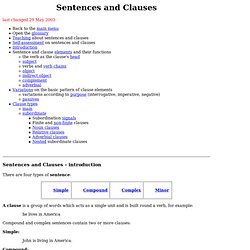
Compound: He lives in America, but his family is still in Wales. Complex: While his family is still in Wales, John’s staying with friends. Senttypes.pdf (application/pdf Object) English Grammar: Types of Phrases « LearningNerd. The Function Of Phrases. A phrase may function as a verb, noun, an adverb, or an adjective.
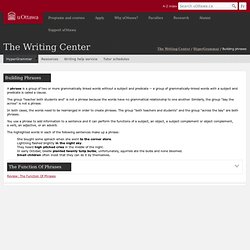
Verb Phrases A verb phrase consists of a verb, its direct and/or indirect objects, and any adverb, adverb phrases, or adverb clauses which happen to modify it. The predicate of a clause or sentence is always a verb phrase: Corinne is trying to decide whether she wants to go to medical school or to go to law school. He did not have all the ingredients the recipe called for; therefore, he decided to make something else. After she had learned to drive, Alice felt more independent. We will meet at the library at 3:30 p.m. Noun Phrases A noun phrase consists of a pronoun or noun with any associated modifiers, including adjectives, adjective phrases, adjective clauses, and other nouns in the possessive case. Nouns, Predicate Nominative.