
Seth Lloyd on Quantum Life. The Dark-Horse Lab That Just Might Figure Out Fusion. “Break-even” is the goal of all fusion researchers.
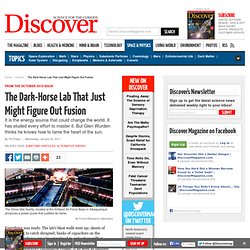
This is the point at which the amount of energy coming out of the fusion reactions equals the amount of energy needed to maintain the plasma. No fusion experiment has yet reached that point. College Students Are Less Empathic Than Generations Past: Scientific American Podcast. The rise of social media sites like Facebook, MySpace and Flikr, has been accompanied by fears that we are producing the most narcissistic “Generation Me” in history.
But is there any actual scientific evidence for that view? Well, a study of 14,000 college students found that today’s young people are 40 percent less empathetic than college kids from 30 years ago. The research was presented this weekend at the annual meeting of Association for Psychological Science. Researchers analyzed data from studies conducted between 1979 and 2009, and found the sharpest drop in empathy occurred in the last nine years. For instance, today’s students are less likely to agree with statements like, “I sometimes try to understand my friends better by imagining how things look from their perspective" and "I often have tender, concerned feelings for people less fortunate than me.
" The Top Ten Daily Consequences of Having Evolved. Free will similar in animals, humans - but not so free. 16 December 2010Last updated at 09:52 By Jason Palmer Science and technology reporter, BBC News A growing idea holds that the chances of our choices are written in our brains The free will that humans enjoy is similar to that exercised by animals as simple as flies, a scientist has said.

The idea may simply require "free will" to be redefined, but tests show that animal behaviour is neither completely constrained nor completely free. The paper, in Proceedings of the Royal Society B, suggests animals always have a range of options available to them. "Choices" actually fit a complex probability but, at least in humans, are perceived as conscious decisions. The idea tackles one of history's great philosophical debates, and Bjoern Brembs of the Berlin Free University brings the latest thinking from neurobiology to bear on the question.
"Even the simple animals are not the predictable automatons that they are often portrayed to be," Dr Brembs told BBC News. Continue reading the main story. Smart People Do More Drugs. Evolutionary psychologist Satoshi Kanazawa has this theory, which he calls the Savanna-IQ Interaction Hypothesis.
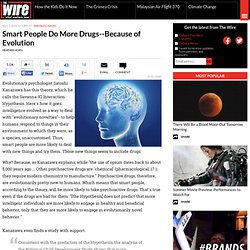
Here's how it goes: intelligence evolved as a way to deal with "evolutionary novelties"--to help humans respond to things in their environment to which they were, as a species, unaccustomed. Thus, smart people are more likely to deal with new things and try them. Those new things seem to include drugs. Feynman 'Fun to Imagine' 4: Magnets (and 'Why?' questions...) Group IQ. For a century, people have been devising tests that aim to capture a person’s mental abilities in a score, whether it is an IQ test or the SAT.

In just an hour or an afternoon, a slate of multiple choice questions or visual puzzles helps sift out the superstars — people whose critical thinking skills suggest they have potent intellectual abilities that could one day help solve real-world problems. But separating the spectacularly bright from the merely average may not be quite as important as everyone believes. A striking study led by an MIT Sloan School of Management professor shows that teams of people display a collective intelligence that has surprisingly little to do with the intelligence of the team’s individual members. Group intelligence, the researchers discovered, is not strongly tied to either the average intelligence of the members or the team’s smartest member. Strangers In A Strange Land : 13.7: Cosmos And Culture. Hide captionArtist impression of HMS Astute, a submarine built with advanced on-board life support systems.

Getty Images “No man is an island, complete unto itself.” 10 Strange Things About The Universe - Top 10 Lists. Space The universe can be a very strange place.
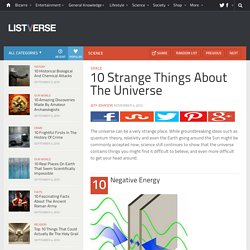
While groundbreaking ideas such as quantum theory, relativity and even the Earth going around the Sun might be commonly accepted now, science still continues to show that the universe contains things you might find it difficult to believe, and even more difficult to get your head around. Theoretically, the lowest temperature that can be achieved is absolute zero, exactly ? 273.15°C, where the motion of all particles stops completely.
However, you can never actually cool something to this temperature because, in quantum mechanics, every particle has a minimum energy, called “zero-point energy,” which you cannot get below. One of the properties of a negative-energy vacuum is that light actually travels faster in it than it does in a normal vacuum, something that may one day allow people to travel faster than the speed of light in a kind of negative-energy vacuum bubble. Dougal Dixon "Man after man. An anthropology of the future" Foreword by Brian Aldiss. It has become necessary to look into the future.
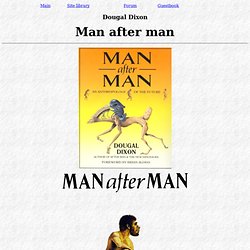
There must have been a time, long past, when animals much like apes looked up into the night sky and wondered about the stars: what those pinpoints of light were, and what they were for.