
Wordpress tutorial - mega. WordPress Comment Blacklist. How to Identify, Remove and Block Spam Comments in WordPress.
WordPress Support Forum - Josh Lobe - Documentation and Video Tutorials. Plugins. Why We Use Limit Login Attempts. Security is something that should be in the back of everyone’s mind.

This is why we always backup our WordPress. One of the very common attack that you can see is Brute Force attack. This basically means that a hacker keeps trying to guess your password until they get it right. Most of the times, they use a script for this. Limit Login Attempts allows us to track and limit the number of failed login attempts. Web fonts with @font-face. Home / CSS3 Previews / Web fonts with @font-face Not exactly a feature which is new to CSS3, @font-face was first proposed for CSS2 and has been implemented in Internet Explorer since version 5!
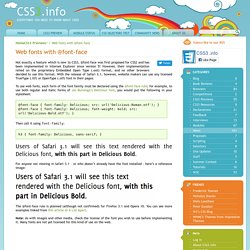
However, their implementation relied on the proprietary Embedded Open Type (.eot) format, and no other browsers decided to use this format. With the release of Safari 3.1, however, website makers can use any licensed TrueType (.ttf) or OpenType (.otf) font in their pages. To use web fonts, each form of the font family must be declared using the @font-face rule; for example, to use both regular and italic forms of Jos Buivenga’s Delicious font, you would put the following in your stylesheet: Then call it using font-family: Users of Safari 3.1 will see this text rendered with the Delicious font, with this part in Delicious Bold.
For anyone not viewing in Safari 3.1 – or who doesn’t already have the font installed – here’s a reference image: What is Zemanta Related Posts & Why You Need it on Your Site. Hot off the heels of our very exciting launch of our Content Discovery Network, we would like to follow up and go into even more detail as to what exactly the Zemanta Related Posts plugin is - and why you need it on your blog.

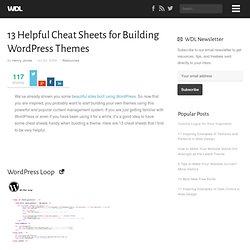
We have been in the business of delivering semantically matched related posts for over five years now, and with a network of over 300,000 publishers, there is no denying that many find our tools useful and beneficial to their site. 13 Helpful Cheat Sheets for Building WordPress Themes. 202 shares MP6: The Shape Of Things To Come For The WordPress Dashboard?
Let’s be honest, the WordPress dashboard is neither attractive to look at nor particularly conducive to efficient workflows. The design is reminiscent of web apps from the early years of the century and would benefit from some serious sprucing up. Because of WordPress’s power and flexibility, that lack of visual and UX pizazz hasn’t held… How to Properly Ask for WordPress Support and Get It. Diving into PHP: Video Series. How to Password Protect Your WordPress Admin (wp-admin) Directory. How to Create a Daily and Weekly Email Newsletter in WordPress. In the past we have written on what, why, and how-to’s of email newsletters.

With our redesign, we have gone ahead with advanced segmenting of our email newsletters. What To Do When You Are Locked Out of WordPress Admin (wp-admin) What is Long Tail Search and Why it Should Matter. PLEASE READ: I decided to give myself a fresh start.
Read more about that here. Long tail search, in essence, refers to search terms that contain 3 or more words. These search terms are very targeted, and are quickly becoming the norm when people are searching for information about whatever they’re looking for. If you aren’t taking advantage of long tail search in your marketing strategies, you are missing out on a key source of traffic – and, if you sell products or services – revenue. Long Tail Search = More (Quality) Traffic While many marketers tend to target very competitive key words, it can take a long time for your marketing efforts to pay off. How to Find a Backdoor in a Hacked WordPress Site and Fix It. Time and time again, we have helped users fix their hacked WordPress sites.

Most of the time when they reach out to us, they have already cleaned up the site, and the hacker was able to get back in. How to Track Links in WordPress using Google Analytics. Earlier, we wrote about how to install Google Analytics in WordPress, and we have received tons of questions from our users.

One of the most commonly asked question was how to track links in WordPress using Google Analytics? Well in this article, we will show you how to track links in WordPress using Google Analytics. Before we answer that question, lets first talk about why would you want to track links in Google Analytics? The general idea people have about Google Analytics is that it tells you how many vistors and pageviews you are getting, where the traffic is coming from, and what content is popular on your website.
All of that is correct. Tracking links in Google Analytics using UTM Source Google Analytics has this amazing feature called custom campaigns. Beginner's Guide to Pasting Snippets from the Web into WordPress. Time to time, we share tutorials on WPBeginner that involves users adding code snippets to their theme’s functions.php file.
While this process is fairly easy for those who know how PHP works, it seems a bit tedious for new users. Often beginners want to accomplish the final result of the tutorial, but they lack the PHP knowledge to understand how to properly paste the code without breaking the site. There is nothing wrong with that, and if you are reading this article because you broke your site doing that, then we want to assure you that you are not the only one. All of us started at that point, and we have all made this mistake. View topic - Remove border around pictures on posts.
WordPress Ping Optimizer - A Necessity For Your 2013 Ping List. Edit: This post is an older post from 2012, before WordPress was updated.
You no longer need a Ping Optimizer; WordPress automatically takes care of the over-pinging issues now. For an updated ping list for your WordPress blog, refer to THIS POST. WordPress is a GREAT service, don’t get me wrong, but if you do not know what you’re doing, you can be passively pissing off the Pinging Services, and might already be de-indexed from search engines! The issue is NOT with WordPress itself, the issue is with people like myself; I tend to make quite a few “edits” after publishing a post or page, and each time you edit a post that’s been published, WordPress will ping the Update Services each time!
Imagine You Being The Pinging Service and Someone Constantly Updating You That They’ve Edited a Post… Not a very fun picture, huh? WordPress Ping Optimizer. Do you know your WordPress blog pings unnecessarily every time you edit a post? Think how many times you click on “Save and Continue Editing” or “Save” button. Understand Keywords: Increase the Odds of Getting Found. How to Write the Perfect Blog Post.