
Harold Gregg
Living in China
CREATIVITY. CHINESE. Christmas tree. Young woman decorates the Christmas tree, painting by Marcel Rieder (1862-1942) from 1898 A Christmas tree is a decorated tree, usually an evergreen conifer such as spruce, pine, or fir associated with the celebration of Christmas.
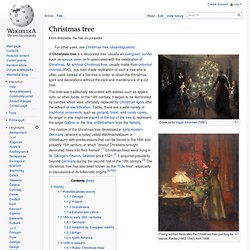
An artificial Christmas tree, usually made from polyvinyl chloride (PVC), is a man-made replication of such a tree and is often used instead of a live tree in order to retain the Christmas spirit and decorations without the care and maintenance of a cut tree. The tree was traditionally decorated with edibles such as apples, nuts, or other foods. In the 18th century, it began to be illuminated by candles which were ultimately replaced by Christmas lights after the advent of electrification. Today, there are a wide variety of traditional ornaments, such as garland, tinsel, and candy canes. History[edit] Possible predecessors[edit] Arc de Triomphe. The Arc de Triomphe de l'Étoile is one of the most famous monuments in Paris.

It stands in the centre of the Place Charles de Gaulle (originally named Place de l'Étoile), at the western end of the Champs-Élysées.[3] It should not be confused with a smaller arch, the Arc de Triomphe du Carrousel, which stands west of the Louvre. The Arc de Triomphe (in English: "Triumphal Arch") honours those who fought and died for France in the French Revolutionary and the Napoleonic Wars, with the names of all French victories and generals inscribed on its inner and outer surfaces.
Santa Claus. 1881 illustration by Thomas Nast who, with the poem "A Visit from St.
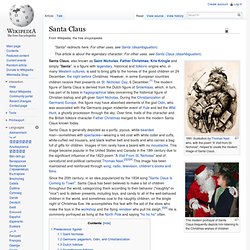
Nicholas", helped to create the modern image of Santa Claus. The modern portrayal of Santa Claus frequently depicts him listening to the Christmas wishes of children Santa Claus, also known as Saint Nicholas, Father Christmas, Kris Kringle and simply "Santa", is a figure with legendary, historical and folkloric origins who, in many Western cultures, is said to bring gifts to the homes of the good children on 24 December, the night before Christmas. However, in some European countries children receive their presents on St.
Nativity scene. An elaborate Neapolitan presepio Saint Francis of Assisi is credited with creating the first nativity scene in 1223 (a "living" one) intending thereby to cultivate the worship of Christ, having been inspired by his recent visit to the Holy Land where he had been shown Jesus's traditional birthplace.

The scene's popularity inspired communities throughout Catholic countries to stage similar pantomimes. Nativity scenes have not escaped controversy. In the United States, nativity scenes on public lands and in public buildings have provoked court challenges. Birth of Jesus[edit] German paper nativity scene, 1885. Menorah. Thanksgiving dinner. A traditional Thanksgiving dinner The centerpiece of contemporary Thanksgiving in the United States and Canada is a large meal, generally centered around a large roasted turkey.

The majority of the dishes in the traditional American version of Thanksgiving dinner are made from foods native to the New World, as according to tradition the Pilgrims received these foods from the Native Americans. However, many of the classic traditions attributed to the first Thanksgiving are actually myths later introduced.[1] [edit] Flag. A flag is a piece of fabric (most often rectangular) with a distinctive design that is used as a symbol, as a signaling device, or as decoration.[1] The term flag is also used to refer to the graphic design employed by a flag, or to its depiction in another medium.

The first flags were used to assist military co-ordination on battlefields, and flags have since evolved into a general tool for rudimentary signalling and identification, especially in environments where communication is similarly challenging (such as the maritime environment where semaphore is used). National flags are potent patriotic symbols with varied wide-ranging interpretations, often including strong military associations due to their original and ongoing military uses. Flags are also used in messaging, advertising, or for other decorative purposes. National emblem. In Africa[edit] In the Americas[edit] In Asia[edit] In Europe[edit]

Great Wall of China. The Great Wall of China is a series of fortifications made of stone, brick, tamped earth, wood, and other materials, generally built along an east-to-west line across the historical northern borders of China to protect the Chinese states and empires against the raids and invasions of the various nomadic groups of the Eurasian Steppe.
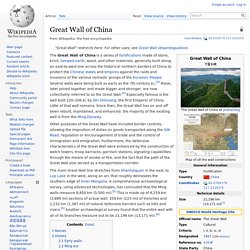
Several walls were being built as early as the 7th century BC;[3] these, later joined together and made bigger and stronger, are now collectively referred to as the Great Wall.[4] Especially famous is the wall built 220–206 BC by Qin Shihuang, the first Emperor of China. Little of that wall remains. Since then, the Great Wall has on and off been rebuilt, maintained, and enhanced; the majority of the existing wall is from the Ming Dynasty.
The main Great Wall line stretches from Shanhaiguan in the east, to Lop Lake in the west, along an arc that roughly delineates the southern edge of Inner Mongolia. Names History Early walls.
DAILY NEWS. COINS. EBAY. ECONOMY. PAPERTOTS.COM. My Jobs. Free Vector Graphics free download and share your vector. My Analytics - Summary. Home. 3D Building Collections by Google 3D Warehouse. SOCIAL MEDIA.