
Haotian He
A kangaroo.
University of Washington - Official. MyUW Welcome. International Student Services. Dept. of Linguistics - University of Washington. Seattle. Networks. Art. Restaurants. What to do/see in Seattle. Computational Linguistics. C Sharp (programming language) C♯ is intended to be a simple, modern, general-purpose, object-oriented programming language.[6] Its development team is led by Anders Hejlsberg.
The most recent version is C♯ 5.0, which was released on August 15, 2012. The ECMA standard lists these design goals for C#:[6] Due to technical limitations of display (standard fonts, browsers, etc.) and the fact that the sharp symbol (U+266F ♯ music sharp sign (HTML: ♯)) is not present on the standard keyboard, the number sign (U+0023 # number sign (HTML: #)) was chosen to represent the sharp symbol in the written name of the programming language.[8] This convention is reflected in the ECMA-334 C# Language Specification.[6] However, when it is practical to do so (for example, in advertising or in box art[9]), Microsoft uses the intended musical symbol. C# used to have a mascot called Andy (named after Anders Hejlsberg). It was retired on Jan 29, 2004.[25] C# has the following syntax: Free Developer Tools - Visual Studio 2010 Express. Microsoft Visual Studio. MonoDevelop - MonoDevelop. Python. Python Programming Language – Official Website.
The Python Standard Library — Python v2.7.1 documentation. While The Python Language Reference describes the exact syntax and semantics of the Python language, this library reference manual describes the standard library that is distributed with Python.
It also describes some of the optional components that are commonly included in Python distributions. Python’s standard library is very extensive, offering a wide range of facilities as indicated by the long table of contents listed below. CLMS. Quarter 1. Linguistics 566: Introduction to Syntax for Computational Linguistics. A core course in UW's Professional Master's in Computational Linguistics Autumn 2013 Course Info Instructor Info Instructor: Emily M.
BenderOffice Hours: (most) Fridays 12:30-2:00 & by appt. Links Syllabus Description This course covers fundamental concepts in syntactic analysis such as part of speech types, constituent structure, the syntax-semantics interface, and phenomena such as complementation, raising, control, passive and long-distance dependencies. Course goals By the end of this course students will be able to: Recognize certain classes of syntactic phenomena Build analyses of those phenomena in the HPSG framework Apply the process of building a formalized analysis to test linguistic hypotheses Note.
Obtaining LaTeX. LaTeX for the impatient Linux Your system distribution or vendor has probably provided a TeX system including LaTeX.
Syntactic Theory: 2nd edition. Emily M.

Bender University of Washington (ebender at u dot washington dot edu) Ivan A. Sag Stanford University (sag at csli dot stanford dot edu) Thomas Wasow Stanford University (wasow at csli dot stanford dot edu) (Back to top of page) To order or to find out more information about the second edition of the Syntactic Theory textbook, by Sag, Wasow and Bender, please go to its CSLI Publications webpage, which is HERE. HPSG Grammar. Stanford NLP class. Web Equation. Online LaTeX Editor. Regex Tester – RegexPal.
LaTeX < Main < TWiki. Qtree download directory. Ling 450/550 Linguistic Phonetics. Linguistics 450/550: Introduction to Linguistic Phonetics Winter, 2010 Syllabus Calendar click here, Moodle page for homework and quizzes click here, Back to the Catalyst page click here, This course is an introductory survey of phonetic theory and a introduction to fundamental aspects of phonological analysis.
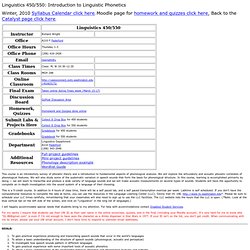
We will explore the articulatory and acoustic phonetic correlates of phonological features. We will also study some of the systematic variation in speech sounds that form the basis for phonological structure. In this course, learning is accomplished primarily by doing — we will learn to transcribe and produce a wide variety of language sounds and we will make acoustic measurements on several types of sounds. This is a 5-credit course. I will happily accommodate special needs that students bring to my attention. For my sanity I require that students use their UW ID as their user name in the online excercises, quizzes, and in the final (including your Moodle account). Transcriptions. Praat: doing Phonetics by Computer. The International Phonetic Alphabet - Audio Illustrations.
International Phonetic Alphabet (IPA) Chart Unicode “Keyboard” Phonetics: The Sounds of English and Spanish - The University of Iowa. IPA character picker 11. Ishida >> apps Character pickers are especially useful for people who don't know a script well, as characters are displayed in ways that aid identification.
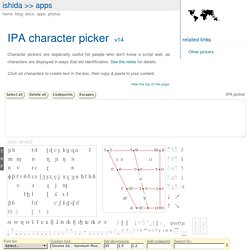
See the notes for details. Click on characters to create text in the box, then copy & paste to your content. Job Search - CompLing Database. Natural Language Processing (NLP) The CMU Pronouncing Dictionary. Query | phonemes | about | | Speech at CMU | Speech Tools Look up the pronunciation for a word or phrase in CMUdict (version 0.7b) Download the current CMU dictionary from SourceForge Find an error?
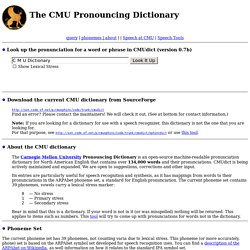
Please contact the maintainers! We will check it out. Note: If you are looking for a dictionary for use with a speech recognizer, this dictionary is not the one that you are looking for. About the CMU dictionary The Carnegie Mellon University Pronouncing Dictionary is an open-source machine-readable pronunciation dictionary for North American English that contains over 134,000 words and their pronunciations. Its entries are particularly useful for speech recognition and synthesis, as it has mappings from words to their pronunciations in the ARPAbet phoneme set, a standard for English pronunciation. Computational Linguistics Course Materials.