
Astronomers anticipate 100 billion Earth-like planets. Researchers at The University of Auckland have proposed a new method for finding Earth-like planets and they anticipate that the number will be in the order of 100 billion.
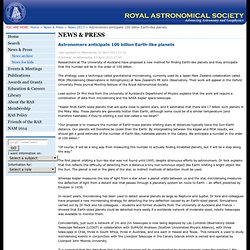
Mammoth found with flowing blood in Siberia. New discovery may allow scientists to make fuel from CO2 in the atmosphere. (Phys.org) —Excess carbon dioxide in the Earth's atmosphere created by the widespread burning of fossil fuels is the major driving force of global climate change, and researchers the world over are looking for new ways to generate power that leaves a smaller carbon footprint.
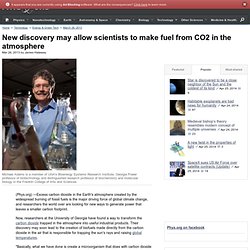
Now, researchers at the University of Georgia have found a way to transform the carbon dioxide trapped in the atmosphere into useful industrial products. Their discovery may soon lead to the creation of biofuels made directly from the carbon dioxide in the air that is responsible for trapping the sun's rays and raising global temperatures. During the process of photosynthesis, plants use sunlight to transform water and carbon dioxide into sugars that the plants use for energy, much like humans burn calories from food.
Cliodynamics. David MacKay: A reality check on renewables. Norman Lockyer. Biography[edit] Lockyer was born in Rugby, Warwickshire.

After a conventional schooling supplemented by travel in Switzerland and France, he worked for some years as a civil servant in the British War office. He settled in Wimbledon, South London after marrying Winifred James. A keen amateur astronomer with a particular interest in the Sun. In 1885 he became the world's first professor of astronomical physics at the Royal College of Science, South Kensington, now part of Imperial College.
Home - Mars One. A comet headed for Mars: The hits keep coming. Einstein's theory is proved - and it is bad news if you own a penthouse - Science - News. Miguel Nicolelis: A monkey that controls a robot with its thoughts. No, really. Lab mice can't help us in the fight against cancer - Comment - Voices. This particular gruesome research provides scientists with a direct view of the path of cancer cells as they move around the body.

In November 2012 the headlines read: “Tiny window in living mice shows cancer spread.” Eureka! Cern announces discovery of Higgs boson 'God particle' - Science - News. Click HERE to view graphic Discovering the so-called "Higgs boson" particle would be one of the greatest achievements in science, rivalling the discovery of the structure of DNA in 1953 and the Apollo Moon landings of the 1960s and 1970s.

It can explain why some particles have mass, but why others, such as photons of light, do not. The Naked Scientists Online, Science Podcast and Science Radio Show. Zooniverse - Real Science Online. Planet Hunters. 1071/large/ Plants they hear? Ceux qui, comme moi, aiment Franquin, ont probablement le souvenir de cette planche savoureuse où Gaston Lagaffe, pensant que les plantes sont sensibles à la musique et désireux d’accroître le bien-être d’un pied de lierre, veut lui jouer un petit air.
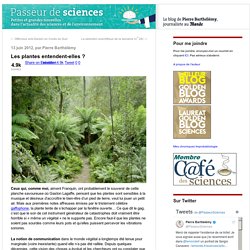
Mais aux premières notes affreuses émises par le tristement célèbre gaffophone, la plante tente de s’échapper par la fenêtre ouverte… Ce que dit le gag, c’est que le son de cet instrument générateur de catastrophes doit vraiment être horrible si « même un végétal » ne le supporte pas. Encore faut-il que les plantes ne soient pas sourdes comme leurs pots et qu’elles puissent percevoir les vibrations sonores. La notion de communication dans le monde végétal a longtemps été tenue pour marginale (voire inexistante) quand elle n’a pas été raillée. Dans une nouvelle étude publiée le 22 mai par PLoS ONE, une équipe italo-australienne a voulu explorer tous les modes de communication possibles entre deux plantes, le piment et le fenouil. Probing the secrets of the Antikythera Mechanism.
Alien_contact infrographics. Peak External Photocurrent Quantum Efficiency Exceeding 100% via MEG in a Quantum Dot Solar Cell. Amory Lovins: A 50-year plan for energy. Reinventing Fire. Digging up and burning the deposits of ancient sunlight stored eons ago in primeval swamps has transformed human existence and made industrial and urban civilization possible.

However, those roughly four cubic miles of fossil fuels every year are no longer the only, best, or even cheapest way to sustain and expand the global economy—whether or not we count fossil fuels’ hidden costs. Those “external” costs, paid not at the fuel pump or electric meter but in our taxes, wealth, and health, are not counted in the Reinventing Fire analysis, but are disturbingly large. Tens of billions of taxpayer dollars each year subsidize America’s fossil fuels, and even more flow to the systems that burn those fuels, distorting market choices by making the fuels look far cheaper than they really are.
But the biggest hidden costs are economic and military. Brian Greene: Why is our universe fine-tuned for life? Are You Smarter Than a 2nd Grader? Io9. Space and NASA News – Universe and Deep Space Information. Guédelon: a castle in the making. Asteroid Mining Venture Backed by Google Execs, James Cameron Unveiled. A newly unveiled company with some high-profile backers — including filmmaker James Cameron and Google co-founder Larry Page — has announced plans to mine near-Earth asteroids for resources such as precious metals and water.
Planetary Resources, Inc. intends to sell these materials, generating a healthy profit for itself. But it also aims to advance humanity's exploration and exploitation of space, with resource extraction serving as an anchor industry that helps our species spread throughout the solar system. WIKISKY.ORG. Profile on TED.com.