
A Raisin in the Sun. A Raisin in the Sun is a play by Lorraine Hansberry that debuted on Broadway in 1959.[1] The title comes from the poem "Harlem" (also known as "A Dream Deferred"[2]) by Langston Hughes. The story is based upon a black family's experiences in the Washington Park Subdivision of Chicago's Woodlawn neighborhood. Plot[edit] Walter and Ruth Younger and their son Travis, along with Walter's mother Lena (Mama) and sister Beneatha, live in poverty in a dilapidated two-bedroom apartment on Chicago's south side. Walter is barely making a living as a limousine driver. Though Ruth is content with their lot, Walter is not and desperately wishes to become wealthy, to which end he plans to invest in a liquor store in partnership with Willy, a street-smart acquaintance of Walter's whom we never meet.
Edgar Allan Poe. Born in Boston, he was the second child of two actors.
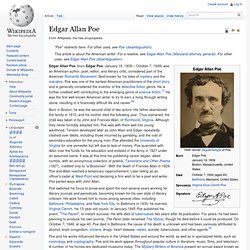
His father abandoned the family in 1810, and his mother died the following year. Thus orphaned, the child was taken in by John and Frances Allan, of Richmond, Virginia. Although they never formally adopted him, Poe was with them well into young adulthood. Tension developed later as John Allan and Edgar repeatedly clashed over debts, including those incurred by gambling, and the cost of secondary education for the young man. Poe attended the University of Virginia for one semester but left due to lack of money.
Poe switched his focus to prose and spent the next several years working for literary journals and periodicals, becoming known for his own style of literary criticism. Poe and his works influenced literature in the United States and around the world, as well as in specialized fields, such as cosmology and cryptography. Life and career Early life The Allan family had Poe baptized in the Episcopal Church in 1812. Military career. Poe Toaster. The Poe Toaster paid a stealthy visit to the cenotaph marking the site of Poe's original grave, in Baltimore, every January 19th for almost 80 years.
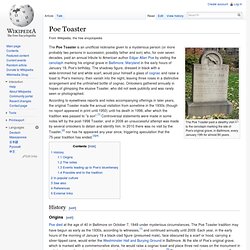
According to eyewitness reports and notes accompanying offerings in later years, the original Toaster made the annual visitation from sometime in the 1930s (though no report appeared in print until 1950) until his death in 1998, after which the tradition was passed to "a son".[1] Controversial statements were made in some notes left by the post-1998 Toaster, and in 2006 an unsuccessful attempt was made by several onlookers to detain and identify him. In 2010 there was no visit by the Toaster,[2] nor has he appeared any year since, triggering speculation that the 75-year tradition has ended.[3][4] History[edit] Origins[edit] A group of varying size composed of reporters and Poe enthusiasts observed the event each year. The notes[edit] Cognac and roses found at Poe's present-day (post-1875) grave on January 19, 2008, likely left by an imitator.
"All that we see or seem is but a dream within a dream." Edgar Allan Poe, short stories, tales, and poems. John Steinbeck. Early life[edit] Steinbeck graduated from Salinas High School in 1919 and went from there to study English Literature at Stanford University in Palo Alto, leaving, without a degree, in 1925.
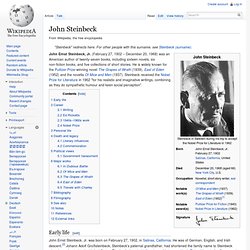
He traveled to New York City where he took odd jobs while trying to write. When he failed to have his work published, he returned to California and worked in 1928 as a tour guide and caretaker[7] in Lake Tahoe, where he met Carol Henning, his first wife.[3][7][8] The two were married in January 1930 in Los Angeles, where, with friends, he attempted to make money manufacturing plaster mannequins.[7] When their money ran out six months later, Steinbeck and Carol moved back to Pacific Grove, California, to a cottage owned by his father, on the Monterey Peninsula a few blocks from the border of the city of Monterey, California. The elder Steinbecks gave John free housing, paper for his manuscripts, and from 1928, loans that allowed him to write without looking for work.