
Web. Javascript. Jenkins. Education. Math. Selenium. Ontologies. Vert.x- Effortless asynchronous application development for the modern web and enterprise. Requirements. Ui design. Java. Java compiler front end. Cassandra. Sonar. Javaone. Vaadin. Ubuntu. Postgres. Virtualbox. Maven. How To Write A Dead-Simple Online Network Drive using Java & WebDAV. There are a variety of ways you can enhance your application with WebDAV access which we will be going into in a latter part of the WebDAV series.
For now we will show you how to create a basic online network drive using WebDAV via Milton, a Java WebDAV Server library. Example We will write the logic to create a network drive containing just one file, scratchpad.txt, which can be modified at will from any location where the drive is mounted. You may want to load the project into your IDE so that you can follow along.
Step 1: Create The Domain Object This is a simple POJO which will allow us to hold some text and attributes which will nicely represent a virtual scratchpad.txt file. Step 2: Create The Equivalent Resource Class As A Composition In this step, we have created a class with a “has-a” relationship with the original domain object. To keep the file-structure analogy going, we should have a root folder to contain our one file.
Source Analysis Diagram « Byte Source Code « Java Products. 280 Slides - Create & Share Presentations Online. Web Framework - Learn About Cappuccino and Objective-J. What is Cappuccino?

Cappuccino is an open source application framework for developing applications that look and feel like the desktop software users are familiar with. Cappuccino is built on top of standard web technologies like JavaScript, and it implements most of the familiar APIs from GNUstep and Apple’s Cocoa frameworks. When you program in Cappuccino, you don’t need to concern yourself with the complexities of traditional web technologies like HTML, CSS, or even the DOM.
The unpleasantries of building complex cross browser applications are abstracted away for you. Caucho Resin : Reliable, Open-Source Application Server. Fixing SSD Performance Degradation, Part 2: Page 3. For IOzone the system specifications are fairly important since they affect the command line options.
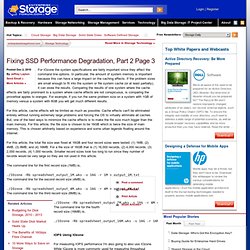
In particular, the amount of system memory is important because this can have a large impact on the caching effects. If the problem sizes are small enough to fit into the system or file system cache (or at least partially), it can skew the results. Comparing the results of one system where the cache effects are fairly prominent to a system where cache effects are not conspicuous, is comparing the proverbial apples to oranges. For example, if you run the same problem size on a system with 1GB of memory versus a system with 8GB you will get much different results.
For this article, cache effects will be limited as much as possible. For this article, the total file size was fixed at 16GB and four record sizes were tested: (1) 1MB, (2) 4MB, (3) 8MB, and (4) 16MB. The command line for the first record size (1MB) is, The Software Industry IS the Problem. Related Content Understanding DRM The explosive growth of the Internet and digital media has created both tremendous opportunities and new threats for content creators.
Advances in digital technology offer new ways of marketing, disseminating, interacting with, and monetizing creative works, giving rise to expanding markets that did not exist just a few years ago. At the same time, however, the technologies have created major challenges for copyright holders seeking to control the distribution of their works and protect against piracy.
Browse this Topic: Queue on Reddit Poul-Henning Kamp One score and seven years ago, Ken Thompson brought forth a new problem, conceived by thinking, and dedicated to the proposition that those who trusted computers were in deep trouble. I am, of course, talking about Thompson's Turing Award lecture, "Reflections on Trusting Trust. "2 Unless you remember this piece by heart, you might want to take a moment to read it if at all possible. Gödel, Escher, Bach. Dijkstra Demo. Algoritmo de dijkstra. Dl.dropbox.com/u/33127/35539144-pnp12pt.pdf. PS_cache/arxiv/pdf/1011/1011.3944v2.pdf. Flyway - The agile database migration framework for Java. Java Reference Guide. Last updated Mar 14, 2003.

Performance tuning your application code can be a difficult task because it requires that you obtain deep performance information about where your application code is spending its CPU cycles. Doing this within your application is nearly impossible, or at least cumbersome to maintain. For example, you could track your method response times by creating a PerformanceTuner class as follows: And then you could implement all of your methods as follows: public void run() { String token = PerformanceTuner.startMethod( "mypackage.MyClass.run()" ); // Do something PerformanceTuner.endMethod( tuner ); } Writing your code as such would write method response times to the standard output.
Another approach would be to use Aspect-Oriented Programming (AOP) to inject this type of behavior, which provides far more control, but has challenges of its own. Invoking HProf Manually HProf can be invoked with either of the following two command line options: WikiCode - WikiCode. Www.sonatype.com/people/wp-content/uploads/2011/10/20110922v1TLBgc_top_ten_ways_to_improve_open_source_management.pdf.
Www.cabinas.net/monografias/informatica/delitos_informaticos_ciberterrorismo.pdf. Cloud. Mercurial. Hibernate. Web frameworks. Utilitarios. Haskell.