
PostGIS : Home. PostGIS. Python Programming Language – Official Website. IPython: Python at your fingertips by Fernando Pérez, Min Ragan-Kelley, Brian E. Granger, Thomas Kluyver — Marc's PyCon 2012 Notes 1.0 documentation. Brief overview of IPython

A Guide to Python's Magic Methods « rafekettler.com. Rafe Kettler Copyright © 2012 Rafe Kettler Version 1.17 A PDF version of this guide can be obtained from my site or Github.
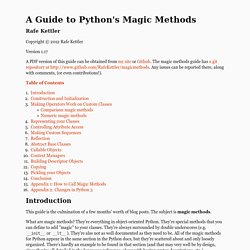
The magic methods guide has a git repository at Any issues can be reported there, along with comments, (or even contributions!). Python for Scientific Computing. Welcome to PyOpenCL’s documentation! — PyOpenCL 2012.2 documentation. PyOpenCL gives you easy, Pythonic access to the OpenCL parallel computation API.

PyOpenCL/Installation/Linux/Ubuntu - Andreas Klöckner's wiki. Ubuntu Maverick Meerkat (10.10) contains PyOpenCL packages for architectures amd64 and i386 in multiverse. Package is called python-pyopencl and depends on NVIDIA drivers. For Ubuntu Lucid Lynx (10.04 LTS) there is PPA with backported python-pyopencl packages: To be able to install PyOpenCL in Lucid Lynx you can: Add ppa:fajran/opencl to the Software Sources. The Intelligent Transport Layer - zeromq. Andrew Cooke: C[omp]ute. Andreas Klöckner's web page. SimPy: Simulating Systems in Python. By Klaus Müller and Tony Vignaux 02/27/2003 Simulating complex real-world systems is now possible with SimPy , an open source simulation package.
SimPy, originally developed by the authors of this article, has been developed to production quality by a small team of enthusiastic open sourcerers around the world. As far as we know, it is the only existing discrete event Python simulation package. PyDSTool. PyDSTool is a sophisticated & integrated simulation and analysis environment for dynamical systems models of physical systems (ODEs, DAEs, maps, and hybrid systems).
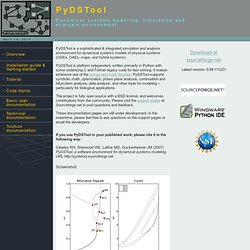
PyDSTool is platform independent, written primarily in Python with some underlying C and Fortran legacy code for fast solving. It makes extensive use of the numpy and scipy libraries. PyDSTool supports symbolic math, optimization, phase plane analysis, continuation and bifurcation analysis, data analysis, and other tools for modeling -- particularly for biological applications. The project is fully open source with a BSD license, and welcomes contributions from the community. Please visit the support pages at Sourceforge.net to post questions and feedback. Complex Networks. Planet SciPy. Python: module os. CodeSkulptor. Mmap – Memory Mapped Files in Python. This article introduces a technique for accessing files in an efficient way, that is used by experienced system engineers when doing development for embedded systems, heavy load network services and large-scale server applications.

By utilizing access methods to memory map files you will be able to implement applications that go easy with resources and result into custom high performance database solutions. Memory mapping of files is a service that is provided by the kernel of modern operating systems. For a closer look into the basics of kernel development you may take a look into the article Memory Mapping and DMA (Linux 2.6) that is part of the book Driver Development for Linux 2.6. Accessing text-based files or binary data via memory mapped files is a technique that allows you to access data in an extremely efficient way with highest data rates. Pyrex. Introduction to Network Management. Applicable to PySNMP 4.2.3 and later. As networks become more complex, in terms of device population, topology and distances, it has been getting more and more important for network administrators to have some easy and convenient way for controlling all pieces of the whole network.
Basic features of a network management system include device information retrieval and device remote control. Former often takes shape of gathering device operation statistics, while latter can be seen in device remote configuration facilities. The Web framework for perfectionists with deadlines. GeoDjango Tutorial. This section will show you how to import the world borders shapefile into the database via GeoDjango models using the LayerMapping data import utility.

There are many different ways to import data into a spatial database – besides the tools included within GeoDjango, you may also use the following: GDAL Interface Earlier, you used ogrinfo to examine the contents of the world borders shapefile. Insert reportlab chart into django template. Pygooglechart/examples at master · gak/pygooglechart. Flask (A Python Microframework) Nltk.googlecode.com/svn/trunk/doc/book/ch05.html. Back in elementary school you learnt the difference between nouns, verbs, adjectives, and adverbs.

These "word classes" are not just the idle invention of grammarians, but are useful categories for many language processing tasks. As we will see, they arise from simple analysis of the distribution of words in text. The goal of this chapter is to answer the following questions: Along the way, we'll cover some fundamental techniques in NLP, including sequence labeling, n-gram models, backoff, and evaluation. These techniques are useful in many areas, and tagging gives us a simple context in which to present them. Twitter sentiment analysis using Python and NLTK. This post describes the implementation of sentiment analysis of tweets using Python and the natural language toolkit NLTK.
The post also describes the internals of NLTK related to this implementation. Background The purpose of the implementation is to be able to automatically classify a tweet as a positive or negative tweet sentiment wise. The classifier needs to be trained and to do that, we need a list of manually classified tweets. Let’s start with 5 positive tweets and 5 negative tweets. Positive tweets: The Glowing Python. 0.8 Documentation. Code School - Try Git. Blockly - A visual programming editor.