
Focal Length and F-Stop Explanation. Lens Focal Length What is Focal Length, anyway?
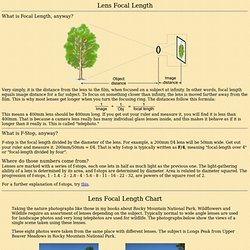
Very simply, it is the distance from the lens to the film, when focused on a subject at infinity. In other words, focal length equals image distance for a far subject. To focus on something closer than infinity, the lens is moved farther away from the film. This is why most lenses get longer when you turn the focusing ring. This means a 400mm lens should be 400mm long. What is F-Stop, anyway? F-stop is the focal length divided by the diameter of the lens. Where do those numbers come from? For a further explanation of f-stops, try this. Lens Focal Length Chart Taking the nature photographs like those in my books about Rocky Mountain National Park, Wildflowers and Wildlife require an assortment of lenses depending on the subject. "I want to take a bluebird picture. As you can see, even a relatively huge 600mm lens at the relatively close distance of 20 feet doesn't give the huge magnification you might expect.
Home © Copyright David Dahms. Focal Length Of Camera Lens. Lens is described by its focal length, which is the distance in millimeters (mm) between the lens and the image it forms on the sensor or film, when it is sharply focused at infinity (the farthest possible visual distance).

Focal length determines the angle of view or how much a lens sees which controls what portion of a scene will be captured. Focal length of a lens controls how wide or narrow its perspective is. A lens with a wide perspective will provide an expansive view while one with an intermediate perspective will offers you a normal view of a subject. A narrow, telephoto view might bring details of a subject in very close. Focal lengths are measured in millimeters. Some lenses have a field of view that is fixed at a particular focal length, such as 18mm, 50mm, 105mm, or 200mm.
The most common focal lengths can be grouped into general categories, with, of course, some overlap between adjacent groups. Ultra-Wide Angle Lenses: 10-15mm Wide Angle Lenses: 16-28mm Normal Lenses: 28-40mm. What Does Focal Length Mean? When parallel rays of light strike a lens focused at infinity, they converge to a point called the focal point.

The focal length of the lens is then defined as the distance from the middle of the lens to its focal point. The focal length of a lens is usually displayed on the lens barrel. Below is a picture of a Canon lens with a focal length of 50mm. The maximum aperture is f/1.8. Lenses are usually categorized as having a wide-angle, normal or telephoto focal length. Any lens with a focal length less than 50mm (or 55mm) can be considered as wide-angle; any lens with a focal length greater than 50mm (or 55mm) can be considered a telephoto. Focal Length and Aperture Explained for the Photography Novice :Digital Photography Tutorials. Focal Length The focal length of a lens determines its angle of view, and also how much the subject will be magnified for a given photographic position.
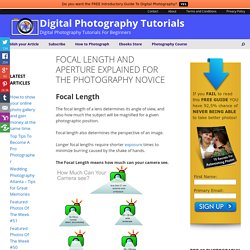
Focal length also determines the perspective of an image. Longer focal lengths require shorter exposure times to minimize burring caused by the shake of hands. The Focal Length means how much can your camera see. Aperture The aperture range of a lens refers to the amount of light that the diaphragm can let inside the camera to reach the sensor. Apertures are listed in terms of f-numbers (expresses the diameter of the entrance pupil in terms of the effective focal length of the lens; It is the quantitative measure of lens speed), which are marked on the lens. Lenses with larger apertures are faster because, for a given ISO speed, the shutter speed can be made faster for the same exposure.
Minimum apertures for lenses are almost as important as maximum apertures. To get the ebook, click here! Focal length and angle of view..in APS-C and 35mm format. Digital Photography 1 on 1: Episode 60: Angle of View: Adorama Photography TV.