
Improving Your Voice. Thanks for Registering! Social Media to Social Business. Rise of the networked enterprise: Web 2.0 finds its payday - McKinsey Quarterly - Organization - Strategic Organization. Every new technology has its skeptics.
In the 1980s, many observers doubted that the broad use of information technologies such as enterprise resource planning (ERP) to remake processes would pay off in productivity improvements—indeed, the economist Robert Solow famously remarked, “You can see the computer age everywhere but in the productivity statistics.” Today, that sentiment has gravitated to Web 2.0 technologies. Management is trying to understand if they are a passing fad or an enduring trend that will underwrite a new era of better corporate performance. Podcast The rise of the networked enterprise: Web 2.0 finds its payday McKinsey Global Institute senior fellow Michael Chui discusses how leaders can prepare for the new business environment as well as the latest results from McKinsey’s survey of global executives on their use of Web 2.0.
New McKinsey research shows that a payday could be arriving faster than expected. The findings Web 2.0 technologies are now more widely used. Republic wireless. Stop Designing Pages And Start Designing Flows - Smashing UX Design. Advertisement For designers, it’s easy to jump right into the design phase of a website before giving the user experience the consideration it deserves.

Too often, we prematurely turn our focus to page design and information architecture, when we should focus on the user flows that need to be supported by our designs. It’s time to make the user flows a bigger priority in our design process. Design flows that are tied to clear objectives allow us to create a positive user experience and a valuable one for the business we’re working for. In this article, we’ll show you how spending more time up front designing user flows leads to better results for both the user and business.
Start With The User When starting a new Web design project, we’re often handed a design brief, branding standards, high-level project goals, as well as feature and functionality requirements. Two examples of popular user flows for e-commerce and subscription websites. Map User Flows Into Conversion Funnels Display Media. Daniel W. Rasmus. The Attention Economy: An Overview. Written by Alex Iskold and edited by Richard MacManus It is no secret that we live in an information overload age.
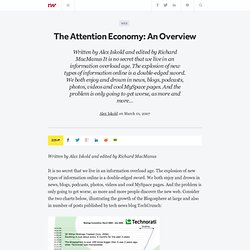
The explosion of new types of information online is a double-edged sword. We both enjoy and drown in news, blogs, podcasts, photos, videos and cool MySpace pages. And the problem is only going to get worse, as more and more people discover the new web. Consider the two charts below, illustrating the growth of the Blogosphere at large and also in number of posts published by tech news blog TechCrunch: Because of this information explosion, we no longer read - we skim. Economics of Attention Things get more interesting when we realize that our attention crisis is not only our problem. When information is abundant, the false positives are very costly - they are basically deal breakers. Attention Economy Concepts The basic ideas behind the Attention Economy are simple. It is important to realize that the key ingredient in the attention game is relevancy. AttentionTrust.