
Critical Thinking and Problem Solving. Using Moodle to Support the Inquiry Process - eClass4learning. Using Moodle to Support the Inquiry Process Inquiry based learning is a process to designed to help students investigate their own questions and convert information and data into knowledge.

The process has several phases including questioning, researching, discussing, creating, and reflecting. Inquiry-based learning is particularly well-suited for Moodle because Moodle was created to be a constructivist platform that has many tools to support inquiry based learning. Questioning Phase In the questioning phase you are helping students define the problem question. At this stage it is helpful to the students for you to provide background information through articles, audio recordings, videos, web sites, photos, art, etc. The Moodle Glossary is a good tool for learning about vocabulary related to your topic. The Research Phase In the Research Phase I recommend giving students some sources to help them find information. You might want to consider doing student inquiry blogs in Moodle. Student-centered Learning. Kathleen McClaskey interviewed Greg Wilborn about District 11, Colorado Springs in Colorado and their journey to personalize learning.

Q. Why personalize learning? Because we finally CAN! Education: Inquiry - Ontario Inquiry Model K-12. What is inquiry-based learning?

Inquiry is the process of formulating questions, exploring and evaluating information, analyzing and synthesizing data, organizing ideas, and communicating findings and conclusions. Inquiry-Based Learning: Is driven by questions of interest rather than general topics. Emphasizes asking good researchable questions. Coaches students as they go. In Ontario K-12 schools, research projects are organized around the four stages of discovery and guided inquiry as outlined on page 23 of the 2010 Ontario School Library Association document Together for Learning: School Libraries and the Emergence of the Learning Commons. What research model should I teach my students? Inquiry%20model. The Inquiry Approach to Learning - Early Learning.
1. systematic instruction in skills students need to learn2. investigative approach to USE these skills in another context.
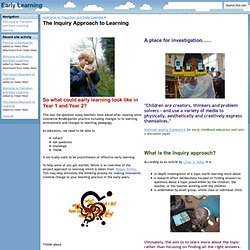
The inquiry approach really focuses on the HOW we learn/find out rather then just focusing on content. It is concerned with acquiring the skills of learning. The approach is centred around finding possible solutions to a problem. In other words, investigating a question posed. Often the teacher is the questioner. How do you know this? An adventure with the Inquiry approach in Year 1 Year 1 at Regents Park investigated life cycles by following the progress of chickens hatching in their classroom. This topic evolved from the HSIE/Science focus which was on investigating "Living Things" and lifecycles. The Year 1 teachers began this real world investigations approach by using EKWQ... Building question askers not question answerers. Trevor Bond, I’m working with CORE Education as a Blended e-Learning facilitator.

One of my passions which has been driving a lot of my learning and working with schools over the last 13 years is student questioning skills. We seem to have an education system that’s growing question answerers, instead of question askers. The research backs it up, there’s research that says that children prior to going into any form of schooling generate 50% of the questions in the home, at preschool they generate 10% of the questions, at high school they generate 0.08% of the questions in the classroom. Inquiry based learning. Question-skills.wikispaces. Inquiry-based Learning: Explanation. What are the benefits of inquiry-based learning?
One of the important missing pieces in many modern schools is a coherent and simplified process for increasing knowledge of a subject from lower grades to upper grades. Students often have difficulty understanding how various activities within a particular subject relate to each other. Much more confusion results when the learner tries to interrelate the various subjects taught at school. Too little effort is devoted to defining important outcomes at the end of high school and planning backwards and across subjects. 15 facts about Creativity - Think Jar Collective Post. TLCenter - Inquiry Learning.
Where Good Things Happen - Inquiry Learning - ICT Learning Experience. TWT: Inquiry-based Learning Strategy. What is Inquiry-based learning?
The old adage, “Tell me and I forget, show me and I remember, involve me and I understand” describes the core of inquiry-based learning. Inquiry is the process of seeking truth, information, or knowledge by questioning. Questioning! That is the key. The process of inquiring begins with gathering information and data through applying the human senses: seeing, hearing, touching, tasting, and smelling. How to: Inquiry. Will you ever just walk into class and ask, "Okay, what do you want to study today?
" Of course not. Inquiry-based learning is founded on students taking the lead in their own learning, but it still requires considerable planning on your part. Projects must fit into your larger program structure, goals and plans, but the students will be actively involved in planning the projects with you and asking the questions that launch their individual inquiries. The Importance of Planning It's impossible to project all the possible ways in which you can build inquiry into programs, projects and activities, but preparing for most projects involves three basic steps: Pre-planning: Before going to the kids, determine any preliminary factors or characteristics that must be true in order to achieve your larger goals or plans.
Ask questions such as "Where could you find resources to answer your questions? "