
Making realistic veins. Wirebundler is awesome, but I'm not sure if it would be good for veins...it basically creates a series of renderable splines at varying thicknesses and whatnot that follow specified targets.

If you set up your targets in the proper direction, you coudl get the wire bundles to follow the path the veins woudl take, but it doesn't handle the branching that veins would do. I woudl be interested in knowing how to make the veins as well...could prove useful to me. Well, with the new wirebundler, you can use pathdeform to use arbitrary meshes as wires, with options to taper those objects. So if you wanted, instead of renderable splines, you could use regular cylinders, and taper tham to get veins that get smaller as they travel along the targets. You could get the splines to split with carefully placed targets and multiple bundles, but no, the script won't help you automate that process much. L-system Generator - Free Misc Modeling Scripts. The first thing to understand is that a lsystem has its own orientation in 3D space, the symbols are explaned in the Lparser.txt file.
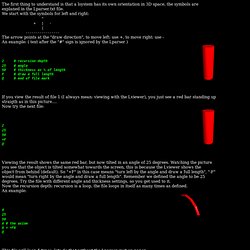
We start with the symbols for left and right: The arrow points at the "draw direction", to move left: use +, to move right: use - An example: ( text after the "#" sign is ignored by the Lparser ) 2 # recursion depth 25 # angle 50 # thickness as % of length F # draw a full length @ # end of file mark If you view the result of file 1 (I always mean: viewing with the Lviewer), you just see a red bar standing up straigth as in this picture.... Now try the next file: Viewing the result shows the same red bar, but now tilted in an angle of 25 degrees. You see that the object is tilted somewhat towards the screen, this is because the Lviewer shows the object from behind (default). C.J. van der Mark's Image Gallery. Index of /ailab/teaching/AL05/L-System/lsfiles/original.
Artificial Life 2003. Penrose tiling. A Penrose tiling A Penrose tiling is a non-periodic tiling generated by an aperiodic set of prototiles.

Penrose tilings are named after mathematician and physicist Roger Penrose who investigated these sets in the 1970s. The aperiodicity of the Penrose prototiles implies that a shifted copy of a Penrose tiling will never match the original. A Penrose tiling may be constructed so as to exhibit both reflection symmetry and fivefold rotational symmetry, as in the diagram at the right. A Penrose tiling has many remarkable properties, most notably: It is non-periodic, which means that it lacks any translational symmetry.It is self-similar, so the same patterns occur at larger and larger scales.
Various methods to construct Penrose tilings have been discovered, including matching rules, substitution tiling or subdivision rule, cut and project schemes and coverings. Background and history[edit] Periodic and aperiodic tilings[edit] Figure 1. Earliest aperiodic tilings[edit] Robinson's six prototiles. Pavage de Penrose - Wikipdia. Un article de Wikipédia, l'encyclopédie libre.
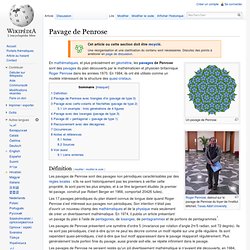
Un pavage de Penrose En mathématiques, et plus précisément en géométrie, les pavages de Penrose sont des pavages du plan découverts par le mathématicien et physicien britannique Roger Penrose dans les années 1970. En 1984, ils ont été utilisés comme un modèle intéressant de la structure des quasi-cristaux. Définition[modifier | modifier le code] Les pavages de Penrose présentent une symétrie d'ordre 5 (invariance par rotation d'angle 2π/5 radian, soit 72 degrés). Les pavages de Penrose ne seraient restés qu'un joli divertissement mathématique si n'avaient été découverts, en 1984, des matériaux présentant une structure fortement ordonnée comme celle des cristaux mais non périodique : les quasi-cristaux. Cette découverte illustra à nouveau ce que Roger Penrose lui-même avait déjà remarqué en 1973, à propos d’un sujet de relativité générale : « On ne sait jamais vraiment quand on perd son temps » [2].
CgTalk Maxscript Challenge 016: "L-Systems!"