
The Peter Principle (9781568491615): Laurence J. Peter. Peter Principle. An illustration visualizing the Peter principle The Peter Principle is a concept in management theory in which the selection of a candidate for a position is based on the candidate's performance in his or her current role rather than on abilities relevant to the intended role.

Thus, employees only stop being promoted once they can no longer perform effectively, and "managers rise to the level of their incompetence. " The principle is named after Laurence J. Peter who co-authored with Raymond Hull the humorous 1969 book The Peter Principle: Why Things Always Go Wrong. Overview[edit] Unskilled and Unaware of It: How Difficulties in Recognizing One's Own Incompetence Lead to Inflated Self-Assessments. Journal of Personality and Social Psychology Selected Article © 1999 by the American Psychological Association For personal use only--not for distribution December 1999 Vol. 77, No. 6, 1121-1134.
Dunning–Kruger effect. Cognitive bias about one's own skill The Dunning–Kruger effect is a hypothetical cognitive bias stating that people with low ability at a task overestimate their own ability, and that people with high ability at a task underestimate their own ability.
As described by social psychologists David Dunning and Justin Kruger, the bias results from an internal illusion in people of low ability and from an external misperception in people of high ability; that is, "the miscalibration of the incompetent stems from an error about the self, whereas the miscalibration of the highly competent stems from an error about others".[1] It is related to the cognitive bias of illusory superiority and comes from people's inability to recognize their lack of ability. Without the self-awareness of metacognition, people cannot objectively evaluate their level of competence.
Original study[edit] Later studies[edit] Mathematical critique[edit] Paired measures[edit] Research Enterprise. Why is innovation in innovation management so difficult?
One explanation that has been developing in my mind involves what I call the “bozonet”. A bozonet is a largely inexpert social network incapable of distinguishing expertise from non-expertise. A bozonet is unsure of the future as a consequence of lacking experience with which to anticipate that future. A bozonet represents itself as standard practice based on ubiquity of like seeming practice, and is ready to claim positions of authority and prestige though ill suited for them, using organized appearances and plausible deniability to shift attention from what doesn’t work. Ignorance Demotivator. Article 60- Beware of Skilled Incompetence. #60 from R&D Innovator Volume 2, Number 10 October 1993 Beware of Skilled Incompetence by Chris Argyris, Ph.D.
Dr. Argyris is James Bryant Conant Professor of Education and Organizational Behavior at the Harvard Graduate School of Business. He has published numerous books, including Overcoming Organizational Defensive Routines (Allyn-Bacon, Needham, MA, 1990) and Knowledge for Action, (Jossey-Bass, San Francisco, CA, 1993). Is a manager who always gets along with others an asset to the company? Vogon. The Vogons are a fictional alien race from the planet Vogsphere in The Hitchhiker's Guide to the Galaxy—initially a BBC Radio series by Douglas Adams—who are responsible for the destruction of the Earth, in order to facilitate an intergalactic highway construction project.

Vogons are slug-like but vaguely humanoid, are bulkier than humans, and have green skin. Strictly Ballroom. Strictly Ballroom is a 1992 Australian romantic comedy film directed and co-written by Baz Luhrmann and produced by M&A Productions, Miramax, and Touchstone Pictures (for the direct-to-video release in North America).
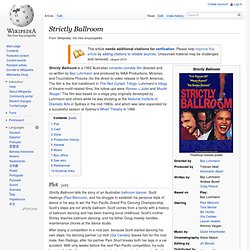
The film is the first installment in The Red Curtain Trilogy, Luhrmann's trilogy of theatre-motif-related films; the follow-ups were Romeo + Juliet and Moulin Rouge!. The film was based on a stage play originally developed by Luhrmann and others while he was studying at the National Institute of Dramatic Arts in Sydney in the mid-1980s, and which was later expanded for a successful season at Sydney's Wharf Theatre in 1988. Plot[edit] Strictly Ballroom tells the story of an Australian ballroom dancer, Scott Hastings (Paul Mercurio), and his struggle to establish his personal style of dance in his way to win the Pan-Pacific Grand Prix Dancing Championship. She's a witch! Predictably Irrational: The Hidden Forces That Shape Our Decisions (9780061353239): Dan Ariely. Fooled by Randomness: The Hidden Role of Chance in the Markets and in Life (9781587990717): Nassim Nicholas Taleb.
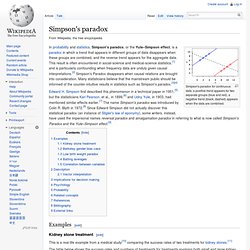
Simpson's paradox. Simpson's paradox for continuous data: a positive trend appears for two separate groups (blue and red), a negative trend (black, dashed) appears when the data are combined.
Outliers: The Story of Success (9780316017923): Malcolm Gladwell. AbileneParadoxJerryHarvey.pdf (application/pdf Object) Send in the Clowns. Meaning of title[edit] The "clowns" in the title do not refer to circus clowns.
Instead, they symbolize fools, as Sondheim explained in a 1990 interview: Stealers Wheel Lyrics, Stuck in the Middle With You Lyrics. Austin Lounge Lizards - "The most laughable band in show business" Frankfurt, H.G.: On Bullshit. One of the most salient features of our culture is that there is so much bullshit.
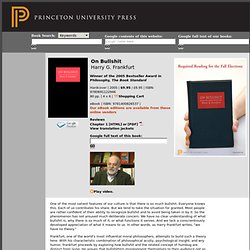
Everyone knows this. Each of us contributes his share. But we tend to take the situation for granted. Most people are rather confident of their ability to recognize bullshit and to avoid being taken in by it. So the phenomenon has not aroused much deliberate concern. Frankfurt, one of the world's most influential moral philosophers, attempts to build such a theory here.
Rather, bullshitters seek to convey a certain impression of themselves without being concerned about whether anything at all is true. Review: "[Frankfurt] tries, with the help of Wittgenstein, Pound, St. The Management Myth: Why the Experts Keep Getting it Wrong (9780393065534): Matthew Stewart. I'm Not Anti-Business, I'm Anti-Idiot [Dilbert] (9780836251821): Scott Adams. Incompetence Demotivator. How The Mighty Fall: And Why Some Companies Never Give In (9780977326419): Jim Collins. The Five Dysfunctions of a Team, Manga Edition: An Illustrated Leadership Fable (9780470823385): Patrick M. Lencioni, Kensuke Okabayashi. Seattle. Meetings, Bloody Meetings: DVD & CD-ROM. Meetings Demotivator. Why Most Published Research Findings Are False. Watts Up With That? Climate Audit. Climategate Document Database : Alleged CRU Email. Aliens Cause Global Warming: A Caltech Lecture by Michael Crichton. "As far as we know, Michael Crichton, author of Jurassic Park, is an evolutionist, however many of his crticisms of mainstream science and it's political, bullying nature are the same ones we've tried to make on these pages...webmaster Caltech Michelin Lecture January 17, 2003 My topic today sounds humorous but unfortunately I am serious.
I am going to argue that extraterrestrials lie behind global warming. State of Fear (9780066214139): Michael Crichton. All the Junk That's Fit to Debunk.