
Raspberry Pi Foundation. _ABB2010_Juhong. Siphonophore – Physical Computing + Architecture. It’s been a while since my last post.

I have been involved with a lot of projects lately so I didn’t have enough time to update my blog. There will be more interesting stuff in the future, like shading optimizations and populating facades with openings, but first I am going to post a last years project that I really enjoyed. Siphonophore is an interactive installation designed as a method and alternative perspective on spatial properties. the project was developed along with my dear friends and colleagues Ermis Adamantidis and Madhav Kidao and has gained recognition through nominations and exhibitions across Europe. The project is a collaboration of Design through Making, Physical Computing (Arduino), Artificial Intelligence ( Processing, ANN) and biomimisis as an inspirational force.
PetToyRobot과 함께 청소를. Simple Arduino Robot: Light Seeker. Many times I have Googled for "Arduino Robot" in hopes of finding a robot to build.

Solid Wood Digital Clock. How To Smell Pollutants. This Instructable explains how to use a gas sensor with your Arduino.

This lets your Arduino smell (and hence you program responses to) overall gas levels for a variety of nasties, including ethanol, methane, formaldehyde, and a bunch of other volatile organic compounds. My cost to make this actual device was under $100, including the full Arduino kit. Here's a video: . Arduino motor/stepper/servo control - How to use. Motor/Stepper/Servo Shield for Arduino kit [v1.0] ID: 81 - $19.50. Blog. Arduino Candygrabber. I've seen a lot of ways to communicate to arduino over the net, but none of them could handle pushing back the messages from arduino to the client(you) in real time and vice versa.

In this instructable you will learn how to connect to your arduino and control it over the net, set up a video stream, and how to control stuff with your arduino all in realtime. I'll try to show you on a concrete example how this could be done, but the code I used and wrote is going to be generic so you can use it for your projects. Note that I haven't discovered anything new but rather used code that I found lying around the net, built from it and changed it fit my needs. Using Grasshopper to Control a Pan/Tilt Servo - LIFT architects - Home. The above is a follow up video to the posting I made last week showing how we can use a Wii nunchuck to control parametric data in Grasshopper.

However, in this video, we are looking at reversing the flow of information and using parametric data (numeric sliders in Grasshopper) to control two different servos. In this case, one slider controls the panning servo, while the other controls the tilting servo. In this demo, we need to set up two different files. The first is the Grasshopper definition (written for ver. 0.6.0019) which sends the numeric slider information over the serial port via a custom VB.NET component. Arduino Daily. 아트로봇 - 아두이노 손바닥컴퓨터 로봇 만들기샵. Arduino+Metaball « SoftRigid. M6: EXPERIMENT: DIY EL SCREEN : MAS CAAD ETHZ 2010-2011 · ITA(Institute of Technology in Architecture), Faculty of Architecture ETH Zurich. Posted by mascaad2010 on Sunday, April 24, 2011 · Leave a Comment This first experiment aimed to understand how do an Electroluminescent display works.

Electroluminescence is a direct conversion of electric energy to light, and it happens when a solid phosphor is subjected to an strong alternating electric field, typically 90VAC @ 500Hz. This is how it works: - The copper precipitates to form nanocrystals of copper sulfide. These enhance the strength of the electric field in the phosphor. - The zinc sulfide and silver form a semiconductor matrix. - When a positive field is applied, holes enter the matrix; when a negative field is applied, electrons enter the matrix. - Light is produced when electrons and holes recombine on a silver atom in the matrix.
There are four basic components inside an Electroluminescent display: 1. KUKA youBot Store. . 미디어. IOIO Lets You Control Your Electronics Project From Your Android Phone. Blog Binturong: Binturong Physics + gHowl + lazyCutter - Test of Concept. iDatoBato Laboratories. Adidas Megalizer by @didierbyte and @SidLee - #Processing #Flash #Sound. Created by Didier Brun and Sid Lee for Adidas to help them promote the release of their sneaker collection MEGA, the team created a system that would allow dancers to create their own beat or music with their shoes.

Although somewhat similar to Nike project by W+K and rhizomatiks, the Sid Lee team have seem to taken the concept a little further making a device like element allowing anyone to pick it up and have a play. The team also built an interactive installation in several Shops in France to allow others to play with the Megalizer. The system is wireless, placed on each shoe (no cable running on the dancer’s leg, or belt case), efficient at a 6-7 meter range from the speakers. It includes very low latency (max 30ms), handling up to 6 shoes simultaneously. There are two force sensors for each shoe (one for the heel and one for the toe), and a wireless transmitter per shoe to capture the pressure applied on each of the sensors. Related. PC-350: An Arduino Synthesiser using DS touch-screen. Contents Aim To create a device that takes a users input and based upon that input play sounds.

I want this 'synthesiser' to be simple to play, requiring little or no skill. Therefore, allowing the user to experiment with the sounds they are producing instantly as opposed to learning the technicalities of it first. Research Experimental Musical Instruments "The EMI project aims to create and experiment with more suitable instruments that will not be a boundary for the performers who do not have any traditional musical background. […] Nontraditional and computer based applications simulate the possibilities of creative freedom in music and enlarge this creative freedom into open form musical activities" - M.Koray Tahiroğlu, Experimental Musical Instruments The Experimental Musical Instrument project in summary uses the Arduino and pureData to create musical instruments.
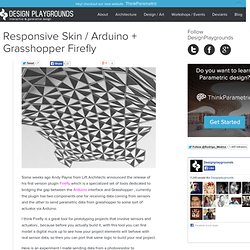
Google Translate. Archive » Responsive Skin / Arduino + Grasshopper Firefly. Some weeks ago Andy Payne from Lift Architects announced the release of his first version plugin Firefly which is a specialized set of tools dedicated to bridging the gap between the Arduino interface and Grasshopper , currently the plugin has two components one for receiving data coming from sensors and the other to send parametric data from grasshopper to some sort of actuator via Arduino.
Modkit Blog. Data Machines – Designing Associativity Seminar. For Designing Associativity Seminar MAA students had to fabricate a machine which responds to data collected from a source.

This is one of the projects for the seminar, developed by Julian Hildebrand and Ohad Meyuhas, that is controlled by Firefly (Grasshopper) through an Arduino board. Simulation of louver movement react to sun change. (watch a student video of the project in motion video-1 and video-2) More information about the work students are doing for the Design Associativity Seminar can be found on the seminar working blog: www.iaacblog.com/designingassociativity/ + t t o k y . c o m _____ by sey.min + Sunghun Kim. Soon_곧. 문지문화원 사이 Saii. Yannick Bontinckx: Blog - UHU-GLUE ADDICT.