
3 Steps to an Effective Social Media Strategy. Do you have a social media strategy for your business yet?
If you don’t, you could be missing out on game-changing results. According to the 2011 Social Media Marketing Industry Report, 78% of marketers saw increased traffic with just six hours a week invested in social media. The businesses that do social media marketing well will see even bigger wins in 2012, as the gap between who “gets it” and who doesn’t grows wider by the minute. The good news? You don’t need to be everything to everyone anymore. As Michael Stelzner predicted, “The old mantra of ‘be everywhere’ will quickly be replaced with ‘be where it matters to our business.’
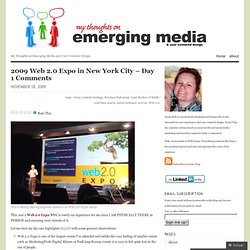
2009 Web 2.0 Expo in New York City – Day 1 Comments. Tim O'Railly during keynote address at Web 2.0 Expo 2009 This year’s Web 2.0 Expo NYC is surely an experience for me since I AM PHYSICALLY THERE in PERSON and enjoying every minute of it.
Let me start my day one highlights (11/17) with some general observations Web 2.0 Expo is one of the largest events I’ve attended and unlike the cozy feeling of smaller events such as MarketingProfs Digital Mixers or PodCamp Boston events it is easy to feel quite lost in the sea of people.Spotty wireless connectivity was a big issue for me during day one (hoping for a better day tomorrow)! I usually tweet a lot from my netbook. I could not since I cannot get online from any of the meeting rooms.
Comments/notes on three sessions I attended: w/ Kristina @Halvorson from Brain Traffic Krisina Halvorson's slide from the Content Strategy Presentation. The Elements of Editorial Strategy. Influence Toolkit. Over the past year, we’ve seen a shift in the way our clients are thinking about social media: namely, the conversations we are having today are less about WHY and more about HOW.
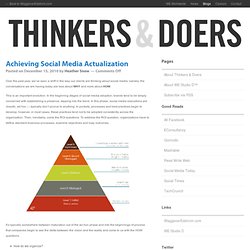
This is an important evolution. In the beginning stages of social media adoption, brands tend to be simply concerned with establishing a presence, tapping into the trend. In this phase, social media executions are chaotic, ad hoc — typically don’t accrue to anything. In pockets, processes and best practices begin to develop; however, in most cases, these practices tend not to be adopted consistently across the organization. Then, inevitably, come the ROI questions. It’s typically somewhere between maturation out of the ad-hoc phase and into the beginnings of process that companies begin to see the delta between the vision and the reality and come to us with the HOW questions.
Content - IGGY. IGGY will offer a wide range of interactive resources and content alongside challenges, debates and competitions.
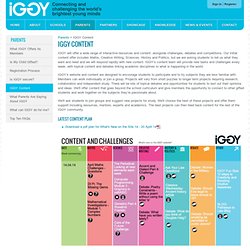
Our initial content offer includes Maths, Creative Writing, Sciences, History and Politics, but we are asking students to tell us what they want and need and we will respond rapidly with new content. IGGY’s content team will provide new tasks and challenges every week, with topical content and debates linking academic disciplines to what is happening in the world. 3 Types of Facebook Marketing Content Mistakes to Avoid. It’s been almost a year when I started to do social media marketing.

Back during the day, I thought my job would be mainly posting on a client’s Facebook page, filling it up with pictures and short by funny one-liners that would give the brand a voice. But while the posts I made on my client pages were short and sometimes flimsy, I realized that the process of creating content for social media use is also difficult; at times I even felt that they were more challenging to do as compared to writing blog posts.
And yes, despite dedicating time and effort to prep up for the content I am going to publish on my clients’ social media profiles, there were still instances in which I came up with bad content. The criteria for knowing the good from the bad are based mainly on four factors: Relevance of informationEngagementMarketing appealEye candy We already know that once we meet these criteria, we’re looking good on social media. . #1. Content is King: A Framework for Editorial Strategy. Marketers are all abuzz about content marketing.
Indeed, it seems to be the hottest marketing topic right now, and everyone is taking a serious look at how to evolve digital programs to align to a content-centric approach. In many aspects, this renewed focus on content is an extension of the social media marketing evolution, and the recognition that in order to succeed in a real-time, always-on social web, content – as it always has been for search – is king. Formulate Your Content Strategy in 10 Simple Steps. More and more, brands are recognizing that a strategic approach to content is becoming important.

Content is moving from being among the final considerations of a Web-development project to being front and center in a digital-marketing strategy. Engage via Conversation It's easy for brands to get drawn into the hype around the latest format, platform, or tactic. A couple of years ago, brands were all asking for a "viral," whereas now they all seem to be asking for iPhone apps. Content Marketing Templates.