
ISTinria sur Twitter : "Une chronologie de l'#openaccess #rediff #été... Open Access: A Chronology. Ross Mounce sur Twitter : "Folks, if you want people to actually read your research, make it #OpenAccess #OAAdvantage. The open access advantage considering citation, article usage and social media attention.
Cartes. Un Open Access sans licence libre a-t-il un sens ? Developments in OA monograph publishing. One of the bigger concerns expressed about the ARC open access policy is that it includes all publication outputs.
That means books and book chapters*. So what is happening out in monograph-land? As book sales plummet and traditional academic publishers struggle for survival, some organisations are looking at alternative models. This page is a summary of some of the new initiatives in this space. * Bear in mind that the ARC policy only applies to research that is funded from the 2013 round and into the future. What happens when you tweet an Open Access Paper. So a few weeks ago, I tweeted and posted about this paper Terras, M (2009) "Digital Curiosities: Resource Creation Via Amateur Digitisation".
Literary and Linguistic Computing, 25 (4) 425 - 438. Available in PDF. I thought it worth revisiting the results of this. Is it worth me digging out the full text, running the gamut with the UCL repository, and trying to spend the time putting my previous research online? Prior to me blogging and tweeting about the paper, it got downloaded twice (not by me). Open access: The true cost of science publishing. Michael Eisen doesn't hold back when invited to vent.
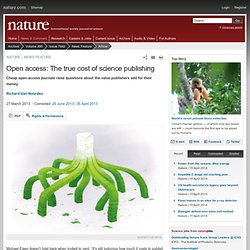
“It's still ludicrous how much it costs to publish research — let alone what we pay,” he declares. The biggest travesty, he says, is that the scientific community carries out peer review — a major part of scholarly publishing — for free, yet subscription-journal publishers charge billions of dollars per year, all told, for scientists to read the final product. “It's a ridiculous transaction,” he says. Eisen, a molecular biologist at the University of California, Berkeley, argues that scientists can get much better value by publishing in open-access journals, which make articles free for everyone to read and which recoup their costs by charging authors or funders. Among the best-known examples are journals published by the Public Library of Science (PLoS), which Eisen co-founded in 2000. The past few years have seen a change, however. The cost of publishing. [1302.1105] Open Access, library and publisher competition, and the evolution of general commerce. OpenEdition Books.
Ngress opens door to US open access. MYSCIENCENEWS. Il y a seulement un an, la page Wikipedia s'habillait de noir pour lutter contre la loi SOPA et PIPA.
Cette semaine, la communauté des défenseurs de l'accès libre à la connaissance est en deuil à l'annonce du suicide d'Aaron Swartz vendredi dernier. De nombreuses réactions ont émergé sur internet et les réseaux sociaux en faveur du mouvement open access. Les réseaux sociaux sont une caisse de résonance puissante et rapide contre des pouvoirs abusifs et cette démonstration se passe encore une fois devant nos yeux aujourd’hui.
Mais il est dommage que des extrêmes tels que le suicide d'une personne ou des mesures legislatives aberrantes soient nécessaires à déclencher une réaction à large échelle… La mort d'Aaron Swartz, le 11 janvier 2013, a généré depuis quelques jours une onde sismique se propageant sur internet et les réseaux sociaux. Depuis samedi dernier, de nombreuses personnes se sont exprimées sur internet et les réseaux sociaux pour déplorer la mort d'Aaron. Open Access Is Not for Scientists. It’s for Patients. Hello there!
If you enjoy the content on Speaking of Medicine, consider subscribing for future posts via email or RSS feed. Open, free access to academic research? This will be a seismic shift. Wikipedia's Jimmy Wales will be helping ensure that the publicly funded portal promotes collaboration and engagement.

Photograph: Peter Macdiarmid/Getty My department spends about £5bn each year funding academic research – and it is because we believe in the fundamental importance of this research that we have protected the science budget for the whole of this parliament. We fund this research because it furthers human knowledge and drives intellectual, social and economic progress. In line with our commitment to open information, tomorrow I will be announcing at the Publishers Association annual meeting that we will make publicly funded research accessible free of charge to readers.
Giving people the right to roam freely over publicly funded research will usher in a new era of academic discovery and collaboration, and will put the UK at the forefront of open research. Harvard: we have a problem. This is astonishing.
Harvard is one of the best and one of the wealthiest universities in the world but last week its Faculty Advisory Council* announced that it can no longer afford to maintain its subscriptions to academic journals. The announcement was made online by the Council as a message to the academic staff at the university. I have taken the liberty of quoting it in full below. 'Enriching' Open Access articles. I've been asked what the relevance is of my previous post to Open Access. The relevance of Utopia Documents to Open Access may not be immediately clear, but it is certainly there. Though Utopia Documents doesn't make articles open that aren't, it provides 'article-of-the-future-like' functionality for any PDFs, OA or not. It opens them up in terms of Web connectivity, as it were, and it is completely publisher-independent.
So PDFs in open repositories – even informal, author-manuscript ones – and from small OA publishers can have the same type of functionality that hitherto only larger publishers could afford to provide, and then only for HTML versions of articles. PDFs are often getting a bad press, as you probably know, yet according to statistics from many publishers, PDFs still represent by far the largest share of scientific article downloads. The new – wholly renewed – version (2.0) of the Utopia Documents scientific PDF-viewer has now been released.
The effects of open access mandates on institutional. SPARC Open Access Program and Speaker Slides. The impact of open access on research and scholarship. Reflections on the Berlin 9 Open Access Conference Heather Joseph + Author Affiliations The recent Berlin 9 Open Access Conference1 presented a striking reflection of the evolution of the scholarly community’s attitude towards open access.
No debate, no controversy—this meeting of high-level research funders, policy makers, university administrators, librarians, publishers, and scholars focused squarely on the impact that open access can have on each phase of the research process. Hosted by the Howard Hughes Medical Institute, and sponsored by a broad spectrum of organizations from the National Endowment for the Humanities to the Marine Biological Laboratory to SPARC, the meeting underscored the central role that open access now plays as part of the research infrastructure in the humanities and social sciences, as well as in the hard sciences.
This thematic evolution reached a new level at the U.S-based meeting. Berlin Open Access Conference 2012 - Home. It’s time to abolish academic publishers. The Guardian reported that publishers like Springer, Elsevier and others make 42% profits.
If you know anything about the business world, that’s amazing. And of course, commenters have been scandalized. In my view, there’s no crime in making a healthy profit by providing something that people willingly buy. The high profit margins do point at a profound problem with academic publishing: the reliance on an archaic business format. In previous centuries, journal publishers used to provide a vital service. Since academic journals were only bought by scholars and libraries, the system relied on a lot of volunteer labor. As the university system grew and became wealthier, publishers learned you could charge quite a bit for journals.
As long as we replied on paper, we needed to live with this situation. It’s called the Internet. This is not a fantasy. So the next time you see high journal prices, stop complaining. GAGA06: "RT @AmSciForum: The Open ..." « Deck.ly. David Lipman on Open Genomics. L’édition électronique de Marin Dacos et Pierre Mounier.
Aujourd’hui sort également aux éditions La découverte dans la collection , le livre de et de : . En voici un avant-goût : Avertissement « Un guide de voyage ressemble un peu à un instantané. À peine a-t-on imprimé le livre que la situation a déjà évolué. Les prix augmentent, les horaires changent, les bonnes adresses se déprécient et les mauvaises font faillite… » On connaît la mise en garde qu’un célèbre éditeur de guides de voyage adresse à ses lecteurs en tête de chacun des ouvrages qu’il publie. Les archives ouvertes : 10 ans après, où en est-on ? Welcome to OATAO (Open Archive Toulouse Archive Ouverte)