
Eisenhower Presidential Library and Museum. The Korean War. The Korean War: "Police Action," 1950-1953. Activity 1.

Public Opinion and the Korean War Finally, the fourth activity will address the war's unpopularity at home. Students will look at the results of public opinion polls taken in late 1952 and early 1953, excerpts from Eisenhower's famous "I will go to Korea" campaign speech, a letter sent to Truman from the father of a young man killed in the conflict, and a map illustrating how the war had resulted in stalemate by the end of 1951. All of these resources may be found on the sites of the Truman and Eisenhower libraries. Links, and abridged versions of these sources, are available on pages 21–24 of the Text Document. Korean War. On 25 June 1950, the young Cold War suddenly turned hot, bloody and expensive.

Within a few days, North Korea's invasion of South Korea brought about a United Nations' "police action" against the aggressors. That immediately produced heavy military and naval involvement by the United States. While there were no illusions that the task would be easy, nobody expected that this violent conflict would continue for more than three years. Throughout the summer of 1950, the U.S. and the other involved United Nations' states scrambled to contain North Korea's fast-moving army, assemble the forces necessary to defeat it and simultaneously begin to respond to what was seen as a global military challenge from the Communist world. Though America's Armed Forces had suffered from several years' of punishing fiscal constraints, the end of World War II just five years earlier had left a vast potential for recovery.
Additional Resources On-line Books - James A. Click photograph for a larger image. The Korean War And Its Origins, 1945-1953. May Correspondence Between Frederick Brown Harris and Harry S.
Truman, May 8, 1945 August Harry S. Truman to General William Donovan with Related Material, August 25, 1945 September Memo, Dean Acheson to Harry S. Online Bookshelves: Korean War. North Korean Attack Escalates Tensions in 60-Year Korean Conflict. President Truman Declares State of Emergency During Korean War. The United States entered Korea in June 1950 following the invasion of South Korea by communist North Korea.

UN forces commanded by American Gen. Douglas MacArthur drove back North Korean forces and followed them into North Korea, but their advance prompted China to enter the conflict in October. By mid-December, Chinese forces had driven the UN forces back across the border into South Korea. As America’s position in Korea worsened, President Truman decided to declare a national emergency. US Enters the Korean Conflict. (Originally published in Social Education, the Journal of the National Council for the Social Studies).
Background While the end of World War II brought peace and prosperity to most Americans, it also created a heightened state of tension between the Soviet Union and the United States. Fearing that the Soviet Union intended to "export" communism to other nations, America centered its foreign policy on the "containment" of communism, both at home and abroad. Korean War (1950-1953) news, photos and video. 50th Anniversary of the War to Resist US - china.
KoreanChildren.org. The Center for the Study of the Korean War. Korean War Veterans Association: POW/MIA Program. Korean War. Land of the Morning Calm Canadians in Korea 1950 - 1953. KOREAN WAR PICTURES. A DMZ (de-militarized zone) exists between North and South Korea, depicted in this photograph.

In the foreground, we see three Republic of Korea soldiers standing guard at Panmunjom (in the DMZ). Photo by Globaljuggler, online courtesy Wikimedia Commons. License: CC BY-SA 3.0 By the time North and South Korea returned to the bargaining table, both sides (and their respective allies) had sustained many casualties and had spent huge amounts of money fighting to an impasse. Rare photographs from the U.S. American men from the 24th Infantry Regiment move up to the firing line on July 18, 1950.Trying to disrupt North Korea's supply lines, U.S.
What took place in Korea, however, was not forgotten by those who were there. Korean War Historical Images. Forgotten Heroes: Canada and the Korean War. Countdown to Victory: The Last...
Day by day, the news got better as the Second World War wound down in Europe. Sixty years ago, CBC Radio brought home re... Go Glenn Gould: Variations on an ... He adored Arrowroot cookies, Barbra Streisand and animals. Go Canada's Earthquakes and Tsuna... Beneath our feet, Canada is constantly atremble. Go. KoreanWar1950english.
KoreanWar1951english. North Korea International Documentation Project. Film No. 927 : National Archives. Korean War Educator: Home Page. The Korean War. Korean War — History.com Articles, Video, Pictures and Facts. Even so, the North Korean invasion came as an alarming surprise to American officials.
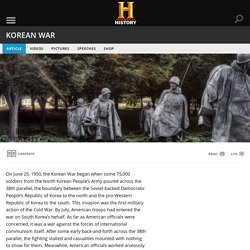
As far as they were concerned, this was not simply a border dispute between two unstable dictatorships on the other side of the globe. Instead, many feared it was the first step in a communist campaign to take over the world. For this reason, nonintervention was not considered an option by many top decision makers. (In fact, in April 1950, a National Security Council report known as NSC-68 had recommended that the United States use military force to “contain” communist expansionism anywhere it seemed to be occurring, “regardless of the intrinsic strategic or economic value of the lands in question.”) “If we let Korea down,” President Harry Truman (1884-1972) said, “the Soviet[s] will keep right on going and swallow up one [place] after another.” U.S. Army Center Of Military History - Korean War. Op-Ed Contributors - The Forgotten War, Remembered. Veterans History Project.