
CompTIA Security+ Certification Exam Glossary. Authentication, Authorization and Accounting.
Security architecture framework designed for: Verification of the identity of a person or process (Authentication)Granting or denying access to network resources (Authorization)Tracking the services users are accessing as well as the amount of network resources they are consuming (Accounting) Access Control List. A mechanism that implements access control for a system resource by enumerating the identities of the system entities that are permitted to access the resource. Advanced Encryption Standard.
Possible Test Question Info. Exam Domains. IT Governance - Governance, Risk Management and Compliance for Information Technology. FAQ: Firewall Forensics (What am I seeing?) This document is intended for both security-experts maintaining corporate firewalls as well as home users of personal firewalls.
Version 0.4.0, April 29, Copyright 1998-2000 by Robert Graham (firewall-seen@robertgraham.com. All rights reserved. This document may only be reproduced (whole or in part) for non-commercial purposes. All reproductions must contain this copyright notice and must not be altered, except by permission of the author. Special thanks to Alan J. 1. PORT GUIDE | source-ports | many-to-one | trojans | DNS | dial-up | IRC | remapping | still can't figure it out 2.
Professor Messer Security+ Course Overview - CompTIA Security+ SY0-301: 0.0. Expect Success With CompTIA Security+ CompTIA Security+ Certification! The CompTIA Security+ certification is an vendor-neutral Information Technology certification that demonstrates competency in: Network SecurityCompliance and operational securityThreat and vulnerabilitiesApplication, data and host securityAccess control and identity managementCyptography Why Should I obtain my CompTIA Security+ certification?
CompTIA Security+ certification proves your abilities to manage system security, network infrastructure, and organizational security.Computer security risks are continuing to increase in all fields and pursuing a CompTIA Security+ certification would almost ensure a job in security for years to come. User Attributes - Inside Active Directory. Lightweight Directory Access Protocol. The Lightweight Directory Access Protocol (LDAP; /ˈɛldæp/) is an open, vendor-neutral, industry standard application protocol for accessing and maintaining distributed directory information services over an Internet Protocol (IP) network.[1] Directory services play an important role in developing intranet and Internet applications by allowing the sharing of information about users, systems, networks, services, and applications throughout the network.[2] As examples, directory services may provide any organized set of records, often with a hierarchical structure, such as a corporate email directory.
Similarly, a telephone directory is a list of subscribers with an address and a phone number. LDAP is specified in a series of Internet Engineering Task Force (IETF) Standard Track publications called Request for Comments (RFCs), using the description language ASN.1. A common use of LDAP is to provide a central place to store usernames and passwords. History[edit] LDAP Attributes. Properties Active Directory Users Computers Distinguished name. This page explains the common LDAP attributes which are used in VBS scripts and PowerShell.
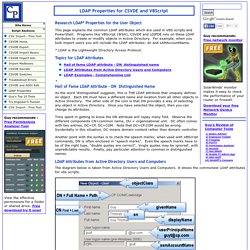
Programs like VBScript (WSH), CSVDE and LDIFDE rely on these LDAP attributes to create or modify objects in Active Directory. For example, when you bulk import users you will include the LDAP attributes: dn and sAMAccountName. * LDAP is the Lightweight Directory Access Protocol. Where Are We With Federated Identity? Topic Description By David S.
Linthicum, CEO, Linthicum Group, LLC , 06/05/2005 Print this article Email this article Talk Back! Write to Editor Since the advent of Web services, and other distributed computing standards for that matter, we’ve been wrestling with the notion of identity and how to manage it. With the increasing interest in identity management, so has risen the need for standards to better define this space. Who Are You? So, why do we need identity management? Identity is important in the growth of sensitive data and confidential relationships online. Today, we use managed identities, including different user names, passwords, and other identifying attributes.
The number of identities that we have creates a challenge. Federated identity, including supporting standards, such as those from OASIS and the Liberty Alliance project are defining mechanisms that organizations may employ to share identity information between domains. Intrusion Detection FAQ: What is behavior-based intrusion detection? Professor Messer's CompTIA SY0-401 Security+ Training Course.