
Is Islamic finance the answer? Investments worth £800bn are made through Islamic finance products.

Experts in Islamic finance believe their way of doing business has shielded them from the global credit crisis. But how does it differ from conventional Western finance? A former executive director of the International Monetary Fund, Dr Abbas Mirakhor, says wider Islamic economics relies on God's guidance, handed down almost 1,400 years ago. There is a "consciousness of a supreme creator and a system that he has provided", he says. What we know as the conventional Western way does not have that, which is "really the major difference between the two", he adds.
In practical terms, the most significant difference is that charging interest is not allowed in Islamic finance. Neither are most forms of speculative investment permitted, such as hedging or derivatives trading. "We don't recognise the concept of interest... to look for some profit from trading money," explains Dr Bambang Brodjonegoro from the Islamic Development Bank. Kondratiev wave. A rough schematic drawing showing growth cycles in the world economy over time according to the Kondratiev theory.
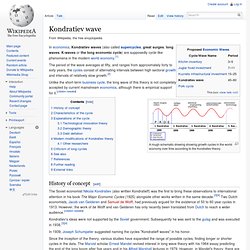
In economics, Kondratiev waves (also called supercycles, great surges, long waves, K-waves or the long economic cycle) are supposedly cycle-like phenomena in the modern world economy.[1] The period of the wave averages at fifty, and ranges from approximately forty to sixty years, the cycles consist of alternating intervals between high sectoral growth and intervals of relatively slow growth.[2] Unlike the short-term business cycle, the long wave of this theory is not completely accepted by current mainstream economics, although there is empirical support for it. [citation needed] History of concept[edit] Kondratiev's ideas were not supported by the Soviet government.
In 1939, Joseph Schumpeter suggested naming the cycles "Kondratieff waves" in his honor. Characteristics of the cycle[edit] Kondratiev identified three phases in the cycle: expansion, stagnation, recession. Mitch Daniels: US faces 'survival-level' economic threat. <img name="holdingImage" class="holding" src=" alt="Mitch Daniels" /><div class="warning"><p><strong>Please turn on JavaScript.

</strong> Media requires JavaScript to play. </p></p></div> Governor Mitch Daniels on why he believes the stimulus is not working Newsnight's Paul Mason meets Mitch Daniels, the Republican governor of Indiana who is tipped to challenge Barack Obama for the US presidency in 2012. "America faces for the first time, other than the nuclear threat of a few decades ago, a genuine survival level issue," Mitch Daniels says.
"My reading of history is that there are points of no return, past which nations will not recover to anything like their previous strength. " It is apocalyptic language, and since Mr Daniels is widely regarded as having a decent chance of becoming the next US president, all the more alarming. The threat the country is facing, according to Mr Daniels, is that of national bankruptcy. But towards what, I ask him, perennial decline? Scathing criticism.