
Grand supercycle. A Grand Supercycle is the longest period, or wave, in the growth of a financial market as described by the Elliott Wave Principle, originally discovered and formulated by Ralph Nelson Elliott.

Elliott speculated that a Grand Supercycle advance had started in the United States stock market in 1857 running to the year 1928.,[1] but acknowledged another interpretation that it may have been the third or even the fifth Grand Supercycle wave.[1] However, these assignments have been reevaluated and clarified using larger historical financial data sets in the works of A. J. Kuznets swing. Kuznets swing is a claimed medium-range economic wave with a period of 15–25 years found in 1930 by Simon Kuznets.[1] Kuznets connected these waves with demographic processes, in particular with immigrant inflows/outflows and the changes in construction intensity that they caused, that is why he denoted them as “demographic” or “building” cycles/swings.

Kuznets swings have been also interpreted as infrastructural investment cycles.[2] Economists now recognize the Kuznets swing as the 18 year land cycle. This cycle of boom and bust could be smoothed or avoided altogether by levying an annual tax on the value of land (Land Value Tax)"[3] [4] Jump up ^ Kuznets S. Secular Movements in Production and Prices. Kondratiev wave. A rough schematic drawing showing growth cycles in the world economy over time according to the Kondratiev theory.
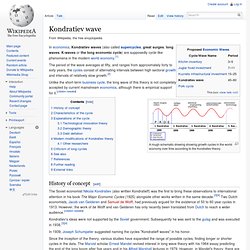
In economics, Kondratiev waves (also called supercycles, great surges, long waves, K-waves or the long economic cycle) are supposedly cycle-like phenomena in the modern world economy.[1] The period of the wave averages at fifty, and ranges from approximately forty to sixty years, the cycles consist of alternating intervals between high sectoral growth and intervals of relatively slow growth.[2] Unlike the short-term business cycle, the long wave of this theory is not completely accepted by current mainstream economics, although there is empirical support for it.