
The Inner Workings of Robots, Spiders, and Web Crawlers - WebReference.com. By Lee Underwood There are three basic types of search engines: crawler-based, human-powered, and a combination of both.

The human-powered search engines - directories - don't really search. They rely on input from other humans. A Web site URL is submitted manually to the directory, sometimes with a short summary of the site. It's reviewed (though not always) by a human and then indexed. The indexes of crawler-based search engines are fed data by computer programs called robots. According to The Web Robots FAQ, "A robot is a program that automatically traverses the Web's hypertext structure by retrieving a document, and recursively retrieving all documents that are referenced. " There are hundreds, if not thousands, of robots sweeping across the Internet 24/7/365. There are some robots that have a more sinister purpose. E-mail addresses, which are then used as targets for spam. Book - Spidering_Hacks. The Internet, with its profusion of information, has made us hungry for ever more, ever better data.
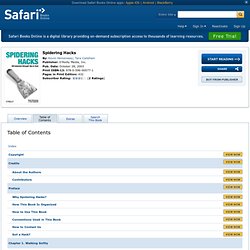
Out of necessity, many of us have become pretty adept with search engine queries, but there are times when even the most powerful search engines aren't enough. If you've ever wanted your data in a different form than it's presented, or wanted to collect data from several sites and see it side-by-side without the constraints of a browser, then Spidering Hacks is for you. Spidering Hacks takes you to the next level in Internet data retrieval--beyond search engines--by showing you how to create spiders and bots to retrieve information from your favorite sites and data sources.
You'll no longer feel constrained by the way host sites think you want to see their data presented--you'll learn how to scrape and repurpose raw data so you can view in a way that's meaningful to you. Spider trap. A spider trap (or crawler trap) is a set of web pages that may intentionally or unintentionally be used to cause a web crawler or search bot to make an infinite number of requests or cause a poorly constructed crawler to crash.

Web crawlers are also called web spiders, from which the name is derived. Spider traps may be created to "catch" spambots or other crawlers that waste a website's bandwidth. They may also be created unintentionally by calendars that use dynamic pages with links that continually point to the next day or year. Common techniques used are: There is no algorithm to detect all spider traps. Politeness[edit] A spider trap causes a web crawler to enter something like an infinite loop, which wastes the spider's resources, lowers its productivity, and, in the case of a poorly written crawler, can crash the program. Googlebot. Googlebot is the search bot software used by Google, which collects documents from the web to build a searchable index for the Google Search engine.

If a webmaster wishes to restrict the information on their site available to a Googlebot, or another well-behaved spider, they can do so with the appropriate directives in a robots.txt file,[1] or by adding the meta tag <meta name="Googlebot" content="nofollow" /> to the web page.[1] Googlebot requests to Web servers are identifiable by a user-agent string containing "Googlebot" and a host address containing "googlebot.com".[2] References[edit] External links[edit] Google's official Googlebot FAQ. Msnbot. Msnbot was a web-crawling robot (type of internet bot), deployed by Microsoft to collect documents from the web to build a searchable index for the MSN Search engine.

It went into beta in 2004, and had full public release in 2005. The month of October 2010 saw the official retirement of msnbot from most active web crawling duties and its replacement by bingbot.[1] As of March 2014 msnbot was still active from the Microsoft and the Bing webmaster help & howto documentation still indicated that msnbot was active (but that it would retire soon).[2] The verification tool for bingbot[3] does not recognise msnbot IP addresses.
Jump up ^ Steve Tullis, Bingbot, the Sequel Webmaster Center blog, Bing Community, September 29, 2010Jump up ^ "bing - Meet our crawlers", Microsoft, 21/Mar/2014Jump up ^ "Verify Bingbot", Microsoft, 21/Mar/2014. Web crawler. Not to be confused with offline reader.
For the search engine of the same name, see WebCrawler. Crawlers can validate hyperlinks and HTML code. They can also be used for web scraping (see also data-driven programming). Overview[edit] A Web crawler starts with a list of URLs to visit, called the seeds. The large volume implies that the crawler can only download a limited number of the Web pages within a given time, so it needs to prioritize its downloads. The number of possible URLs crawled being generated by server-side software has also made it difficult for web crawlers to avoid retrieving duplicate content. Crawling policy[edit]