
Diagnostic Geometry Assessment. Diagnostic Geometry Assessment The Diagnostic Geometry Assessment (DGA) project is a federally-funded research project.

The DGA aims to develop a formative assessment that middle-school teachers can use to identify the misconceptions and degrees of understanding that their students hold in geometry. The DGA will be an online assessment that can be administered from any Internet-connected computer, and that provides instant feedback to teachers. The DGA will enable teachers to identify underdeveloped reasoning in specific areas of geometry, while also providing information about why students struggle with concepts. Teachers can use this feedback, along with a package of instructional resource materials, to target instruction to each student's individual need.
Geometric Focus Areas The DGA project is based on findings from cognitive research related to student geometric conceptions. Realistic Mathematics Education; a solution to prevent the linearity illusion (Extended) « P4MRI Universitas Pendidikan Ganesha. Introduction Linearity illusion, a tendency to see any relation between two quantities as a proportional or linear one, is a phenomenon in mathematics education, especially among students in lower education level.

Students tend to improperly utilize the linear model in solving word problems related to lengths, areas, and volumes of similar planes, figures, and solids (De Bock et al, 2002). The best known example of this misconception (Van Dooren et al, 2004), originated from what is called “synthetic model of linearity”, is that if a geometrical shape is enlarged k times, its area or volume will also become k times larger too. In some extend, the linearity illusion can be considered as an obstacle in promoting the mathematical literacy since it provides some restriction to the students in solving ‘real’ problems related to mathematics. Referring to de Lange (2006), mathematical literacy is about dealing with ‘real’ problems. Main Question. Transformation Units of Work. Transformation Transformation begins at Level 1 with the identification of lines of symmetry in objects and making simple symmetrical patterns and culminates in Level 5 with the exploration of the invariant properties of objects under transformation.

Geometry Information. Why teach Geometry?

There are a number of reasons why geometry holds an important place in the curriculum. We list some of these below. Geometry Information. Why teach Geometry?

Build a Solar System Model. Points of View. The following examples of student work illustrate achievement at the mathematics standards for years 5, 6, and 7.

This activity was part of a technology unit on responding to people’s needs after a disaster. The students identified the need for stable shelters that can be quickly assembled, and so they explored modular housing in which individual modules are combined to create living spaces. This activity also had links to achievement objectives for Geometry from the mathematics and statistics learning area in The New Zealand Curriculum. The Task. Realistic Mathematics Education. Work in progress This text is based on the NORMA-lecture, by Marja van den Heuvel-Panhuizen, held in Kristiansand, Norway on 5-9 June 1998 (Quoted From Utrecht University Website) RME in brief Realistic Mathematics Education, or RME, is the Dutch answer to the world-wide felt need to reform the teaching and learning of mathematics.

Realistic Mathematics Education. Misunderstanding of ‘realistic’ Despite this clear statement about horizontal and vertical mathematization, RME became known as ‘real-world mathematics education’.

Realistic Math Makes Sense for Students » Mathematically Sane. Realistic Math Makes Sense for Students By admin - Last updated: Friday, January 24, 2003 - Save & Share - Leave a Comment By Eve Torrence From Education Update Online, December 2002 I am a mathematician.

I am a college professor. What Is Geometry? Chickscope 1.5: Explore: EggMath. EggMath: Welcome to EggMath This is the EggMath version 1.5, a collection of web modules (including many interactive applets) covering different topics in mathematics related to eggs; it is intended for use in K-12 classrooms, as in the Chickscope project at the Beckman Institute.
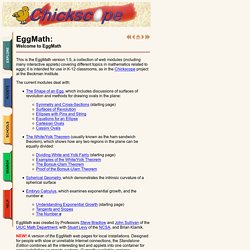
The current modules deal with: Ptolemy's Ptools - a 1998 Think Quest Project. As of July 1, 2013 ThinkQuest has been discontinued. About Space. Visualization is an important part of geometrical thinking. It's the skill you use when you pretend to be somewhere else and imagine how that place looks, or when you fancy how a situation would look if things were just a little bit different. But visualization is especially problematic in three dimensions—perhaps because math curricula do not emphasize three-dimensional geometry. Web Links - Geometry. Activities. Geometric Solids and Their Properties. InterMath. Investigating Geometry On-Line. Is a faciliated online course that uses dynamic mathematics software to investigate geometric relationships. Students work independently on materials.
They can interact with their teacher via emails, phone calls, or face-to face visits during regularly scheduled office hours. Henrico County Public Schools (HCPS), by providing links to other sites, does not guarantee, approve, or endorse the information or products available at these sites, nor does a link indicate any association with or endorsement by the linked sites to HCPS. Because we do not control linked Web sites, we are not responsible or liable for the content, products, policies, or performance of such external Web sites.Course Software HCPS provides the following mathematics software on our student computers. The actor’s and observer’s point of view: A geometry applet as an example. Abstract When designing mathematical educational tasks, a designer tries to anticipate how students will react. Home. Mathematics Learning in Early Childhood: Paths Toward Excellence and Equity.
Geometry Information. Why teach Geometry? WMAP Big Bang Concepts. The Big Bang model of cosmology rests on two key ideas that date back to the early 20th century: General Relativity and the Cosmological Principle. By assuming that the matter in the universe is distributed uniformly on the largest scales, one can use General Relativity to compute the corresponding gravitational effects of that matter. Relativity: Chpt. 1. Albert Einstein: Relativity Part I: The Special Theory of Relativity. A Case for a Logo-Based Elementary School Geometry Curriculum. Michael T. Battista Douglas H. For Teachers. NRICH promotes the learning of mathematics through problem solving. We provide engaging problems, linked to the curriculum, with support for teachers in the classroom. This is what a typical teacher's home page looks like. January 2010. For the past century, the north magnetic pole has been drifting across the CanadianArtic.