
Asyndeton. Asyndeton (from the Greek: ἀσύνδετον, "unconnected", sometimes called asyndetism) is a figure of speech in which one or several conjunctions are omitted from a series of related clauses.[1][2] Examples are veni, vidi, vici and its English translation "I came, I saw, I conquered".
Its use can have the effect of speeding up the rhythm of a passage and making a single idea more memorable. Asyndeton may be contrasted with syndeton (syndetic coordination) and polysyndeton, which describe the use of one or multiple coordinating conjunctions, respectively. Paragraph. History and orthography[edit] Indented paragraphs demonstrated in the US Constitution In ancient manuscripts, another means to divide sentences in into paragraphs was a line break (newline) followed by an initial at the beginning of the next paragraph.
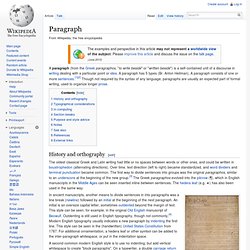
An initial is an oversize capital letter, sometimes outdented beyond the margin of text. This style can be seen, for example, in the original Old English manuscript of Beowulf. Genitive case. Depending on the language, specific varieties of genitive-noun–main-noun relationships may include: Depending on the language, some of the relationships mentioned above have their own distinct cases different from the genitive.

Possessive pronouns are distinct pronouns, found in Indo-European languages such as English, that function like pronouns inflected in the genitive. They are considered separate pronouns if contrasting to languages where pronouns are regularly inflected in the genitive. For example, English my is either a separate possessive adjective or an irregular genitive of I, while in Finnish, for example, minun is regularly agglutinated from minu- "I" and -n (genitive). Many languages have a genitive case, including Albanian, Arabic, Armenian, Basque, Dutch, Estonian, Finnish, Georgian, German, Greek, Icelandic, Irish, Latin, Latvian, Lithuanian, Romanian, Sanskrit, Scottish Gaelic, Turkish and all Slavic languages except Bulgarian and Macedonian.