
Not Giving Up. About ten years ago, I found myself sitting on the floor of my San Francisco Bay Area apartment, hoping that the call I was on wasn’t going to drop yet again. At the other end of the line was a Seattle public radio station, hosting a live debate/conversation between me and computer scientist Bill Joy on the question of whether our technologies were going to kill us; at that point, my main concern was whether our technologies would even work.
Joy had recently published his infamous “ Why the Future Doesn’t Need Us ” essay in Wired , and was still charged with the fiery nihilism of his argument that we are less than a generation away from nano-, bio-, and information technologies that would fundamentally transform — in a bad way — human society and the human species. Joy was convinced that these emerging technologies would cause our extinction, and that the only hope for humanity was to give up entirely on these innovations. And they’re both wrong. Technology is part of who we are. Nick Bostrom's Home Page. Nassim N. Taleb Home & Professional Page.
RichardDawkins.net - The Official Richard Dawkins Website. The Skeptic's Dictionary - Skepdic.com. About critical thinking. THE STONE - Opinionator Blog. This is the second in a series of interviews about religion that I am conducting for The Stone.
The interviewee for this installment is Louise Antony, a professor of philosophy at the University of Massachusetts at Amherst and the editor of the essay collection “Philosophers Without Gods: Meditations on Atheism and the Secular Life.” Gary Gutting: You’ve taken a strong stand as an atheist, so you obviously don’t think there are any good reasons to believe in God. But I imagine there are philosophers whose rational abilities you respect who are theists. How do you explain their disagreement with you?
Are they just not thinking clearly on this topic? Louise Antony: I’m not sure what you mean by saying that I’ve taken a “strong stand as an atheist.” Should This Be the Last Generation? - Opinionator Blog - NYTimes. The Stone is a forum for contemporary philosophers and other thinkers on issues both timely and timeless.
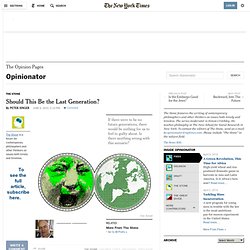
Have you ever thought about whether to have a child? If so, what factors entered into your decision? Was it whether having children would be good for you, your partner and others close to the possible child, such as children you may already have, or perhaps your parents? For most people contemplating reproduction, those are the dominant questions. Some may also think about the desirability of adding to the strain that the nearly seven billion people already here are putting on our planet’s environment. If there were to be no future generations, there would be nothing for us to feel to guilty about.
The 19th-century German philosopher Arthur Schopenhauer held that even the best life possible for humans is one in which we strive for ends that, once achieved, bring only fleeting satisfaction. Erin Schell Here is a thought experiment to test our attitudes to this view. ‘Last Generation?’: A Response - Opinionator Blog. What Is a Philosopher? - Opinionator Blog. Books of The Times - ‘Being Wrong,’ by Kathryn Schulz - ‘Wrong,’ Here’s what they are instead: investigations into why, as Ms.
Schulz writes, with a Cole Porterish lilt in her voice, “As bats are batty and slugs are sluggish, our own species is synonymous with screwing up.” Bookstores will shelve these two volumes side by side, and critics like me will think, bingo! , and set them up for a blind date too. But they could not be more unalike.
Ms. Mr. Ms. This is not a bulletin from the scientific or epistemological frontier. But it’s lovely to watch this idea warm in Ms. The idea that error can be eradicated, she writes, can lead to frightening and reactionary impulses. She is epigrammatic. I don’t bring this up because it’s rare to find a range of reference in a work of popular philosophy. Ms. Most of all she is for skepticism. “Being Wrong” is optimistic. Mr. He points out that most expert wisdom, especially about health issues, isn’t just sometimes but nearly always ultimately proved wrong.
Mr. Žižek in the garbage.