
Kenneth Weisbrode. There is much talk in the air – especially in Britain and the United States – about reinventing diplomacy for the 21st century.
New diplomacy. Forum for new Diplomacy. Video Secretary of State Hillary Clinton gives a speech on Internet freedom at the Newseum in Washington, DC. Digital Diplomacy. The 20th century roots of 21st century statecraft. Let's imagine a parallel universe for a second.
In that universe, the U.S. State Department decides that energy -- rather than the Internet -- would form one of the core pillars of "21st century statecraft. " Clay Shirky The Political Power of Social Media whole article via. On January 17, 2001, during the impeachment trial of Philippine President Joseph Estrada, loyalists in the Philippine Congress voted to set aside key evidence against him.
Less than two hours after the decision was announced, thousands of Filipinos, angry that their corrupt president might be let off the hook, converged on Epifanio de los Santos Avenue, a major crossroads in Manila. The protest was arranged, in part, by forwarded text messages reading, "Go 2 EDSA.
The Political Power of Social Media. Freedom.gov - By Evgeny Morozov. A year ago this January, U.S.
Politics and the internet: Caught in the net. Office of eDiplomacy. State eDiplomacy (eDipAtState) eDiplomacy: The US State Department's Global Collaborative Backbone. The United States Department of State (often referred to as the State Department), is responsible for the international relations of the United States and equivalent to the foreign ministries of other countries.
The Department was created in 1789 and was the first executive department established. Currently lead by Secretary of State Hillary Clinton, the department is the U.S. president’s principal means of conducting treaty negotiations and forging agreements with foreign countries, and is also responsible for the U.S. Mission to the United Nations, the Foreign Service Institute, and various offices of diplomatic security, foreign intelligence, policy analysis, international narcotics control, protocol, and passport services. The Morningside Post: eDiplomacy Ushers In a New Culture of Collaboration at State. By Kristen Coco Richard Boly is not what you'd expect from your typical State Department diplomat.
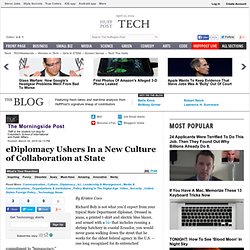
Dressed in jeans, a printed t-shirt and electric blue blazer, and armed with a bio that includes running a shrimp hatchery in coastal Ecuador, you would never guess walking down the street that he works for the oldest federal agency in the U.S. -- one long recognized for its entrenched commitment to "bureaucracy. " Diplopedia. Diplopedia Logo Diplopedia, billed as the Encyclopedia of the United States Department of State, is a wiki running on a State internal Intranet, called "OpenNet".
It houses a unique collection of information pertaining to diplomacy, international relations, and Department of State tradecraft. The wiki may be used by U.S. foreign affairs agencies domestic and abroad with State intranet access. It is also available to the United States intelligence community and other national-security related organizations using the Intelink-U network as a mirrored, read-only archive.
Homepage. Anne-Marie Slaughter Director of Policy Planning for the United States Department of State. Photo credit: Denise Applewhite Anne-Marie Slaughter is currently the President and CEO of the New America Foundation, a public policy institute and idea incubator based in Washington and New York.
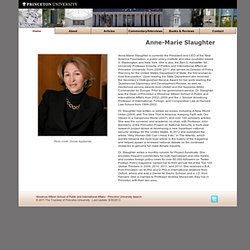
She is also the Bert G. Kerstetter '66 University Professor Emerita of Politics and International Affairs at Princeton University. From 2009–2011 she served as Director of Policy Planning for the United States Department of State, the first woman to hold that position. WikiLeaks turned the tables on governments, but the power relationship has not changed.
WikiLeaks "changes everything".
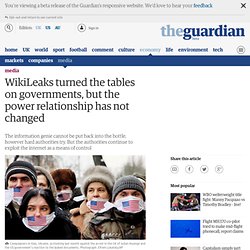
So says Christian Caryl in the latest New York Review of Books, as the media, technology and foreign policy worlds ponder the effect of the industrial dumping of US government cables. For several years American analysts in particular have been trying to make sense of the information free-for-all facilitated by the internet. Julian Assange's perhaps inadvertent contribution is to have brought a previously arcane debate into the forefront of global politics. Apps@State. Apps@State (AppsAtState) Introducing Apps@State. GovTwit - the Government Social Media Directory. Macon Phillips (EOP) (macon44) Leiders gezocht: De interactieve leider. Eric Schmidt, Alec Ross & Jared Cohen on 21st Century Statecraft. Jared Cohen (JaredCohen) Facebook and Arab Dignity. Alec Ross (AlecJRoss) Alec Ross: Worth reading: @erict19 on... 21st Century Statecraft: What does it really mean? - The TechChange Blog. (pdf)America's Edge power in the Networked Century Anne-Marie Slaughter.
The man opening up government. For Chris Quigley, the day Barack Obama took office in January 2009 changed his life.
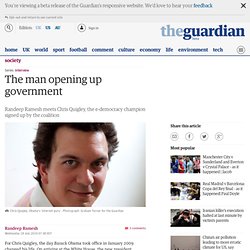
On arriving at the White House, the new president ordered the US government to make available as much information as possible "with a clear presumption: in the face of doubt, openness prevails". This, says the e-democracy evangelist, was all the more remarkable since the Bush administration had instructed agencies to do the opposite. MinBuZa (minbuza) Ambtenaar 2.0 _Ning_samen werken aan overheid 2.0. Ambtenaar 2.0 (ambtenaar20) NeelieKroesEU: Met Andrew Rasiej #persona... Andrew Rasiej (Rasiej) Verhagen forceert iPhone van de zaak. Nieuws - Maxime Verhagen had op een gegeven moment drie telefoons. UK Government Building Facebook App. UK Government to Crowdsource Spending Cuts on Facebook. This could get very messy, very quickly. Multiple reports have emerged overnight that the UK government is to consult the public over how to cut public spending via a dedicated Facebook page.
The ‘Spending Challenge Channel’ doesn’t appear to be live yet but it is expected to be officially announced today. Accompanying an official website which is already online, it will allow the public to suggest, discuss and vote on ways to cut public spending. The BBC reports that prime minister David Cameron spoke to Facebook CEO Mark Zuckerberg via Skype recently about the plan. Fouad Ajami: WikiLeaks and the Art of Diplomacy. Video: Clinton Comments on Wikileaks 11/29/2010 3:06:50 PM. Gov 2.0 Summit 2010 - Co-produced by UBM TechWeb & O'Reilly Conferences, September 07 - 08, 2010, Washington, DC. Watch Gov 2.0 Summit presentations and other interviews » News & Coverage See all » Government as a Platform. Gov 2.0 (govwiki) Cool Gov 2.0 sites you don’t know about. Web 2.0-fueled resources to help each other as citizens Target audience: Political activists, change agents, NGOs, nonprofits, social change organizations, educators, librarians, citizens.
It’s become a cliché to be skeptical of what government can do for society. Twitter list @timoreilly/gov20... Digital Diplomacy. Digital Governance. US Public Diplomacy 2.0. Institute for Public Diplomacy and Global Communication - The Elliott School of International Affairs and The School of Media and Public Affairs - The George Washington University. Handbookofpublicdiplomacy. Diplomatie publique. Officiellement la diplomatie publique vise à « promouvoir l’intérêt national des États-Unis par la compréhension, l’information et l’influence des publics étrangers ». Telle est du moins la définition qu’en donnent les sites de l’administration du seul pays au monde qui, à notre connaissance, se soit doté d’un secrétariat d’État « à la diplomatie publique ». La formule sonne bien, mais comment définir cette action sans évoquer de vilains mots comme « propagande » ?
Pour bien comprendre, il faut revenir à un contexte de guerre froide. La première occurrence du terme date de 1965 (même si la chose existait bien avant) lorsqu’Edmund Gullion du Fletcher’s Scholl of Law and Diplomacy définit ce domaine (qui, soi dit en passant, est enseigné dans des universités américaines). La formulation est encore un peu embarrassée, mais on entrevoit de quoi il s’agit. Trois sources nourrissent cette politique : En 1953, l’USIA (U.S. . - Tout recommence après le 11 Septembre. Homepage. Institute for video_Public Diplomacy and Global Communication. QDDR_Lord_Jan2010_code213_policybrf_0.