
Einstein writes of 'childish superstition' "Science without religion is lame, religion without science is blind.

" So said Albert Einstein, and his famous aphorism has been the source of endless debate between believers and non-believers wanting to claim the greatest scientist of the 20th century as their own. A little known letter written by him, however, may help to settle the argument - or at least provoke further controversy about his views. Due to be auctioned this week in London after being in a private collection for more than 50 years, the document leaves no doubt that the theoretical physicist was no supporter of religious beliefs, which he regarded as "childish superstitions". Freedom From Religion Foundation.
Printed books existed nearly 600 years before Gutenberg's Bible. The Big Idea: « The New Oxonian. Hristopher Hitchens is, of all the atheists I admire, the one I admire the most.
I want him to live forever. But as that is impossible–for any of us–it’s his voice I will miss the most. He is a journalist, a polemicist, a bad boy. But he is also a keen observer. And, though he may hide it, a well-trained philosopher. Christopher Hitchens' wit and warmth remembered as New York pays tribute. "Little Keith" called him a suffering auto-contrarian and likened him to Houdini; Graydon Carter said he was a "bit of a scallywag" but an editor's dream; and the doctor who treated him for the cancer of the oesophagus that killed him said he was a "pioneer at the frontier".
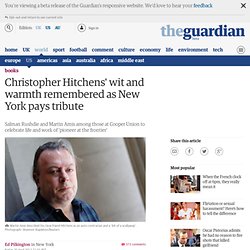
Unsurprisingly, though, it was Christopher Hitchens who had the funniest and the most apposite words with which to describe himself at his own memorial in New York on Friday. He was, he said of himself in posthumous film clips and readings, a "radical freelance scribbler" who had devoted his life to curiosity, irony, debunking, disputation, drinking, love and hate (though of all those things, it was hate that got him out of bed in the morning). "The cause of my life," Hitchens said in one snippet included in a compilation put together by the Oscar-winning documentary maker Alex Dibney, "has been to oppose superstition. It's a battle you can't hope to win – it's a battle that's going to go on forever.
For many, faith in God rises with age. U.

CHICAGO (US) — Belief in God increases with age, even in countries that are largely atheist, according to new research. International surveys about the depth of people’s belief in God show vast differences among nations, ranging from 94 percent of people in the Philippines who say they always believed in God, to only 13 percent of people in the former East Germany. Yet the surveys found one constant—belief in God is higher among the elderly, regardless of where they live. A new report on the international surveys, “Belief About God Across Time and Countries,” was issued by the General Social Survey of the social science research organization NORC at the University of Chicago. The report is based on a comprehensive, international study of belief in God and includes information from the International Social Survey Program, a consortium of the world’s leading opinion survey organizations. Global beliefs vary Among the findings: The Lions of Judah – a glance at a Christian dominionist conference.
Over the past three years, I have been reporting a lot about the 7 Mountains dominionist movement and decided it was time to actually attend a conference instead of watching sermon after sermon on YouTube.
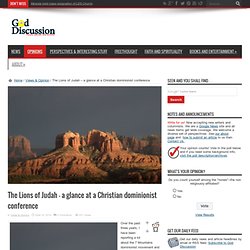
So for the Passover weekend, a friend of mine and I spent three days at a Christian dominionist conference in Sedona, Arizona, a New Age "mecca," if you will. By Christian dominionism, I am referring to the "Seven Mountains mandate" whereby a sect of evangelical Christians believe that they must "occupy" and "dominate" seven spheres of culture — education; religion; family; business; government; arts and entertainment; and media in order to create a Christian kingdom for Jesus Christ to rule. One of the most popular seven mountains teachers is Lance Wallnau, and I heard him there. I have to admit, I was impressed with Wallnau's speaking talents and ability to enthuse a crowd. {video link} What the “nones” believe. How to respond to requests to debate creationists : Pharyngula.
Your secular news source! Americans United. Friendly Atheist. Alberta Officials Reject Proposed Catholic Sex Ed Lessons That “Deny Science” Alberta officials deserve praise for this strong stance against harmful misinformation.

Read more Gordon Klingenschmitt: “The Church Should Take Over the Government” Gordon Klingenschmitt, the former Colorado State Rep. who eventually lost his seat in part because of his theocratic fantasies, is at it again. Read more Duck Dynasty Dad Wrongly Says Crime and Murder Rates Soar in Areas Without God Phil Robertson shows us that saying you’re religious means you can lie about anything. Linda Harvey: My Childhood Ouija Board Saved Me From Homosexual Halloween This Christian activist knew Halloween was evil when she was 14 and an Ouija board told her all about it. Alt Med Advocates Are Wrong to Say Doctors Don’t Treat the Whole Patient Modern medicine isn’t perfect. Atheists Sue TX School Officials for Harassing Student Who Sat During Pledge.
Margaret Downey. Steven Pinker. JREF. Shermer. God Discussion. The Brights. Harris. Hitchens. Dawkins. Atheist Nexus.