
Game Development Methodology, Game Interface Design Solutions Company. List of Case Study Game Development Methodology Story Board Building the storyboard is an integral part of putting together an animated feature.

The process provides not only a visual interpretation of the script, it also allows designers in each area to get a feel for what is being presented on screen. At GameZ3, we follow a specific process for story boarding which is shown below User Interface Designing At GameZ3, we first of all understand the user requirement and then developed the objects and before developing the complete User Interface, we work with the prototype of the interface to that we can reduce the wastage of resources in repetitive work.
Game Programming Once the requirements are gathered and we have a well defined user interface, the programming for the game takes place. Backend Development This is the phase that runs parallel to the programming phase as, the backend development. Game Testing Test Planning is done at the onset of project in project planning phase. Demo. Methodology - What are the most popular software development methodologies used by game studios. Video game development. Video game development is the process of creating a video game.
Development is undertaken by a game developer, which may range from a single person to a large business. Traditional commercial PC and console games are normally funded by a publisher and take several years to develop. Indie games can take less time and can be produced cheaply by individuals and small developers. The indie game industry has seen a rise in recent years with the growth of new online distribution systems and the mobile game market. The first video games were developed in the 1960s, but required mainframe computers and were not available to the general public. Mainstream PC and console games are generally developed in phases. Mobile games are, in general, much quicker to develop than the mainstream PC and console games. Overview[edit] Game development is the software development process by which a video game is produced. All but the smallest developer companies work on several titles at once.
History[edit] The Process of Game Creation & the Game Design Document « Digital Worlds – Interactive Media and Game Design. If you’ve been following the Game Maker activities, or if you had a look at the Skillset Industry Standards, you’ll probably have realised by now that developing a ‘major’ game title can be a significant task – writers, game designers, sound designers, visual artists and more must work together to create the actual game.

So what sort of team – and what sort of development process – is involved in developing a game? To get you in the mood, read section 1 of the Gamasutra article A Primer for the Design Process, Part 1: Do. What questions do game designers need to ask before they start to work on the design of a game? Which key team members need appointing right at the start of the game design and development process? Now, let’s consider the case of an educational game, where as well as the game development team, we require input from educational specialists. [Game Development Process - What do you think the testing phase is designed to uncover? But we’re getting ahead of ourselves… Like this: Spiral model. The spiral model is a risk-driven process model generator for software projects.
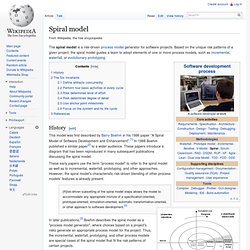
Based on the unique risk patterns of a given project, the spiral model guides a team to adopt elements of one or more process models, such as incremental, waterfall, or evolutionary prototyping. History[edit] This model was first described by Barry Boehm in his 1986 paper "A Spiral Model of Software Development and Enhancement".[1] In 1988 Boehm published a similar paper[2] to a wider audience. These papers introduce a diagram that has been reproduced in many subsequent publications discussing the spiral model. Spiral model (Boehm, 1988). These early papers use the term "process model" to refer to the spiral model as well as to incremental, waterfall, prototyping, and other approaches. In later publications,[3] Boehm describes the spiral model as a "process model generator", where choices based on a project's risks generate an appropriate process model for the project.