
Portrait Lighting Cheat Sheet Card. Setting up lighting for a portrait can be quite a complex task.
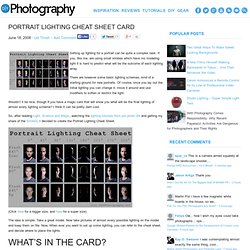
If you, like me, are using small strobes which have mo modeling light it is hard to predict what will be the outcome of each lighting array. There are however some basic lighting schemes, kind of a starting ground for new portraits. Of course, once you lay out the initial lighting you can change it, move it around and use modifiers to soften or restrict the light. Wouldn’t it be nice, though if you have a magic card that will show you what will be the final lighting of almost every lighting scheme? I think it can be pretty darn cool. So, after reading Light, Science and Magic, watching the lighting tutorials from pro photo life and getting my share of the Strobist, I decided to create the Portrait Lighting Cheat Sheet. (Click here for a bigger size, and here for a super size) The idea is simple: Take a great model. For each angle I took 8 pictures, in 45 degrees interval, so I have a full circle of lights covered.
Light Falloff Cheat Sheet Card. As part of my ongoing exploration of portrait photography in general and flash studio photography in particular, I wanted to examine the effect that a large light source will have on light fall off.

This was a great chance for me to produce a new cheat sheet to companion the portrait lighting cheat sheet and reflector cheat sheet that are already out there. (And this time we have a special guest, read on…) When ever we use a light source to illuminate an object, that object is being hit with multiple “rays” of light. Some of those rays are hitting the object in the place which is nearest to the light source, and some of the rays are hitting the subject where is furthest from the light source. OK, nothing new until now. As a crude generalization one can argue that the light that falls on the closer side to the light source will be brighter then the light hitting the furthest side. The effect in which the light is dimmer on the far side is called light falloff. Image cc by Meredith Farmer.
Reflector Card Cheat Sheet. My previous cheat sheet dealt with the impact of light position on portraiture.

The idea was that you can print this cheat sheet and carry it around for fast consultation and getting fast results. My next investigation involved a single flash again (this time shot through a shoot though umbrella) and different uses and positions for a 5 in one reflector. Again I suggest printing the card so you have a quick look when ever you are not sure of what a certain reflector effect may be. (Click here for a bigger size, and here for a super size) The idea is similar to the Portrait Lighting Cheat Sheet Card.
Like the previous card, this card has three rows, each row displays a different comparison that has to do with using a reflector. The first row shows the different color bounce you get when using the different “covers” of the 5-in-1 reflector. The black reflector will give a darker left side then no reflector at all. The Silver coat will give a better bounce then the white no-coat.