
Ungoliant - Wikipedia, the free encyclopedia - Nightly. Ungoliant is a fictional character in J.

R. R. Tolkien's legendarium, described as an evil spirit in the form of a spider. She is mentioned briefly in The Lord of the Rings, and plays a supporting role in The Silmarillion. Her origins are unclear, as Tolkien's writings don't explicitly reveal her nature, other than that she is from "before the world". Name[edit] Ungoliant means "dark spider" in the Sindarin language. Internal history[edit] Sea monster cast ashore. A strange ugly sea monster was cast ashore in Guinea.

The partially decomposed monster has 4 paws, a tail and long fur. Scientists who examined the creature said that they had already seen such animals before, but they have no clue to their definition. More pictures after the jump. Link & Image: PravdaTags: Sea Monster | Creature Labels: Animal. Rohonc Codex. The Rohonc Codex (Hungarian pronunciation: [ˈrohont͡s]) is a set of writings in an unknown writing system. This codex is also referred to as Rohonczi Codex which is the Hungarian name of the codex spelled according to the old Hungarian orthography that was reformed in the first half of the 19th century.
This spelling has spread on-line probably due to the book of V. Enăchiuc (see Bibliography below). Book of Soyga. John Dee Provenance[edit] Elias Ashmole recorded that the Duke of Lauderdale owned a manuscript titled Aldaraia sive Soyga vocor that had formerly belonged to Dee. The manuscript was sold at auction in 1692 and is now probably Sloane MS. 8, based on Jim Reeds' identification. Bodley MS. 908 was donated to the Bodleian Library in 1605.[2] Contents[edit] Codex Seraphinianus. Codex Seraphinianus, originally published in 1981, is an illustrated encyclopedia of an imaginary world, created by the Italian artist, architect, and industrial designer Luigi Serafini during thirty months, from 1976 to 1978.[1] The book is approximately 360 pages long (depending on edition), and written in a strange, generally unintelligible alphabet.
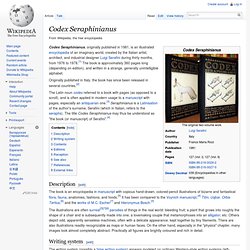
Originally published in Italy, the book has since been released in several countries.[2] The Latin noun codex referred to a book with pages (as opposed to a scroll), and is often applied in modern usage to a manuscript with pages, especially an antiquarian one.[3] Seraphinianus is a Latinisation of the author's surname, Serafini (which in Italian, refers to the seraphs). The title Codex Seraphinianus may thus be understood as "the book (or manuscript) of Serafini".[4] Description[edit] Writing system[edit]
Voynich manuscript. The Voynich manuscript is an illustrated codex hand-written in an unknown writing system.
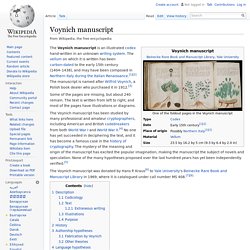
The vellum on which it is written has been carbon-dated to the early 15th century (1404–1438), and may have been composed in Northern Italy during the Italian Renaissance.[1][2] The manuscript is named after Wilfrid Voynich, a Polish book dealer who purchased it in 1912.[3] Shugborough inscription. Still a mystery: the eight letters 'OUOSVAVV', framed by the letters 'DM' The Monument[edit] The Shepherds Monument, enclosed in its rustic arch Fingers touching the letters 'N' and 'R' in the phrase "ET IN ARCADIA EGO' Carved bald head of a smiling man.
Rongorongo. Rongorongo (/ˈrɒŋɡoʊˈrɒŋɡoʊ/; Rapa Nui: [ˈɾoŋoˈɾoŋo]) is a system of glyphs discovered in the 19th century on Easter Island that appears to be writing or proto-writing.
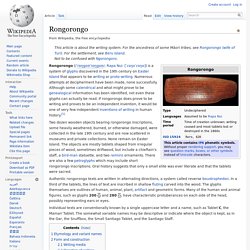
Numerous attempts at decipherment have been made, none successfully. Although some calendrical and what might prove to be genealogical information has been identified, not even these glyphs can actually be read. If rongorongo does prove to be writing and proves to be an independent invention, it would be one of very few independent inventions of writing in human history.[1] Two dozen wooden objects bearing rongorongo inscriptions, some heavily weathered, burned, or otherwise damaged, were collected in the late 19th century and are now scattered in museums and private collections. None remain on Easter Island. History of writing ancient numbers. Pre-history[edit] The first method of counting was counting on fingers.[1] This evolved into sign language for the hand-to-eye communication of numbers which, while not writing, gave way to written numbers.

Tallies made by carving notches in wood, bone, and stone were used for at least forty thousand years.[2] Stone age cultures, including ancient Native American groups, used tallies for gambling with horses, slaves, personal services and trade-goods. Roman numerals evolved from this primitive system of cutting notches.[3] It was once believed that they came from alphabetic symbols or from pictographs, but these theories have been disproved.[4][5] Behistun Inscription. Coordinates: The Behistun Inscription (also Bistun or Bisutun), (Persian: بیستون, Old Persian: Bagastana, meaning "the place of god") is a multi-lingual inscription located on Mount Behistun in the Kermanshah Province of Iran, near the city of Kermanshah in western Iran.
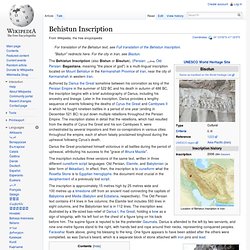
Authored by Darius the Great sometime between his coronation as king of the Persian Empire in the summer of 522 BC and his death in autumn of 486 BC, the inscription begins with a brief autobiography of Darius, including his ancestry and lineage. Later in the inscription, Darius provides a lengthy sequence of events following the deaths of Cyrus the Great and Cambyses II in which he fought nineteen battles in a period of one year (ending in December 521 BC) to put down multiple rebellions throughout the Persian Empire. Invisible ink. Invisible ink, also known as security ink, is a substance used for writing, which is invisible either on application or soon thereafter, and can later be made visible by some means.

Outline of cryptography. Steganography tools. Steganography architecture example - OpenPuff A steganography software tool allows a user to embed hidden data inside a carrier file, such as an image or video, and later extract that data.

Architecture[edit] Biosemiotics. Definition[edit] Biosemiotics is biology interpreted as a sign systems study, or, to elaborate, a study of Approaches[edit] Furthermore, by providing new concepts, theories and case studies from biology, biosemiotics attempts to throw new light on some of the unsolved questions within the general study of sign processes (semiotics), such as the question about the origin of signification in the universe.
Here, signification (and sign) is understood in a very general sense, that is, not simply the transfer of information from one place to another, but the generation of the very content and meaning of that information in human as well as non-human sign producers and sign receivers. Sign processes are thus taken as real: They are governed by regularities (habits, or natural rules) that can be discovered and explained. Semiotics. Semiotics frequently is seen as having important anthropological dimensions; for example, Umberto Eco proposes that every cultural phenomenon may be studied as communication.[2] Some semioticians focus on the logical dimensions of the science, however. They examine areas belonging also to the life sciences – such as how organisms make predictions about, and adapt to, their semiotic niche in the world (see semiosis). In general, semiotic theories take signs or sign systems as their object of study: the communication of information in living organisms is covered in biosemiotics (including zoosemiotics).
Syntactics is the branch of semiotics that deals with the formal properties of signs and symbols.[3] More precisely, syntactics deals with the "rules that govern how words are combined to form phrases and sentences".[4] Terminology[edit] Amy Cuddy: Your body language shapes who you are. Chaffing and winnowing. Chaffing and winnowing is a cryptographic technique to achieve confidentiality without using encryption when sending data over an insecure channel. The name is derived from agriculture: after grain has been harvested and threshed, it remains mixed together with inedible fibrous chaff.
The chaff and grain are then separated by winnowing, and the chaff is discarded. The technique was conceived by Ron Rivest and published in an on-line article on 18 March 1998.[1] Although it bears similarities to both traditional encryption and steganography, it cannot be classified under either category. Steganographia, by Johannes Trithemius. Steganographia (Secret Writing), by Johannes Trithemius. 1500.
This digital edition Copyright © 1997 by Joseph H. Peterson. All rights reserved. Johannes Trithemius. Johannes Trithemius (1 February 1462 – 13 December 1516), born Johann Heidenberg, was a German Benedictine abbot and a polymath active in the German Renaissance, as a lexicographer, chronicler, cryptographer and occultist. He took considerable influence on the development of early modern and modern occultism; among his students were Heinrich Cornelius Agrippa and Paracelsus. Free Open-Source Disk Encryption - Documentation - Encryption Algorithms.
Free Open-Source Disk Encryption - Documentation - Hash Algorithms. Cyrillic script. Hiragana. Side channel attack. D'Agapeyeff cipher. The D'Agapeyeff cipher is an as-yet unbroken cipher that appears in the first edition of Codes and Ciphers, an elementary book on cryptography published by the Russian-born English cryptographer and cartographer Alexander D'Agapeyeff in 1939. Dorabella Cipher. Chaocipher. The Chaocipher [1] is a cipher method invented by J. F. Byrne in 1918 and described in his 1953 autobiographical Silent Years.[2] He believed Chaocipher was simple, yet unbreakable. Byrne stated that the machine he used to encipher his messages could be fitted into a cigar box. He offered cash rewards for anyone who could solve it. Unicode equivalence. Unicode provides two such notions, canonical equivalence and compatibility: Collation. Coptic alphabet. List of Latin-script letters. Steganography. One-time pad. RC4. Q code. Modular arithmetic.