
Startup Voodoo sur Twitter : "final #StartupVoodoo keynote is fireside chat between @ycombinator head @Sama and @tomforemski... Startup Voodoo sur Twitter : "Following his #StartupVoodoo keynote @Scobleizer and @tomforemski talk urban breeding grounds for tech. Tom Foremski sur Twitter : "Rackspace's Robert Scoble sharing his startup wisdom at #Startup Voodoo in St. Louis... Tom Foremski sur Twitter : "The start to #StartupVoodoo at #tinybar... The World's Richest Tech Billionaires: Jack Ma Breaks Through to Top, Google Leaders Slip. Tech M&A and IPOs - CB Insights. This in-depth report analyzes the worldwide exit activity within private technology companies including overall activity, vc participation in exits, which countries saw the most exits, and more.

Below is a high-level summary of some of the report’s highlights. For all of the findings, download the entire report. It’s free. Tech exit activity up 58% vs. 2013 2014 saw 2886 tech exits (2807 M&A and 79 IPOs). Almost 2x as many unicorn exits in 2014 vs. 2013 After just 17 private tech companies exited for a $1B+ valuation in 2013, that number nearly doubled to 32 in 2014. US dominates exit activity followed by UK. Three European countries were in the top 10 based on tech exit activity in 2014. A list of the top 15 countries by exit activity is below. United StatesUnited KingdomCanadaGermanyIndiaChinaAustraliaFranceIsraelSwedenNetherlandsSpainSingaporeRussiaDenmark 2014: 589 venture-backed tech companies acquired & 51 tech IPOs Accel Partners leads investors with the most tech exits in 2014. 'Your Story Is Your Strategy' Says VC Who Backed Facebook And Twitter. In My Humble Opinion. NASDAQ plans to unify private shares markets for startups.
NASDAQ plans to unify US private shares markets and introduce set periodic trading periods in a bid to reduce volatility and improve liquidity in shares of startups.
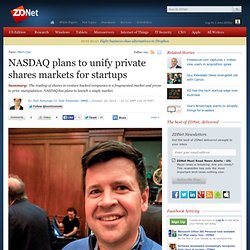
NASDAQ has plans to unify US private shares markets and introduce set periodic trading periods in a bid to reduce volatility and improve liquidity in shares of startups. The NASDAQ plans would help startup founders, investors, and employees, cash out some of their shares without the need for an IPO. The money could be used to fund additional startups.
Secondary share markets are somewhat controversial because they are lightly regulated and potentially vulnerable to price manipulation because of low trading volumes. The Dirty Little Secret Of Silicon Valley's Startup Boom... Posted by Tom Foremski - February 3, 2012 In San Francisco cafes and bars, even on the street, I overhear people talking about their startup ideas, business plans, and goals.
And there are tons of incubators, Angels, wannabe Angels, VC firms, making investments in startups. Are Women Bad for Start-ups? You've Got To Be Kidding... Posted by Tom Foremski - August 7, 2011 By Vanessa Camones, PR veteran and founder of theMIX agency.
Women have made astounding advances in the workforce in the past fifty years. Even in the tech sector, traditionally an enclave of geeky guys, women have progressed from support roles to becoming respected builders, leaders and innovators. We're still a minority, but no longer an anomaly. So it bothers me, and a lot of my female colleagues, to see another woman argue that we still don't belong. Startups, she reasons, are a special kind of business that can't afford the "diversity" of having a woman on the team. From lean startups to open innovation success. Serial entrepreneur and Harvard Business School Entrepreneur-in-Residence Eric Ries delivered an insightful and entertaining talk on his Lean Startup methodology at the PARC Forum invited expert speaker series last week.
(This is part of the Entrepreneurial Spirit series; you can see the other speakers and videos here.) Don’t let the word “startup” fool you – according to Eric’s definition, a startup is any organization of any size dedicated to creating something new under conditions of uncertainty. Sound familiar? Of course it does, because anybody working in innovation – whether in a garage or Fortune 500 boardroom – is doing just that.
The challenge is how to penetrate that “fog of uncertainty”, as Eric puts it, to discover a path to a successful, sustainable business. I’m not going to restate all of his points in this post. The science behind the art: what both entrepreneurs and inventors have in common Both of these maxims represent statements that are easier said than done.
Startup News. Forum. Don’t Cede Control: Why You Need to Cut out Middle Men in Negotiations. Middle Men.

Middle People? They exist in all forms of work and life. They’re essential in helping us get our jobs done because they specialize in something we do not. They do a routine task over-and-over again all year long that we do only periodically. Lawyers. We need them all. Let me start with an example. “That’s nuts!” “Because he told me that he wants the move in date to be X.” I said, “If I start with your position I have nowhere to go but down. She way annoyed. The Problem With Silicon Valley Is Itself - TNW Entrepreneur. As a Brit who gave up cheerleading the European tech scene to make the pilgrimage to Silicon Valley to live, eat and breath the world’s leading hub for technology startup innovation, I’ve been largely unimpressed and disappointed by the quality of startups here.
Living in San Francisco since January, I’ve interviewed around two hundred startups and there’s only two, out of two hundred, I think are game changers. Now, don’t get me wrong, Silicon Valley is an incredibly inspiring place to be. Everyone is doing something amazing and trying to change the world, but in reality much of the technology being built here is not changing the world at all, it’s short-sighted and designed for scalability, big exits and big profits. Page not found » TNW Entrepreneur.
What is The Best Thing About Being An Entrepreneur? Until one is committed, there is hesitancy, the chance to draw back, always ineffectiveness…the moment one definitely commits oneself, the providence moves too. A whole stream of events issues from the decision, raising in one’s favor all manner of unforeseen incidents, meetings and material assistance, which no man [or woman] could have dreamt would have come his [or her] way. -W. H. Murray in The Scottish Himalaya Expedition, 1951. So you want to do a startup, eh? Founder CEOs. The Most Important Question Peter Thiel Asks Any Startup Looking For Money. Silicon Valley Angels. VCs. UK startups. French startups. SoCalifornia Startups.