
Gödel, Escher, Bach: A Mental Space Odyssey. Hofstadterian Loops. Reading a book by Douglas Hofstadter is the intellectual equivalent of eating the most satisfyingly delicious meal imaginable in the most enjoyable company ever.

I've only read three so far and my favourite has definitely been "Le Ton Beau de Marot", because I don't think it'll ever be possible for a book's subject matter to be so broad in scope and yet so perfectly match my own areas of deepest interest. His most recent book, I Am a Strange Loop, was a thoroughly enjoyable read as well and extremely thought-provoking: it has really whetted my appetite for literature in the field of philosophy of mind. The book begins with Hofstadter giving a brief history of his own personal grapplings with the idea of consciousness, an inevitable question arising from which is whether non-human animals have consciousness in any analogous way to humans.
In those days, I often wondered how some of my personal idols - Albert Einstein, for instance - could have been meat-eaters. Free Online Course Materials. Sounds Like Bach. Sounds Like Bach But the day when music is finally and irrevocably reduced to syntactic pattern and pattern alone will be, to my old-fashioned way of looking at things, a very dark day indeed. DOUGLAS HOFSTADTER Back when I was young -- when I wrote "Gödel, Escher, Bach" -- I asked myself the question "Will a computer program ever write beautiful music? ", and then proceeded to speculate as follows: "There will be no new kinds of beauty turned up for a long time by computer music-composing programs...
To think -- and I have heard this suggested -- that we might soon be able to command a preprogrammed mass-produced mail-order twenty-dollar desk-model 'music box' to bring forth from its sterile circuitry pieces which Chopin or Bach might have written had they lived longer is a grotesque and shameful misestimation of the depth of the human spirit. " I went on and on in this vein. What do I make of such speculations now, a quarter-century later? EMI is evolving -- it is a moving target. An Interview with Douglas R. Hofstadter, following ''I. Douglas R.
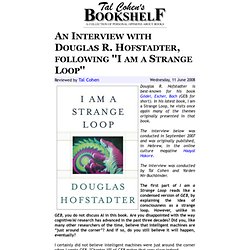
Hofstadter is best-known for his book Gödel, Escher, Bach (GEB for short). In his latest book, I am a Strange Loop, he visits once again many of the themes originally presented in that book. The interview below was conducted in September 2007 and was originally published, in Hebrew, in the online culture magazine Haayal Hakore. The interview was conducted by Tal Cohen and Yarden Nir-Buchbinder. The first part of I am a Strange Loop reads like a condensed version of GEB, by explaining the idea of consciousness as a strange loop.
I certainly did not believe intelligent machines were just around the corner when I wrote GEB. Am I disappointed by the amount of progress in cognitive science and AI in the past 30 years or so? I am a deep admirer of humanity at its finest and deepest and most powerful — of great people such as Helen Keller, Albert Einstein, Ella Fitzgerald, Albert Schweitzer, Frederic Chopin, Raoul Wallenberg, Fats Waller, and on and on. We'll return to Kurzweil soon.