
How to build an ultra cheap beowulf cluster. Vintage Video: Computing Across America. In 1983, [Steve Roberts] packed up a Tandy 100 laptop and a 5-watt solar panel, fleeing suburbia on his recumbent bicycle on what would become a 17,000 mile journey that forever cemented his place in the geek pantheon…not just as a technology hacker, but as one of the preeminent “life hackers,” pursuing his own dreams on his own terms and inspiring others to do the same. In this 1989 video, recently unearthed by Hack a Day, [Roberts] reflects on the first 16,000 miles of his voyage, detailing some of the technology that went into his then-current ride, the Next time you’re comfortably working from the local park with your laptop tethered to a 3G connection, raise your latte in toast to [Roberts], who was pioneering the “mobile professional lifestyle” more than There was no Google Maps, no mainstream consumer internet, no 3G wireless.
It was all packet radio and acoustic couplers on pay phones. My first computer. How I got my first computer was like this.

My grandfather was a tinkerer, inventor, high school science teacher and an enthusiastic ham radio operator. He loved gadgets. When I was a kid and we visited, I’d say a brief “Hi” to Grandma and make a beeline for Grandpa’s well-equipped basement shop. I’d come upstairs for meals and excursions to see other relatives in the area, but mostly I was mucking around in Grandpa’s basement (the collection of old Tom Swift books helped keep me down there, too). Grandpa taught me about tools and loved to show off his latest gadgets (he was very fond of anything magnetic, especially electro-magnets, and always had a few around that he’d recently made or acquired).
On one visit, when I was nine or ten years old, he tried to teach me Ohm’s Law. I remember him saying, “This is the most important equation I know. Top 10 industry-changing applications. The top 10 operating system stinkers. FreeTechBooks.com. IT posters to cover your empty walls.
Posted in Tech blog on June 4th, 2008 by Pingdom If you’re like us and have lots of empty wall space in your office you need to check out this list. We have collected a list of posters that focus on interesting information rather than nice-looking sunsets. And of course all are computer and network related. We will definitely be ordering or printing some of these ourselves to add to the create spirit here at the office. OS evolution over the past 60 years Computer OS functionality and evolution, including UNIX and UNIX-like OSs and also Microsoft from DOS to Vista. Price/availability: $19.99Link: Anatomy of a Linux System Poster for O’Reilly’s Open Source Software Convention in 2001, so it’s a bit dated, but still full of information.
Price/availability: Free PDF downloadLink: Windows 2008 deployment planning Two Windows 2008 posters showing core functionality and Active Directory components. Price/availability: Free PDF downloadLink: Linux kernel Price/availability: $15-30Link: Network protocols. Who Is This "Licklider" Guy? Who are they talking about?

Why haven't I ever heard of him? Thinking Machines. Through the much of the 1980’s and early 1990’s, Cambridge-based Thinking Machines was ahead of its time. Early Days: Visicalc. The Ten Most Beautiful Computers. Every now and then, a computer comes along that makes a mark, that sets a trend, or that simply stuns you - but not because of its internals, its processor or its software, but because of its appearance. Through the history of computing, there have been a number of computers that were actually designed to appeal not just because of raw technology alone, but also because of stunning looks. Read on for a countdown of my ten most beautiful computers. [Digg this story!] 10. Honeywell H316 "kitchen computer" Most likely the weirdest one of the bunch. The machine had a 2.5Mhz processor, 4kb of core magnetic memory, and had some recipes pre-programmed, since learning how to program any new recipes into the device took two weeks.
Readers of the popular webcomic User Friendly will know the SGI O2 as the body for the Erwin character, an artificial intelligence written in COBOL. I do not really know why I like the O2's design so much. 8. Papers Written by Googlers. Google publishes hundreds of research papers each year.
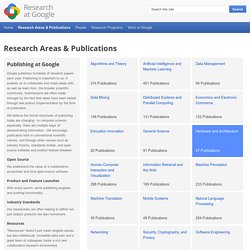
Publishing is important to us; it enables us to collaborate and share ideas with, as well as learn from, the broader scientific community. Submissions are often made stronger by the fact that ideas have been tested through real product implementation by the time of publication. We believe the formal structures of publishing today are changing - in computer science especially, there are multiple ways of disseminating information. We encourage publication both in conventional scientific venues, and through other venues such as industry forums, standards bodies, and open source software and product feature releases. Open Source We understand the value of a collaborative ecosystem and love open-source software. Product and Feature Launches With every launch, we're publishing progress and pushing functionality. Industry Standards Our researchers are often helping to define not just today's products but also tomorrow's.
Resources Impact.