
Foreland basin. The Persian Gulf - the foreland basin produced by the Zagros orogenic belt Types of foreland basin[edit] Foreland Basin Classes: Peripheral vs.

Retroarc Foreland basins can be divided into two categories: Peripheral (Pro) foreland basins, which occur on the plate that is subducted or underthrust during plate collision (i.e. the outer arc of the orogen) Examples include the North Alpine Foreland Basin of Europe, or the Ganges Basin of AsiaRetroarc (Retro) foreland basins, which occur on the plate that overrides during plate convergence or collision (i.e. situated behind the magmatic arc that is linked with the subduction of oceanic lithosphere) Examples include the Andean basins, or Late Mesozoic to Cenozoic Rocky Mountain Basins of North America Foreland basin system[edit] The Foreland Basin System DeCelles & Giles (1996) provide a thorough definition of the foreland basin system.
Molasse. The molasse can sometimes completely fill a foreland basin, creating a nearly flat depositional surface, that nonetheless remains a structural syncline.

Molasse can be very thick near the mountain front, but usually thins out towards the interior of a craton; such massive, convex accumulations of sediment are known as clastic wedges.[1] See also[edit] References[edit] Further reading[edit] External links[edit] Molasse, definitions and examples, simplified geological map of the western Alps. Orogeny. Orogeny refers to forces and events leading to a large structural deformation of the Earth's lithosphere (crust and uppermost mantle) due to the engagement of tectonic plates.

Response to such engagement results in the formation of long tracts of highly deformed rock called orogens or orogenic belts. The word "orogeny" comes from the Greek (oros for "mountain" plus genesis for "creation" or "origin"),[1] and it is the primary mechanism by which mountains are built on continents. Orogens develop while a continental plate is crumpled and is pushed upwards to form mountain ranges, and involve a great range of geological processes collectively called orogenesis.[2][3] Physiography Two processes that can contribute to an orogen. Continental collision of two continental plates to form a collisional orogen. Orogeny usually produces long arcuate (from arcuare, to bend like a bow) structures, known as orogenic belts. Orogenic cycle Erosion Erosion is a subsequent phase of the orogenic cycle. H.J. Orogeny. Physiography[edit] Continental collision of two continental plates to form a collisional orogen.
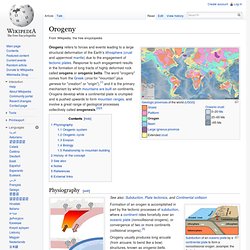
However, usually no continental crust is subducted, only uplifted. (example: the Alps) Formation of an orogen is accomplished in part by the tectonic processes of subduction, where a continent rides forcefully over an oceanic plate (noncollisional orogens), or convergence of two or more continents (collisional orogens).[5] Frequently, rock formations that undergo orogeny are severely deformed and undergo metamorphism. An orogenic event may be studied as: (a) a tectonic structural event, (b) as a geographical event, and (c) a chronological event. Orogenic system[edit] An orogeny produces an orogenic system, or (mountain) range-foredeep-foreland system. Orogenic cycle[edit] Although orogeny involves plate tectonics, the tectonic forces result in a variety of associated phenomena, including magmatization, metamorphism, crustal melting, and crustal thickening. Erosion[edit] Biology[edit] H.J.
Flysch. Carpathian flysch Sedimentological properties[edit] Flysch is formed under deep marine circumstances, in a quiet and low-energetic depositional environment.

The coarser layers (which require higher energy) are disruptions in these circumstances, caused by pulsewise flows of mass transport from the forming orogenic wedge. In many cases the mass transports are represented in the record by turbidites. Tectonics[edit] Name and use[edit] The name flysch was introduced in geologic literature by the Swiss geologist Bernhard Studer in 1827. The name flysch is currently used in many mountain chains belonging to the Alpine belt. See also[edit] Turbidite References[edit] Jump up ^ Laphart, T.; 2005: Geologie der Schweiz, Ott Verlag, ISBN 3-7225-0007-9. Further reading[edit] Stanley, S.M.; 1999: Earth System History, W.H.