
Being Bold on Social Media is About Risk Versus Reward. There is plenty of vanilla out there.
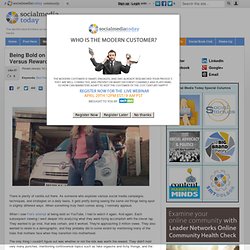
As someone who explores various social media campaigns, techniques, and strategies on a daily basis, it gets pretty boring seeing the same old things being spun in slightly different ways. When something truly fresh comes along, I normally applaud. When I saw Fiat's attempt at being bold on YouTube, I had to watch it again. And again. Business Model Innovation. Customer Service: Uncommon Wisdom Quotes. Since there's so much misinformation floating around about customer service and its importance to business, I've decided to share with OUR customers, some quotations and sound-bytes about the entire universe of customer service knowledge and skills.
Got a Question? Disagree? Agree? You can comment at the bottom of this page. (coming soon) The Power of Differentiating Your Business. Think about this: Why do customers pay for your product or service?

12 Most Impactful Ways You Can Give Little Extras To Enhance Customer Experience. Fast Company. Value proposition in commercials – favorites of 2010. Big companies spend big money – sometimes outrageous sums of money – on advertising.

Fortune 2000 companies, especially those in the B2C and/or CPG space, spend much of it on traditional advertising channels such as TV, radio and newspapers. The global advertising market equates to a cool $450 billion, with online advertising adding up to just about $50 billion. This means that traditional advertising channels still dominate the world. Carving Up the Retail Industry by Customer Jobs to Be Done. January 11, 2012 by Hutch Carpenter Online retailers had a heck of 2011 holiday season, up 15%.

On the Utility of Thinking in Terms of Jobs-to-Be-Done. By: Hutch Carpenter | January 31, 2012 In a recent post examining the future of retail, I used the jobs-to-be-done approach to break down the industry.

And I’ve been using it more in other ways. It’s quite useful as a basis for innovation. The premise of the jobs-to-be-done approach is that it provides a much better basis for innovation. The focus is on unmet needs of customers. SpigitIdea Management Software. By: Hutch Carpenter | February 16, 2012 I do product management for Spigit.

I’ve done product management for other companies as well. And let me tell you, the easiest thing in the world is to fall into the trap of focusing on how customers are using your product. Product forms your relationship with customers. Opening the Practice of Collaborative Innovation to the End User. From innovationmanagement.se By: Doug Collins | March 14, 2012 In a past article I provided a framework for thinking about the practice of collaborative innovation.

I recommended that people new to the practice start their journey by pursuing the internally focused, enquiry-led form (figure 1). Figure 1: forms and areas of focus for the practice of collaborative innovation Learning how to craft the critical question (the enquiry), form the community, and develop commitment between sponsor and member takes time. Jobs-to-be-done’s place in a customer-centric organization. By: Hutch Carpenter | May 16, 2012 On Twitter, I asked this question: When firms talk about being customer-centric today, what are they actually *doing*?

FB page? Reacting to tweets? Sentiment analysis? What’s your view on customers’ value to innovation? Four Innovation Insights Customers Provide. By: Hutch Carpenter | December 14, 2011 Customers, properly, have been having a renaissance of sorts in terms of business thinking.

Peter Drucker famously espoused a very customer-centric business philosophy. Nowadays, social CRM represents the return of a customer-first orientation. Last year, Altimeter published the 18 use cases of social CRM. Included in those use cases were several that relate to innovation. Customers are a rich source of innovation insight, and the ultimate authority on what innovation is useful.
It turns out, there is a structure to customer insight. Identifying target customers for a social enterprise. Every type of business, both social and traditional, has many types of customers; however, typically in traditional businesses, the paying customer makes the purchase decision. In the case of social enterprises, the customer who buys the product or service may often not be the ultimate consumer (or target customer) of the product or service.
The decision-maker on the product or service is likely the party paying for it (the payer) and this may be the government, a foundation, an individual or other third party such as a funder. The customer who consumes the product or service (the participant) will likely have access to the product or service at no cost or a lower than market price through the payer. This added customer profile means that your marketing strategy and planning will be slightly different from traditional businesses. Social enterprise marketing: participant-focused Your ongoing marketing program to payers and funders Marketing tips for social entrepreneurs. 11 product names that mean unfortunate things in other languages. Once in a while, an international company will come out with a new product, brand name or slogan that gets, well, seriously lost in translation.

One famous example is Mitsubishi’s unfortunate 1973 decision to name its new SUV the “Pajero,” which translates in Spanish to “wanker.” Here are 11 more tragic, hilarious, and definitely off-color examples of products that really exist—and don’t always mean what their manufacturers think. 1. Pee Cola. This extremely popular soda, which is bottled in Ghana, means “very good Cola,” but that’s not, suffice to say, most tourists’ first impression. 2.